

Architecture-Oriented Agile Approach for Sustainability Reporting
49
4 The Application Case
Frequently, when the organization chooses to produce the sustainability report
according to GRI Standards, it always addresses all specific topics, i.e., economic
(200), environmental (300), and social (400) perspectives. However, for the purpose
of explaining the use of the procedure in this case, part of the social booklet was
selected, since the result of the other notebooks and indicators would be performed
in the same way. Thus, it was considered that applying the procedure on a portion
of the indicators, i.e., a cut-out of the reports would be enough to demonstrate its
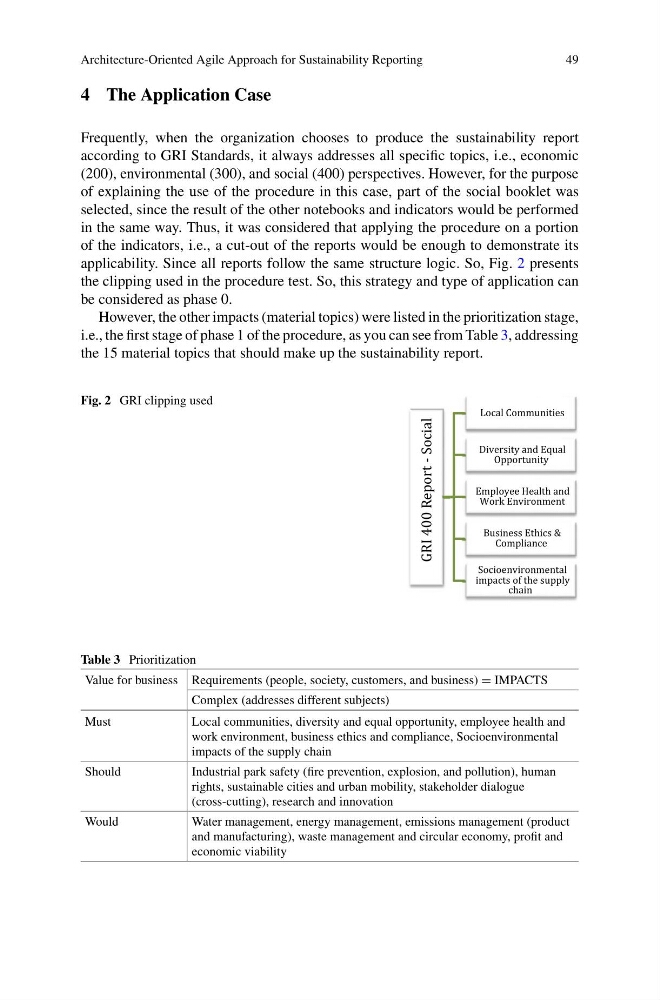
applicability. Since all reports follow the same structure logic. So, Fig. 2 presents
the clipping used in the procedure test. So, this strategy and type of application can
be considered as phase 0.
However, the other impacts (material topics) were listed in the prioritization stage,
i.e., the first stage of phase 1 of the procedure, as you can see from Table 3, addressing
the 15 material topics that should make up the sustainability report.
Fig. 2 GRI clipping used
GRI 400 Report - Social
Local Communities
Diversity and Equal
Opportunity
Employee Health and
Work Environment
Business Ethics &
Compliance
Socioenvironmental
impacts of the supply
chain
Table 3 Prioritization
Value for business Requirements (people, society, customers, and business) = IMPACTS
Complex (addresses different subjects)
Must
Local communities, diversity and equal opportunity, employee health and
work environment, business ethics and compliance, Socioenvironmental
impacts of the supply chain
Should
Industrial park safety (fire prevention, explosion, and pollution), human
rights, sustainable cities and urban mobility, stakeholder dialogue
(cross-cutting), research and innovation
Would
Water management, energy management, emissions management (product
and manufacturing), waste management and circular economy, profit and
economic viability
49
4 The Application Case
Frequently, when the organization chooses to produce the sustainability report
according to GRI Standards, it always addresses all specific topics, i.e., economic
(200), environmental (300), and social (400) perspectives. However, for the purpose
of explaining the use of the procedure in this case, part of the social booklet was
selected, since the result of the other notebooks and indicators would be performed
in the same way. Thus, it was considered that applying the procedure on a portion
of the indicators, i.e., a cut-out of the reports would be enough to demonstrate its
applicability. Since all reports follow the same structure logic. So, Fig. 2 presents
the clipping used in the procedure test. So, this strategy and type of application can
be considered as phase 0.
However, the other impacts (material topics) were listed in the prioritization stage,
i.e., the first stage of phase 1 of the procedure, as you can see from Table 3, addressing
the 15 material topics that should make up the sustainability report.
Fig. 2 GRI clipping used
GRI 400 Report - Social
Local Communities
Diversity and Equal
Opportunity
Employee Health and
Work Environment
Business Ethics &
Compliance
Socioenvironmental
impacts of the supply
chain
Table 3 Prioritization
Value for business Requirements (people, society, customers, and business) = IMPACTS
Complex (addresses different subjects)
Must
Local communities, diversity and equal opportunity, employee health and
work environment, business ethics and compliance, Socioenvironmental
impacts of the supply chain
Should
Industrial park safety (fire prevention, explosion, and pollution), human
rights, sustainable cities and urban mobility, stakeholder dialogue
(cross-cutting), research and innovation
Would
Water management, energy management, emissions management (product
and manufacturing), waste management and circular economy, profit and
economic viability