

The Social License to Operate as a Tool to Promote Sustainability …
417
Poor communications and lack of engagement were common complaints, especially in rural communities. Most of them considered riots were their only tool to
be heard and have their demands addressed. However, some rural protesters have
been prosecuted for demanding better life and working conditions (Clésio 2020).
Consequently, rural workers did not grant an SLO—its low level indicates grave
dissatisfaction and reflects the low commitment of mining companies with that social
group.
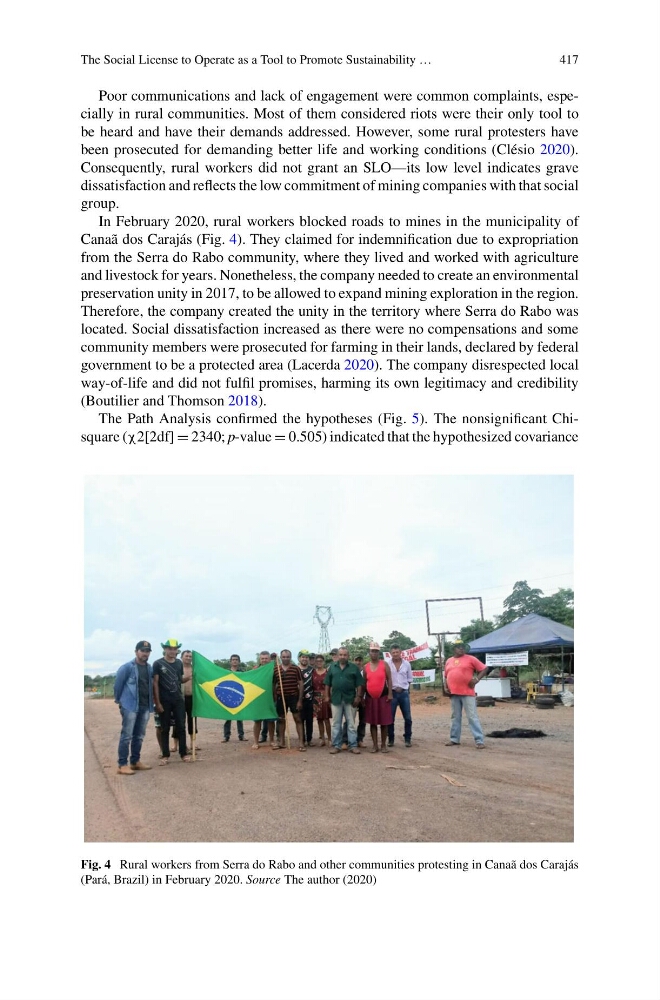
In February 2020, rural workers blocked roads to mines in the municipality of
Canaã dos Carajás (Fig. 4). They claimed for indemnification due to expropriation
from the Serra do Rabo community, where they lived and worked with agriculture
and livestock for years. Nonetheless, the company needed to create an environmental
preservation unity in 2017, to be allowed to expand mining exploration in the region.
Therefore, the company created the unity in the territory where Serra do Rabo was
located. Social dissatisfaction increased as there were no compensations and some
community members were prosecuted for farming in their lands, declared by federal
government to be a protected area (Lacerda 2020). The company disrespected local
way-of-life and did not fulfil promises, harming its own legitimacy and credibility
(Boutilier and Thomson 2018).
The Path Analysis confirmed the hypotheses (Fig. 5). The nonsignificant Chisquare (χ2[2df] = 2340; p-value = 0.505) indicated that the hypothesized covariance
Fig. 4 Rural workers from Serra do Rabo and other communities protesting in Canaã dos Carajás
(Pará, Brazil) in February 2020. Source The author (2020)
417
Poor communications and lack of engagement were common complaints, especially in rural communities. Most of them considered riots were their only tool to
be heard and have their demands addressed. However, some rural protesters have
been prosecuted for demanding better life and working conditions (Clésio 2020).
Consequently, rural workers did not grant an SLO—its low level indicates grave
dissatisfaction and reflects the low commitment of mining companies with that social
group.
In February 2020, rural workers blocked roads to mines in the municipality of
Canaã dos Carajás (Fig. 4). They claimed for indemnification due to expropriation
from the Serra do Rabo community, where they lived and worked with agriculture
and livestock for years. Nonetheless, the company needed to create an environmental
preservation unity in 2017, to be allowed to expand mining exploration in the region.
Therefore, the company created the unity in the territory where Serra do Rabo was
located. Social dissatisfaction increased as there were no compensations and some
community members were prosecuted for farming in their lands, declared by federal
government to be a protected area (Lacerda 2020). The company disrespected local
way-of-life and did not fulfil promises, harming its own legitimacy and credibility
(Boutilier and Thomson 2018).
The Path Analysis confirmed the hypotheses (Fig. 5). The nonsignificant Chisquare (χ2[2df] = 2340; p-value = 0.505) indicated that the hypothesized covariance
Fig. 4 Rural workers from Serra do Rabo and other communities protesting in Canaã dos Carajás
(Pará, Brazil) in February 2020. Source The author (2020)