

Corporate Responsibility in Practice: Co-processing …
275
of MSW, provided that its technical and environmental viability has been proven and
a toxic gas emission monitoring program has been approved by the environmental
agency.” It also establishes that each generator is responsible for its waste.
Tailings can be defined as solid waste that does not have any form of treatment
or recovery, thus the only remaining alternative is the environmentally appropriate
final disposition (Brazil 2010). According to Santos (2014), tailings reduce the ecoefficiency of the sorting facility, because its separation does not bring gains for the
association, becoming an unproductive effort. In addition, this material can contaminate other items with potential of recycling and can bring vectors to the workplace.
Santos (2014) still says that the quantity and quality of waste are determined by its
separation in the generating source.
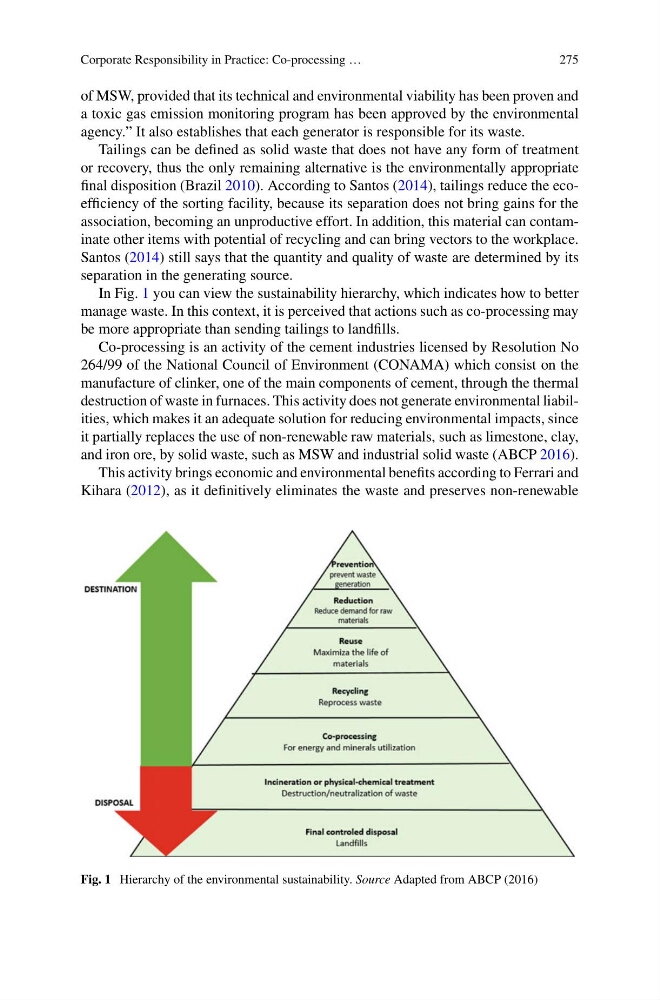
In Fig. 1 you can view the sustainability hierarchy, which indicates how to better
manage waste. In this context, it is perceived that actions such as co-processing may
be more appropriate than sending tailings to landfills.
Co-processing is an activity of the cement industries licensed by Resolution No
264/99 of the National Council of Environment (CONAMA) which consist on the
manufacture of clinker, one of the main components of cement, through the thermal
destruction of waste in furnaces. This activity does not generate environmental liabilities, which makes it an adequate solution for reducing environmental impacts, since
it partially replaces the use of non-renewable raw materials, such as limestone, clay,
and iron ore, by solid waste, such as MSW and industrial solid waste (ABCP 2016).
This activity brings economic and environmental benefits according to Ferrari and
Kihara (2012), as it definitively eliminates the waste and preserves non-renewable
Fig. 1 Hierarchy of the environmental sustainability. Source Adapted from ABCP (2016)
275
of MSW, provided that its technical and environmental viability has been proven and
a toxic gas emission monitoring program has been approved by the environmental
agency.” It also establishes that each generator is responsible for its waste.
Tailings can be defined as solid waste that does not have any form of treatment
or recovery, thus the only remaining alternative is the environmentally appropriate
final disposition (Brazil 2010). According to Santos (2014), tailings reduce the ecoefficiency of the sorting facility, because its separation does not bring gains for the
association, becoming an unproductive effort. In addition, this material can contaminate other items with potential of recycling and can bring vectors to the workplace.
Santos (2014) still says that the quantity and quality of waste are determined by its
separation in the generating source.
In Fig. 1 you can view the sustainability hierarchy, which indicates how to better
manage waste. In this context, it is perceived that actions such as co-processing may
be more appropriate than sending tailings to landfills.
Co-processing is an activity of the cement industries licensed by Resolution No
264/99 of the National Council of Environment (CONAMA) which consist on the
manufacture of clinker, one of the main components of cement, through the thermal
destruction of waste in furnaces. This activity does not generate environmental liabilities, which makes it an adequate solution for reducing environmental impacts, since
it partially replaces the use of non-renewable raw materials, such as limestone, clay,
and iron ore, by solid waste, such as MSW and industrial solid waste (ABCP 2016).
This activity brings economic and environmental benefits according to Ferrari and
Kihara (2012), as it definitively eliminates the waste and preserves non-renewable
Fig. 1 Hierarchy of the environmental sustainability. Source Adapted from ABCP (2016)