

276
M. L. M. Bernartt et al.
natural resources. In addition, it can receive a large volume of waste to be coprocessed safely. This treatment technique brought greater competitiveness to cement
plants, due to cost reduction in production with the replacement of non-renewable
natural resources. The technique does not influence the quality of the cement
produced and does not have significant environmental impacts, preserving health
and safety (Ferrari and Kihara 2012).
Co-processing is an activity that has several controls that ensure product quality in
the industrial process and the safety of the environment and employees. The activity
should be very well monitored and requires specific feeding and handling systems,
adequate areas of waste storage, and constant process monitoring (Votorantim 2014).
For the company to be able to perform this activity, it must be licensed meeting
the requirements determined in Resolution CONAMA No 264/99 and comply with
specific state laws. In Paraná, in addition to Federal Legislation (CONAMA), there
is the Resolution No 076/09 from the Environment State Council (CEMA), which
establishes “the requirements and criteria to request and issue Environmental Authorizations for co-processing of waste in cement furnaces, with the purpose of replacing
raw material or energy use” (CEMA 2009). According to its article 4, MSW can be
co-processed in the state of Paraná.
According to the Environmental Institute of Paraná—IAP (2018), the coprocessing activity happens in Brazil since the 1990s and aims to make better disposal
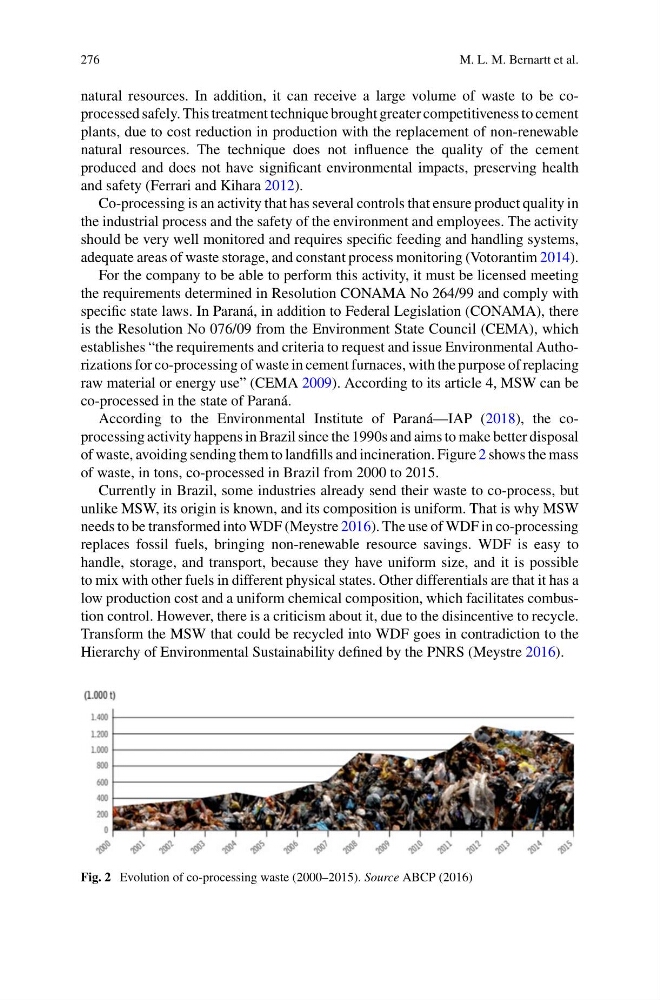
of waste, avoiding sending them to landfills and incineration. Figure 2 shows the mass
of waste, in tons, co-processed in Brazil from 2000 to 2015.
Currently in Brazil, some industries already send their waste to co-process, but
unlike MSW, its origin is known, and its composition is uniform. That is why MSW
needs to be transformed into WDF (Meystre 2016). The use of WDF in co-processing
replaces fossil fuels, bringing non-renewable resource savings. WDF is easy to
handle, storage, and transport, because they have uniform size, and it is possible
to mix with other fuels in different physical states. Other differentials are that it has a
low production cost and a uniform chemical composition, which facilitates combustion control. However, there is a criticism about it, due to the disincentive to recycle.
Transform the MSW that could be recycled into WDF goes in contradiction to the
Hierarchy of Environmental Sustainability defined by the PNRS (Meystre 2016).
Fig. 2 Evolution of co-processing waste (2000–2015). Source ABCP (2016)
M. L. M. Bernartt et al.
natural resources. In addition, it can receive a large volume of waste to be coprocessed safely. This treatment technique brought greater competitiveness to cement
plants, due to cost reduction in production with the replacement of non-renewable
natural resources. The technique does not influence the quality of the cement
produced and does not have significant environmental impacts, preserving health
and safety (Ferrari and Kihara 2012).
Co-processing is an activity that has several controls that ensure product quality in
the industrial process and the safety of the environment and employees. The activity
should be very well monitored and requires specific feeding and handling systems,
adequate areas of waste storage, and constant process monitoring (Votorantim 2014).
For the company to be able to perform this activity, it must be licensed meeting
the requirements determined in Resolution CONAMA No 264/99 and comply with
specific state laws. In Paraná, in addition to Federal Legislation (CONAMA), there
is the Resolution No 076/09 from the Environment State Council (CEMA), which
establishes “the requirements and criteria to request and issue Environmental Authorizations for co-processing of waste in cement furnaces, with the purpose of replacing
raw material or energy use” (CEMA 2009). According to its article 4, MSW can be
co-processed in the state of Paraná.
According to the Environmental Institute of Paraná—IAP (2018), the coprocessing activity happens in Brazil since the 1990s and aims to make better disposal
of waste, avoiding sending them to landfills and incineration. Figure 2 shows the mass
of waste, in tons, co-processed in Brazil from 2000 to 2015.
Currently in Brazil, some industries already send their waste to co-process, but
unlike MSW, its origin is known, and its composition is uniform. That is why MSW
needs to be transformed into WDF (Meystre 2016). The use of WDF in co-processing
replaces fossil fuels, bringing non-renewable resource savings. WDF is easy to
handle, storage, and transport, because they have uniform size, and it is possible
to mix with other fuels in different physical states. Other differentials are that it has a
low production cost and a uniform chemical composition, which facilitates combustion control. However, there is a criticism about it, due to the disincentive to recycle.
Transform the MSW that could be recycled into WDF goes in contradiction to the
Hierarchy of Environmental Sustainability defined by the PNRS (Meystre 2016).
Fig. 2 Evolution of co-processing waste (2000–2015). Source ABCP (2016)