

Nature-Based Solution in the Context of Sustainability …
247
6 Single Case Model: Artificial Reef
Therefore, the choice of the REBIMAR Program case was justified because it seeks
to contribute to the strengthening of the Nature-Based Solution concept, adopting
a methodology based on the interconnection of a gray infrastructure to the marine
ecosystem, contributing to the mitigation of environmental demands, such as: degradation the marine ecosystem; and social and economic demands, such as: industrial
fishing.
Covering the coast of the Paraná Coast, the REBIMAR Program, using the installation of artificial reefs as its main tool. Executed by the MarBrasil Association and
FUNPAR (Foundation of the Federal University of Paraná), it has the support of the
Federal University of Paraná, the Sea Studies Center of the Federal University of
Paraná and the Federal Institute of Paraná—Campus Paranaguá.
It was featured on a national network, when shown on the Globo Mar television
program, in the same year, received the ODM Brazil Award, being recognized for
being a project that contributes to achieving the Millennium Development Goal 7
established by the United Nations in the year 2000 (MarBrasil Association 2011).
To analyze the data generated over the years of evaluation, the SWOT interpretation tool created by professors Kenneth Adrews and Ronald Christensen, from
Harward Business School, and applied in the academic and business community, is
used in a methodology based on the acronic SWOT, in which represents its variables
(Razzolini and Zarpelon 2005).
Such methodology comes from the exact area, in which it recognizes the limitations of an institution and/or project, maximizes its potentials and opportunities and
monitors its source points and opportunities, maintaining a plasticity with regard to
being applicable in different projects and/or institutions different segments (Bicho
and Baptista 2006).
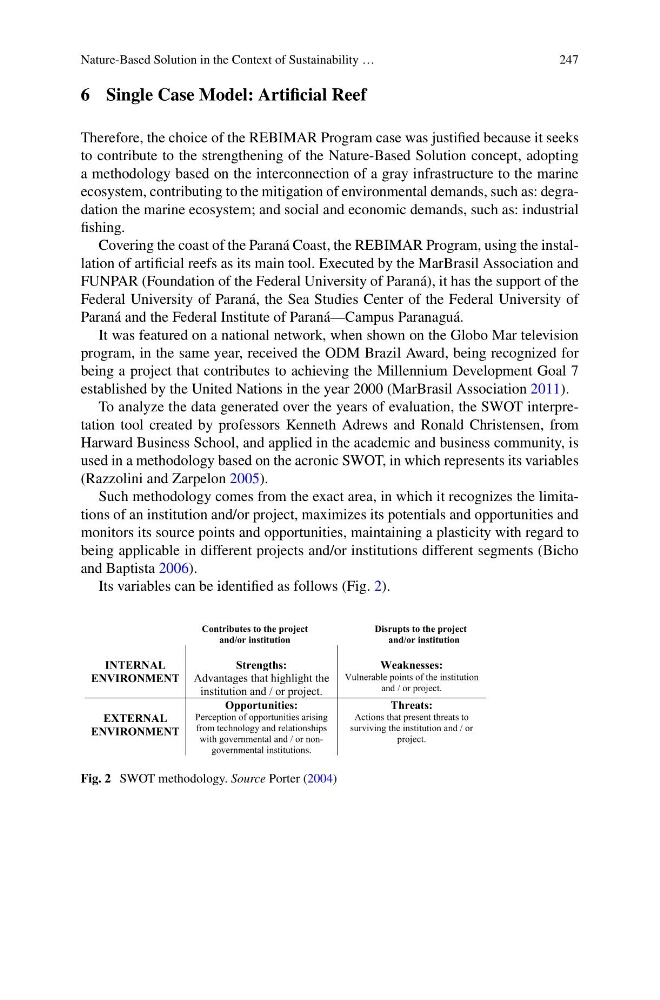
Its variables can be identified as follows (Fig. 2).
Contributes to the project
Disrupts to the project
and/or institution
and/or institution
INTERNAL
ENVIRONMENT
Strengths:
Advantages that highlight the
institution and / or project.
Weaknesses:
Vulnerable points of the institution
and / or project.
EXTERNAL
ENVIRONMENT
Opportunities:
Perception of opportunities arising
from technology and relationships
with governmental and / or nongovernmental institutions.
Threats:
Actions that present threats to
surviving the institution and / or
project.
Fig. 2 SWOT methodology. Source Porter (2004)
247
6 Single Case Model: Artificial Reef
Therefore, the choice of the REBIMAR Program case was justified because it seeks
to contribute to the strengthening of the Nature-Based Solution concept, adopting
a methodology based on the interconnection of a gray infrastructure to the marine
ecosystem, contributing to the mitigation of environmental demands, such as: degradation the marine ecosystem; and social and economic demands, such as: industrial
fishing.
Covering the coast of the Paraná Coast, the REBIMAR Program, using the installation of artificial reefs as its main tool. Executed by the MarBrasil Association and
FUNPAR (Foundation of the Federal University of Paraná), it has the support of the
Federal University of Paraná, the Sea Studies Center of the Federal University of
Paraná and the Federal Institute of Paraná—Campus Paranaguá.
It was featured on a national network, when shown on the Globo Mar television
program, in the same year, received the ODM Brazil Award, being recognized for
being a project that contributes to achieving the Millennium Development Goal 7
established by the United Nations in the year 2000 (MarBrasil Association 2011).
To analyze the data generated over the years of evaluation, the SWOT interpretation tool created by professors Kenneth Adrews and Ronald Christensen, from
Harward Business School, and applied in the academic and business community, is
used in a methodology based on the acronic SWOT, in which represents its variables
(Razzolini and Zarpelon 2005).
Such methodology comes from the exact area, in which it recognizes the limitations of an institution and/or project, maximizes its potentials and opportunities and
monitors its source points and opportunities, maintaining a plasticity with regard to
being applicable in different projects and/or institutions different segments (Bicho
and Baptista 2006).
Its variables can be identified as follows (Fig. 2).
Contributes to the project
Disrupts to the project
and/or institution
and/or institution
INTERNAL
ENVIRONMENT
Strengths:
Advantages that highlight the
institution and / or project.
Weaknesses:
Vulnerable points of the institution
and / or project.
EXTERNAL
ENVIRONMENT
Opportunities:
Perception of opportunities arising
from technology and relationships
with governmental and / or nongovernmental institutions.
Threats:
Actions that present threats to
surviving the institution and / or
project.
Fig. 2 SWOT methodology. Source Porter (2004)