

236
R. E. Restelli et al.
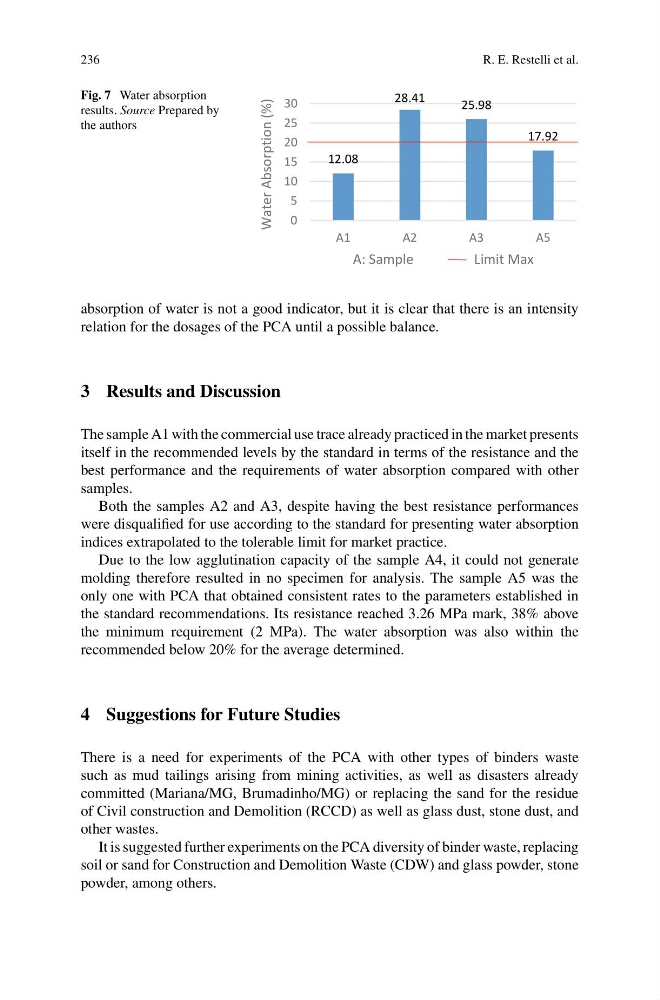
Fig. 7 Water absorption
results. Source Prepared by
the authors
12.08
28.41
25.98
17.92
0
5
10
15
20
25
30
A1
A2
A3
A5
Water Absorption (%)
A: Sample
Limit Max
absorption of water is not a good indicator, but it is clear that there is an intensity
relation for the dosages of the PCA until a possible balance.
3 Results and Discussion
The sample A1 with the commercial use trace already practiced in the market presents
itself in the recommended levels by the standard in terms of the resistance and the
best performance and the requirements of water absorption compared with other
samples.
Both the samples A2 and A3, despite having the best resistance performances
were disqualified for use according to the standard for presenting water absorption
indices extrapolated to the tolerable limit for market practice.
Due to the low agglutination capacity of the sample A4, it could not generate
molding therefore resulted in no specimen for analysis. The sample A5 was the
only one with PCA that obtained consistent rates to the parameters established in
the standard recommendations. Its resistance reached 3.26 MPa mark, 38% above
the minimum requirement (2 MPa). The water absorption was also within the
recommended below 20% for the average determined.
4 Suggestions for Future Studies
There is a need for experiments of the PCA with other types of binders waste
such as mud tailings arising from mining activities, as well as disasters already
committed (Mariana/MG, Brumadinho/MG) or replacing the sand for the residue
of Civil construction and Demolition (RCCD) as well as glass dust, stone dust, and
other wastes.
It is suggested further experiments on the PCA diversity of binder waste, replacing
soil or sand for Construction and Demolition Waste (CDW) and glass powder, stone
powder, among others.
R. E. Restelli et al.
Fig. 7 Water absorption
results. Source Prepared by
the authors
12.08
28.41
25.98
17.92
0
5
10
15
20
25
30
A1
A2
A3
A5
Water Absorption (%)
A: Sample
Limit Max
absorption of water is not a good indicator, but it is clear that there is an intensity
relation for the dosages of the PCA until a possible balance.
3 Results and Discussion
The sample A1 with the commercial use trace already practiced in the market presents
itself in the recommended levels by the standard in terms of the resistance and the
best performance and the requirements of water absorption compared with other
samples.
Both the samples A2 and A3, despite having the best resistance performances
were disqualified for use according to the standard for presenting water absorption
indices extrapolated to the tolerable limit for market practice.
Due to the low agglutination capacity of the sample A4, it could not generate
molding therefore resulted in no specimen for analysis. The sample A5 was the
only one with PCA that obtained consistent rates to the parameters established in
the standard recommendations. Its resistance reached 3.26 MPa mark, 38% above
the minimum requirement (2 MPa). The water absorption was also within the
recommended below 20% for the average determined.
4 Suggestions for Future Studies
There is a need for experiments of the PCA with other types of binders waste
such as mud tailings arising from mining activities, as well as disasters already
committed (Mariana/MG, Brumadinho/MG) or replacing the sand for the residue
of Civil construction and Demolition (RCCD) as well as glass dust, stone dust, and
other wastes.
It is suggested further experiments on the PCA diversity of binder waste, replacing
soil or sand for Construction and Demolition Waste (CDW) and glass powder, stone
powder, among others.