

Assessing the Use of Pine Chip Ash in Manufacturing …
237
It was restricted to the number of two specimens of average values in the tests. It is
suggested further testing with 10 specimens per sample, 7 to break in the resistance
test and 3 for the water absorption test.
It is proposed discussion and review of the technical standard NBR 8491, where in
item 4.3.5 emphasizes on not discounting the area of the brick holes or the calculation
of MPa. One sees a contradiction, given the fact that the item 5.2.1 indicates that the
area calculation should be considered by the “Load area”. The holes of the bricks
are empty spaces that receive no charge, including the practical implementation of
the walls.
It is suggested further studies related to the proportion of the traces with the actual
density of each material. In the same order to increase the accuracy of results, it is
suggested a review of optical microscopy and analysis of broken samples as the
uniformity of the mixtures.
It would be of fundamental importance to explore standards indoor wall sealing
materials, in order to promote research in the use of PCA product which limits water
absorption are more tolerable, or where they are not considered. As the gypsum used
for partition walls.
In view of the need to trace additive in the sample A5, there is an opportunity for
economic feasibility analysis research, seeking cost parameters with reference to the
conventional bricks for comparison.
Study groups have room to explore several variables of the same nuance. The
present study provides a simple alternative to PCA, making room for a wide range of
experiments with this undervalued waste. To the student’s interest, research projects
and product development with sustainable nature have numerous tools to support
and/or resources.
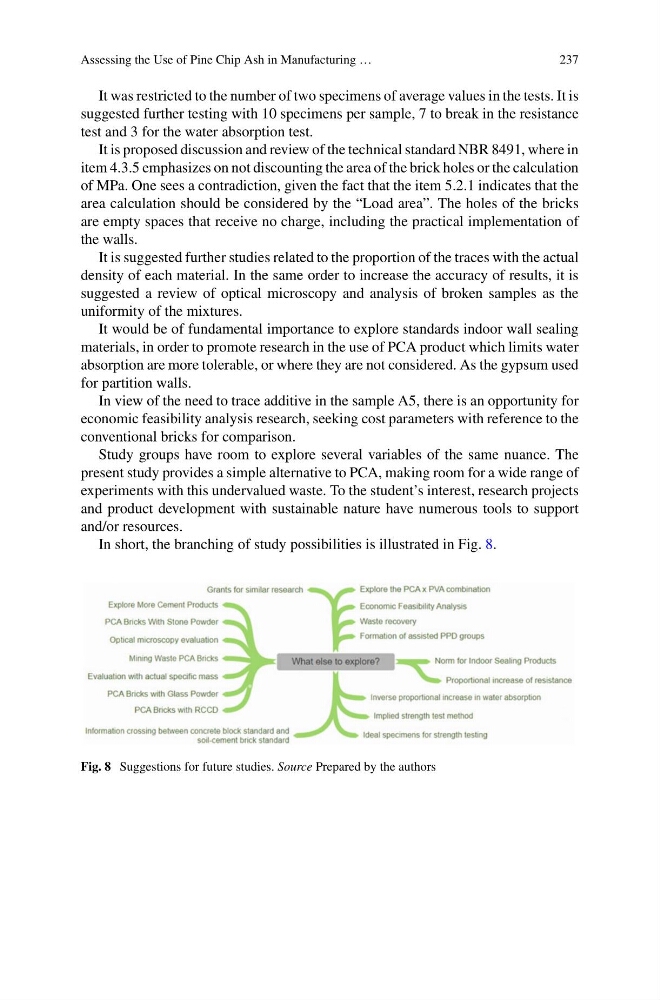
In short, the branching of study possibilities is illustrated in Fig. 8.
Fig. 8 Suggestions for future studies. Source Prepared by the authors
237
It was restricted to the number of two specimens of average values in the tests. It is
suggested further testing with 10 specimens per sample, 7 to break in the resistance
test and 3 for the water absorption test.
It is proposed discussion and review of the technical standard NBR 8491, where in
item 4.3.5 emphasizes on not discounting the area of the brick holes or the calculation
of MPa. One sees a contradiction, given the fact that the item 5.2.1 indicates that the
area calculation should be considered by the “Load area”. The holes of the bricks
are empty spaces that receive no charge, including the practical implementation of
the walls.
It is suggested further studies related to the proportion of the traces with the actual
density of each material. In the same order to increase the accuracy of results, it is
suggested a review of optical microscopy and analysis of broken samples as the
uniformity of the mixtures.
It would be of fundamental importance to explore standards indoor wall sealing
materials, in order to promote research in the use of PCA product which limits water
absorption are more tolerable, or where they are not considered. As the gypsum used
for partition walls.
In view of the need to trace additive in the sample A5, there is an opportunity for
economic feasibility analysis research, seeking cost parameters with reference to the
conventional bricks for comparison.
Study groups have room to explore several variables of the same nuance. The
present study provides a simple alternative to PCA, making room for a wide range of
experiments with this undervalued waste. To the student’s interest, research projects
and product development with sustainable nature have numerous tools to support
and/or resources.
In short, the branching of study possibilities is illustrated in Fig. 8.
Fig. 8 Suggestions for future studies. Source Prepared by the authors