

232
R. E. Restelli et al.
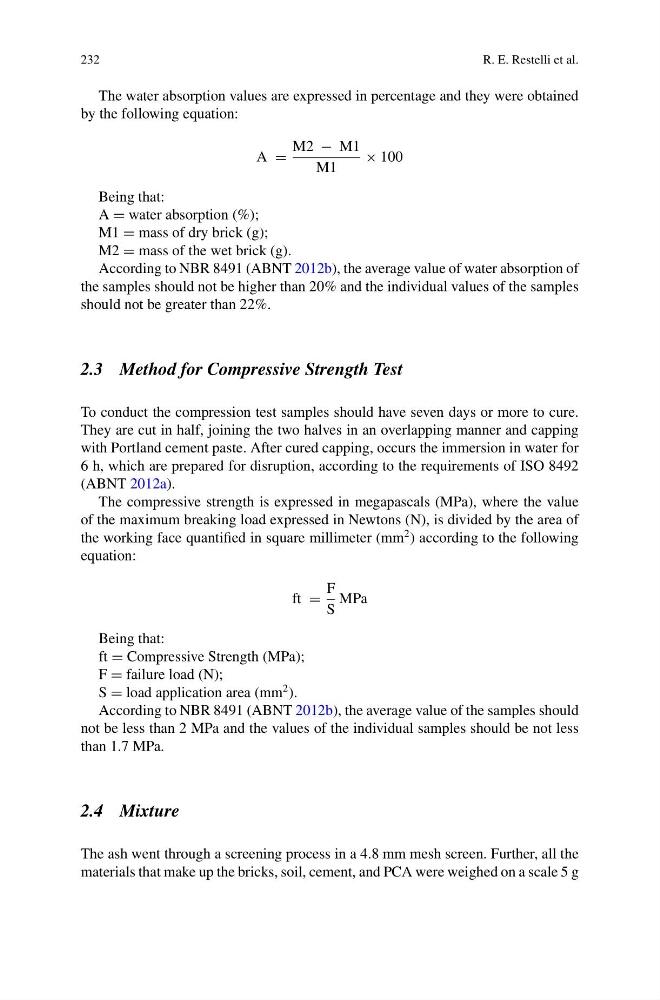
The water absorption values are expressed in percentage and they were obtained
by the following equation:
A =
M2 − M1
M1
× 100
Being that:
A = water absorption (%);
M1 = mass of dry brick (g);
M2 = mass of the wet brick (g).
According to NBR 8491 (ABNT 2012b), the average value of water absorption of
the samples should not be higher than 20% and the individual values of the samples
should not be greater than 22%.
2.3 Method for Compressive Strength Test
To conduct the compression test samples should have seven days or more to cure.
They are cut in half, joining the two halves in an overlapping manner and capping
with Portland cement paste. After cured capping, occurs the immersion in water for
6 h, which are prepared for disruption, according to the requirements of ISO 8492
(ABNT 2012a).
The compressive strength is expressed in megapascals (MPa), where the value
of the maximum breaking load expressed in Newtons (N), is divided by the area of
the working face quantified in square millimeter (mm
2 ) according to the following
equation:
ft =
F
S
MPa
Being that:
ft = Compressive Strength (MPa);
F = failure load (N);
S = load application area (mm
2 ).
According to NBR 8491 (ABNT 2012b), the average value of the samples should
not be less than 2 MPa and the values of the individual samples should be not less
than 1.7 MPa.
2.4 Mixture
The ash went through a screening process in a 4.8 mm mesh screen. Further, all the
materials that make up the bricks, soil, cement, and PCA were weighed on a scale 5 g
R. E. Restelli et al.
The water absorption values are expressed in percentage and they were obtained
by the following equation:
A =
M2 − M1
M1
× 100
Being that:
A = water absorption (%);
M1 = mass of dry brick (g);
M2 = mass of the wet brick (g).
According to NBR 8491 (ABNT 2012b), the average value of water absorption of
the samples should not be higher than 20% and the individual values of the samples
should not be greater than 22%.
2.3 Method for Compressive Strength Test
To conduct the compression test samples should have seven days or more to cure.
They are cut in half, joining the two halves in an overlapping manner and capping
with Portland cement paste. After cured capping, occurs the immersion in water for
6 h, which are prepared for disruption, according to the requirements of ISO 8492
(ABNT 2012a).
The compressive strength is expressed in megapascals (MPa), where the value
of the maximum breaking load expressed in Newtons (N), is divided by the area of
the working face quantified in square millimeter (mm
2 ) according to the following
equation:
ft =
F
S
MPa
Being that:
ft = Compressive Strength (MPa);
F = failure load (N);
S = load application area (mm
2 ).
According to NBR 8491 (ABNT 2012b), the average value of the samples should
not be less than 2 MPa and the values of the individual samples should be not less
than 1.7 MPa.
2.4 Mixture
The ash went through a screening process in a 4.8 mm mesh screen. Further, all the
materials that make up the bricks, soil, cement, and PCA were weighed on a scale 5 g