

174
T. L. Cruz
the respondents complained about lack of transparency in government’s activities
involving collecting and investing mining taxes.
Transparency involving the investments of CFEM resources is mandatory
according to Law 13,240/2017 (2nd article, § 13). Both the processes of collection and investments of the tax must be publicly available to let society, legislative
and judicial organs control the government’s management of such an important tax.
However, the results indicate that the local government needs to be substantially
more transparent regarding public finances, as almost 90% of the participants in this
study were not satisfied with its current transparency.
In fact, the assessment of the Annual Municipal Budget Law of the municipality
of Canaã dos Carajás confirms such results. Enríquez (2018), Cruz et al. (2019) and
INESC (2019) pointed that the government in the municipality has only explicitly
indicated the total amount of CFEM it collected and how it was invested in the
Annual Municipal Budget Law of 2018. The municipality collects the CFEM since
2005, but only in 2018 its use was detailed and made publicly available. Until then,
it was included among general expenses of the government and therefore could not
be tracked.
Nevertheless, research on the Annual Municipal Budget Laws of the following
years points to a major setback for transparency in Canaã dos Carajás. INESC (2019)
and Angelo (2019) indicated that CFEM expenses were not described in the budget
law of 2019, but could only be found in the government’s transparency website. Local
government followed trends from previous years and blended CFEM investments
among general expenses in the budget law again. In 2020, no changes have been
made to correct this contravention.
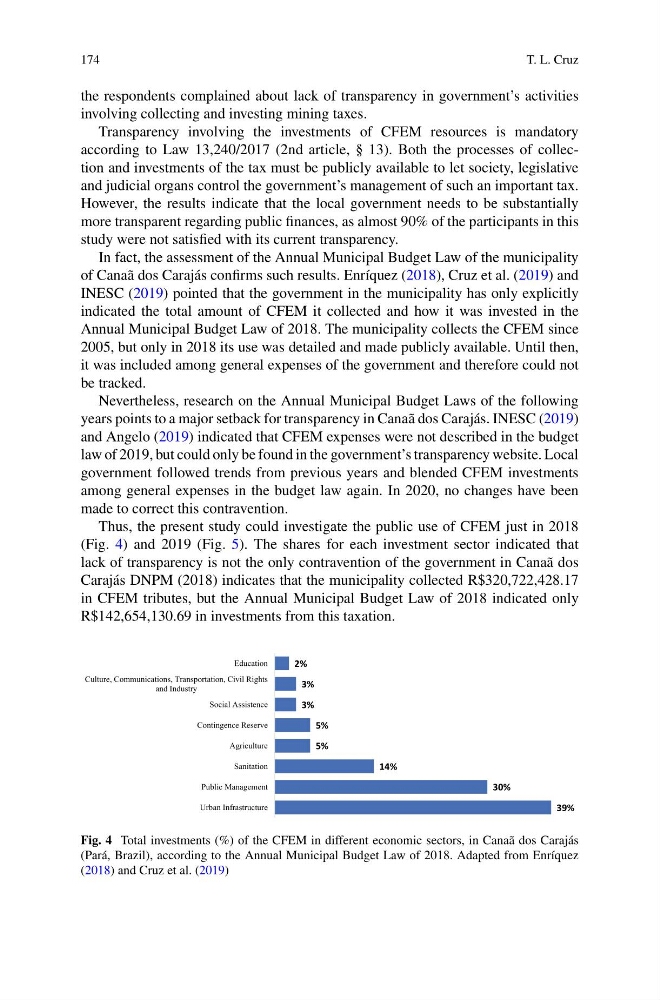
Thus, the present study could investigate the public use of CFEM just in 2018
(Fig. 4) and 2019 (Fig. 5). The shares for each investment sector indicated that
lack of transparency is not the only contravention of the government in Canaã dos
Carajás DNPM (2018) indicates that the municipality collected R$320,722,428.17
in CFEM tributes, but the Annual Municipal Budget Law of 2018 indicated only
R$142,654,130.69 in investments from this taxation.
39%
30%
14%
5%
5%
3%
3%
2%
Urban Infrastructure
Public Management
Sanitation
Agriculture
Contingence Reserve
Social Assistence
Culture, Communications, Transportation, Civil Rights
and Industry
Education
Fig. 4 Total investments (%) of the CFEM in different economic sectors, in Canaã dos Carajás
(Pará, Brazil), according to the Annual Municipal Budget Law of 2018. Adapted from Enríquez
(2018) and Cruz et al. (2019)
T. L. Cruz
the respondents complained about lack of transparency in government’s activities
involving collecting and investing mining taxes.
Transparency involving the investments of CFEM resources is mandatory
according to Law 13,240/2017 (2nd article, § 13). Both the processes of collection and investments of the tax must be publicly available to let society, legislative
and judicial organs control the government’s management of such an important tax.
However, the results indicate that the local government needs to be substantially
more transparent regarding public finances, as almost 90% of the participants in this
study were not satisfied with its current transparency.
In fact, the assessment of the Annual Municipal Budget Law of the municipality
of Canaã dos Carajás confirms such results. Enríquez (2018), Cruz et al. (2019) and
INESC (2019) pointed that the government in the municipality has only explicitly
indicated the total amount of CFEM it collected and how it was invested in the
Annual Municipal Budget Law of 2018. The municipality collects the CFEM since
2005, but only in 2018 its use was detailed and made publicly available. Until then,
it was included among general expenses of the government and therefore could not
be tracked.
Nevertheless, research on the Annual Municipal Budget Laws of the following
years points to a major setback for transparency in Canaã dos Carajás. INESC (2019)
and Angelo (2019) indicated that CFEM expenses were not described in the budget
law of 2019, but could only be found in the government’s transparency website. Local
government followed trends from previous years and blended CFEM investments
among general expenses in the budget law again. In 2020, no changes have been
made to correct this contravention.
Thus, the present study could investigate the public use of CFEM just in 2018
(Fig. 4) and 2019 (Fig. 5). The shares for each investment sector indicated that
lack of transparency is not the only contravention of the government in Canaã dos
Carajás DNPM (2018) indicates that the municipality collected R$320,722,428.17
in CFEM tributes, but the Annual Municipal Budget Law of 2018 indicated only
R$142,654,130.69 in investments from this taxation.
39%
30%
14%
5%
5%
3%
3%
2%
Urban Infrastructure
Public Management
Sanitation
Agriculture
Contingence Reserve
Social Assistence
Culture, Communications, Transportation, Civil Rights
and Industry
Education
Fig. 4 Total investments (%) of the CFEM in different economic sectors, in Canaã dos Carajás
(Pará, Brazil), according to the Annual Municipal Budget Law of 2018. Adapted from Enríquez
(2018) and Cruz et al. (2019)