

Title Suppressed Due to Excessive Length
173
A total of 200 anonymous people participated in this study. The respondents
belonged to ten different social groups that reflected the social diversity in the
municipality: students; teachers; politicians; religious leaders; journalists; members
of NGOs and trade unions; public service, private sector, industrial and rural workers.
The sample margin of error was approximately 10%. The sample size would have
been smaller, but sub-samples were taken for small social groups to make sure all
participated in the study.
64.5% (129) of the respondents were men, and 35.5% (71) were women. The
average age and its standard deviation were 33.8 and 12.17, respectively. Age varied
from 18 to 71 years. The average years of education and its standard deviation were
10.62 and 3.2, respectively.
Data collection took place in February 2020. A descriptive statistical analysis was
conducted using the IBM SPSS 23 software (IBM Corporation 2015). It assessed the
mean average scores of both factors (trust in government’s management and improvements on social infrastructure) and identified the percentages of each response in the
Likert scale.
A bibliographic review was conducted on previous works that assessed the use of
CFEM in Canaã dos Carajás (Pará, Brazil). The actual Annual Municipal Budget Law
of the municipality, whose access is publicly available online, was also analyzed to
verify whether the actual use of mining taxation follow the prohibitions and general
guidelines indicated by the laws 7990/1989 and 13,540/2017, and the Federal Decree
01/1991 (Brasil 1989, 1990, 2017a, b).
4 Results and Discussion
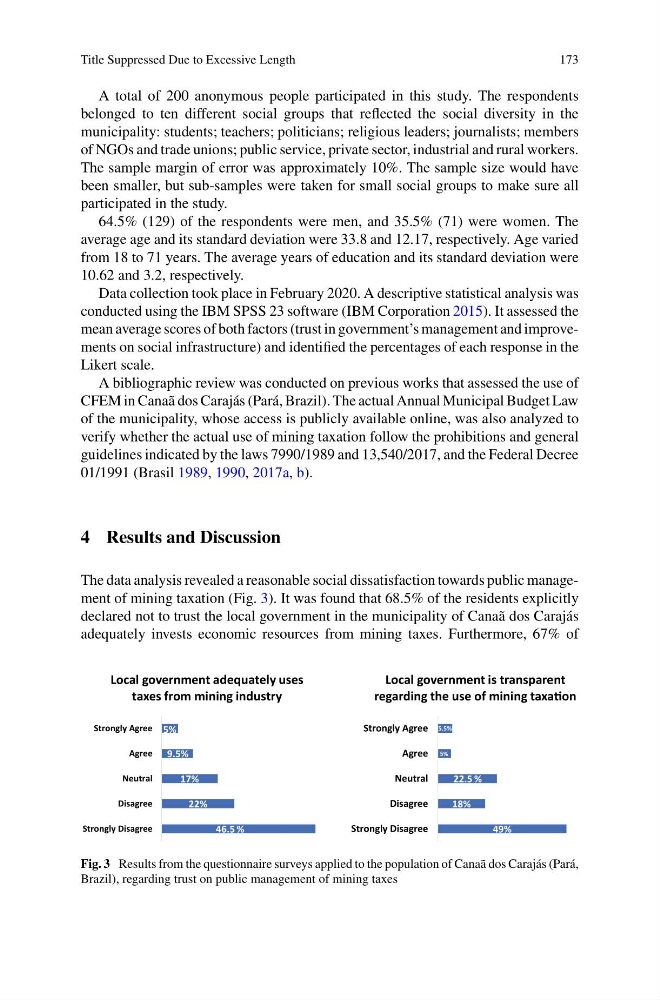
The data analysis revealed a reasonable social dissatisfaction towards public management of mining taxation (Fig. 3). It was found that 68.5% of the residents explicitly
declared not to trust the local government in the municipality of Canaã dos Carajás
adequately invests economic resources from mining taxes. Furthermore, 67% of
46.5 %
22%
17%
9.5% %
5%
Strongly Disagree
Disagree
Neutral
Agree
Strongly Agree
Local government adequately uses
taxes from mining industry
49%
18%
22.5 %
5%
5.5%R] %
Strongly Disagree
Disagree
Neutral
Agree
Strongly Agree
Local government is transparent
regarding the use of mining taxaƟon
Fig. 3 Results from the questionnaire surveys applied to the population of Canaã dos Carajás (Pará,
Brazil), regarding trust on public management of mining taxes
173
A total of 200 anonymous people participated in this study. The respondents
belonged to ten different social groups that reflected the social diversity in the
municipality: students; teachers; politicians; religious leaders; journalists; members
of NGOs and trade unions; public service, private sector, industrial and rural workers.
The sample margin of error was approximately 10%. The sample size would have
been smaller, but sub-samples were taken for small social groups to make sure all
participated in the study.
64.5% (129) of the respondents were men, and 35.5% (71) were women. The
average age and its standard deviation were 33.8 and 12.17, respectively. Age varied
from 18 to 71 years. The average years of education and its standard deviation were
10.62 and 3.2, respectively.
Data collection took place in February 2020. A descriptive statistical analysis was
conducted using the IBM SPSS 23 software (IBM Corporation 2015). It assessed the
mean average scores of both factors (trust in government’s management and improvements on social infrastructure) and identified the percentages of each response in the
Likert scale.
A bibliographic review was conducted on previous works that assessed the use of
CFEM in Canaã dos Carajás (Pará, Brazil). The actual Annual Municipal Budget Law
of the municipality, whose access is publicly available online, was also analyzed to
verify whether the actual use of mining taxation follow the prohibitions and general
guidelines indicated by the laws 7990/1989 and 13,540/2017, and the Federal Decree
01/1991 (Brasil 1989, 1990, 2017a, b).
4 Results and Discussion
The data analysis revealed a reasonable social dissatisfaction towards public management of mining taxation (Fig. 3). It was found that 68.5% of the residents explicitly
declared not to trust the local government in the municipality of Canaã dos Carajás
adequately invests economic resources from mining taxes. Furthermore, 67% of
46.5 %
22%
17%
9.5% %
5%
Strongly Disagree
Disagree
Neutral
Agree
Strongly Agree
Local government adequately uses
taxes from mining industry
49%
18%
22.5 %
5%
5.5%R] %
Strongly Disagree
Disagree
Neutral
Agree
Strongly Agree
Local government is transparent
regarding the use of mining taxaƟon
Fig. 3 Results from the questionnaire surveys applied to the population of Canaã dos Carajás (Pará,
Brazil), regarding trust on public management of mining taxes