

Title Suppressed Due to Excessive Length
175
30.78%
30.10%
15.29%
13.11%
4.61%
2.30%
1.80%
0.49%
0.44%
0.32%
0.74%
Public Management
Urban Infrastruture
Health
Education
Sanitation
Agriculture and Livestock
Social Assistance
Industry
Culture
Environmental Management
Others
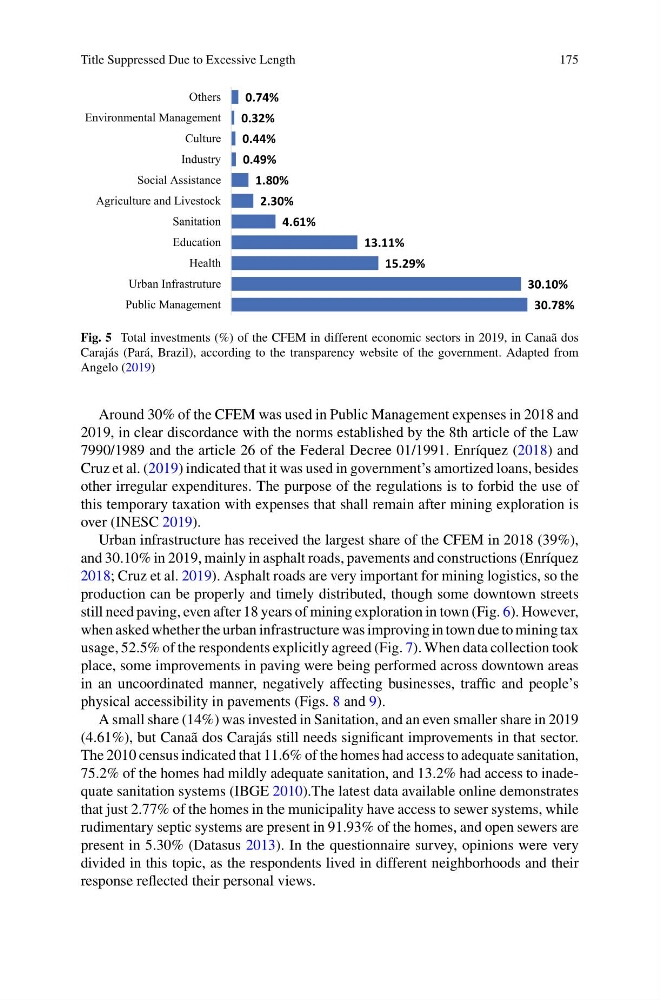
Fig. 5 Total investments (%) of the CFEM in different economic sectors in 2019, in Canaã dos
Carajás (Pará, Brazil), according to the transparency website of the government. Adapted from
Angelo (2019)
Around 30% of the CFEM was used in Public Management expenses in 2018 and
2019, in clear discordance with the norms established by the 8th article of the Law
7990/1989 and the article 26 of the Federal Decree 01/1991. Enríquez (2018) and
Cruz et al. (2019) indicated that it was used in government’s amortized loans, besides
other irregular expenditures. The purpose of the regulations is to forbid the use of
this temporary taxation with expenses that shall remain after mining exploration is
over (INESC 2019).
Urban infrastructure has received the largest share of the CFEM in 2018 (39%),
and 30.10% in 2019, mainly in asphalt roads, pavements and constructions (Enríquez
2018; Cruz et al. 2019). Asphalt roads are very important for mining logistics, so the
production can be properly and timely distributed, though some downtown streets
still need paving, even after 18 years of mining exploration in town (Fig. 6). However,
when asked whether the urban infrastructure was improving in town due to mining tax
usage, 52.5% of the respondents explicitly agreed (Fig. 7). When data collection took
place, some improvements in paving were being performed across downtown areas
in an uncoordinated manner, negatively affecting businesses, traffic and people’s
physical accessibility in pavements (Figs. 8 and 9).
A small share (14%) was invested in Sanitation, and an even smaller share in 2019
(4.61%), but Canaã dos Carajás still needs significant improvements in that sector.
The 2010 census indicated that 11.6% of the homes had access to adequate sanitation,
75.2% of the homes had mildly adequate sanitation, and 13.2% had access to inadequate sanitation systems (IBGE 2010).The latest data available online demonstrates
that just 2.77% of the homes in the municipality have access to sewer systems, while
rudimentary septic systems are present in 91.93% of the homes, and open sewers are
present in 5.30% (Datasus 2013). In the questionnaire survey, opinions were very
divided in this topic, as the respondents lived in different neighborhoods and their
response reflected their personal views.
175
30.78%
30.10%
15.29%
13.11%
4.61%
2.30%
1.80%
0.49%
0.44%
0.32%
0.74%
Public Management
Urban Infrastruture
Health
Education
Sanitation
Agriculture and Livestock
Social Assistance
Industry
Culture
Environmental Management
Others
Fig. 5 Total investments (%) of the CFEM in different economic sectors in 2019, in Canaã dos
Carajás (Pará, Brazil), according to the transparency website of the government. Adapted from
Angelo (2019)
Around 30% of the CFEM was used in Public Management expenses in 2018 and
2019, in clear discordance with the norms established by the 8th article of the Law
7990/1989 and the article 26 of the Federal Decree 01/1991. Enríquez (2018) and
Cruz et al. (2019) indicated that it was used in government’s amortized loans, besides
other irregular expenditures. The purpose of the regulations is to forbid the use of
this temporary taxation with expenses that shall remain after mining exploration is
over (INESC 2019).
Urban infrastructure has received the largest share of the CFEM in 2018 (39%),
and 30.10% in 2019, mainly in asphalt roads, pavements and constructions (Enríquez
2018; Cruz et al. 2019). Asphalt roads are very important for mining logistics, so the
production can be properly and timely distributed, though some downtown streets
still need paving, even after 18 years of mining exploration in town (Fig. 6). However,
when asked whether the urban infrastructure was improving in town due to mining tax
usage, 52.5% of the respondents explicitly agreed (Fig. 7). When data collection took
place, some improvements in paving were being performed across downtown areas
in an uncoordinated manner, negatively affecting businesses, traffic and people’s
physical accessibility in pavements (Figs. 8 and 9).
A small share (14%) was invested in Sanitation, and an even smaller share in 2019
(4.61%), but Canaã dos Carajás still needs significant improvements in that sector.
The 2010 census indicated that 11.6% of the homes had access to adequate sanitation,
75.2% of the homes had mildly adequate sanitation, and 13.2% had access to inadequate sanitation systems (IBGE 2010).The latest data available online demonstrates
that just 2.77% of the homes in the municipality have access to sewer systems, while
rudimentary septic systems are present in 91.93% of the homes, and open sewers are
present in 5.30% (Datasus 2013). In the questionnaire survey, opinions were very
divided in this topic, as the respondents lived in different neighborhoods and their
response reflected their personal views.