

L
–L
x
r
r o
r o
r
(a)
(b)
(c)
θ
x
r
r
θ
θ
= fn B i , F o ,
;
;
= fn B i , F o ,
= fn B i , F o ,
L
θ 0
r
r
θ 0
θ 0
o
o
Thick slab
Cylinder
Sphere
70
Analytical Heat Transfer
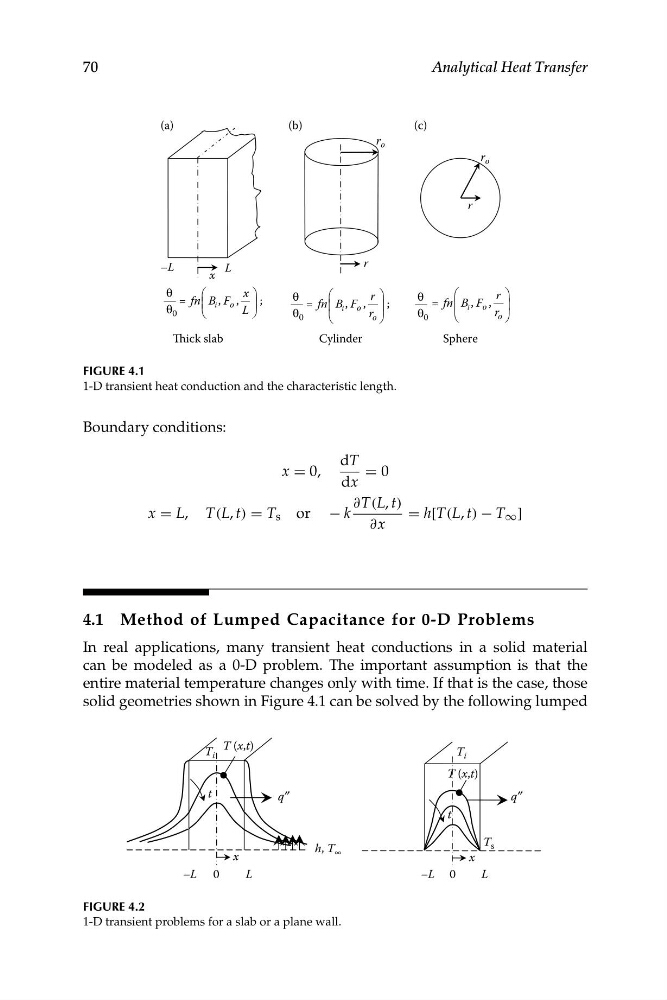
FIGURE 4.1
1-D transient heat conduction and the characteristic length.
Boundary conditions:
dT
x = 0,
= 0
dx
∂T(L, t)
x = L, T(L, t) = T s or − k
= h[T(L, t) − T ∞ ]
∂x
4.1 Method of Lumped Capacitance for 0-D Problems
In real applications, many transient heat conductions in a solid material
can be modeled as a 0-D problem. The important assumption is that the
entire material temperature changes only with time. If that is the case, those
solid geometries shown in Figure 4.1 can be solved by the following lumped
–L
L
0
x
t
q″
T (x,t)
T i
h, T ∞
–L
L
0
x
t
q″
T (x,t)
T s
T i
FIGURE 4.2
1-D transient problems for a slab or a plane wall.
–L
x
r
r o
r o
r
(a)
(b)
(c)
θ
x
r
r
θ
θ
= fn B i , F o ,
;
;
= fn B i , F o ,
= fn B i , F o ,
L
θ 0
r
r
θ 0
θ 0
o
o
Thick slab
Cylinder
Sphere
70
Analytical Heat Transfer
FIGURE 4.1
1-D transient heat conduction and the characteristic length.
Boundary conditions:
dT
x = 0,
= 0
dx
∂T(L, t)
x = L, T(L, t) = T s or − k
= h[T(L, t) − T ∞ ]
∂x
4.1 Method of Lumped Capacitance for 0-D Problems
In real applications, many transient heat conductions in a solid material
can be modeled as a 0-D problem. The important assumption is that the
entire material temperature changes only with time. If that is the case, those
solid geometries shown in Figure 4.1 can be solved by the following lumped
–L
L
0
x
t
q″
T (x,t)
T i
h, T ∞
–L
L
0
x
t
q″
T (x,t)
T s
T i
FIGURE 4.2
1-D transient problems for a slab or a plane wall.