

–L
L
x
T i
T (t)
=
(a)
t
θ
θ 0
(b)
hA s t
–
θ = e
ρVc
θ
1
i
θ
fn(B i , F o )
θ i
0.368
hA s t
0-D Transient problem–lumped
1
ρVc
capacitance method
Thermal time constant
(c)
t
1
t
hA s
ρVc
=
2
3
i
0.368
1
θ
θ
τ
τ
τ
τ
The solution of 0-D heat conduction
�
�
71
Transient Heat Conduction
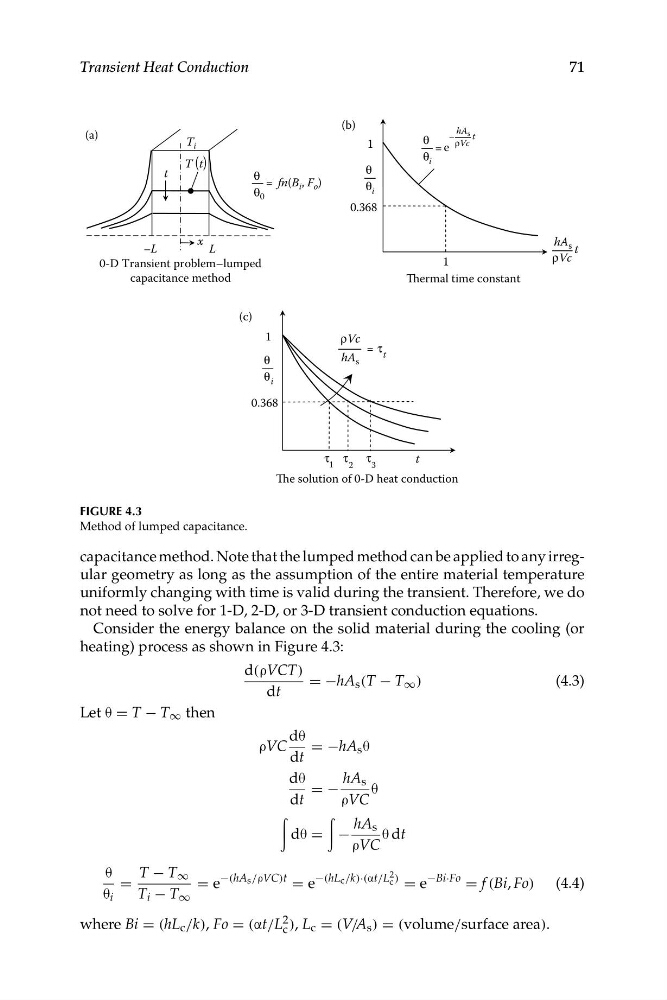
FIGURE 4.3
Method of lumped capacitance.
capacitance method. Note that the lumped method can be applied to any irregular geometry as long as the assumption of the entire material temperature
uniformly changing with time is valid during the transient. Therefore, we do
not need to solve for 1-D, 2-D, or 3-D transient conduction equations.
Consider the energy balance on the solid material during the cooling (or
heating) process as shown in Figure 4.3:
d(ρVCT) = −hA s (T − T ∞ )
(4.3)
dt
Let θ = T − T ∞ then
dθ
ρVC
= −hA s θ
dt
dθ
hA s
= −
θ
dt
ρVC
hA s
dθ = −
θ dt
ρVC
θ
T − T ∞
−(hA s /ρVC)t
−(hL c /k)·(αt/L 2 )
−Bi·Fo
c
=
= e
= e
= e
= f (Bi, Fo) (4.4)
θ i
T i − T ∞
where Bi = (hL c /k), Fo = (αt/L 2 ), L c = (V/A s ) = (volume/surface area).
c
L
x
T i
T (t)
=
(a)
t
θ
θ 0
(b)
hA s t
–
θ = e
ρVc
θ
1
i
θ
fn(B i , F o )
θ i
0.368
hA s t
0-D Transient problem–lumped
1
ρVc
capacitance method
Thermal time constant
(c)
t
1
t
hA s
ρVc
=
2
3
i
0.368
1
θ
θ
τ
τ
τ
τ
The solution of 0-D heat conduction
�
�
71
Transient Heat Conduction
FIGURE 4.3
Method of lumped capacitance.
capacitance method. Note that the lumped method can be applied to any irregular geometry as long as the assumption of the entire material temperature
uniformly changing with time is valid during the transient. Therefore, we do
not need to solve for 1-D, 2-D, or 3-D transient conduction equations.
Consider the energy balance on the solid material during the cooling (or
heating) process as shown in Figure 4.3:
d(ρVCT) = −hA s (T − T ∞ )
(4.3)
dt
Let θ = T − T ∞ then
dθ
ρVC
= −hA s θ
dt
dθ
hA s
= −
θ
dt
ρVC
hA s
dθ = −
θ dt
ρVC
θ
T − T ∞
−(hA s /ρVC)t
−(hL c /k)·(αt/L 2 )
−Bi·Fo
c
=
= e
= e
= e
= f (Bi, Fo) (4.4)
θ i
T i − T ∞
where Bi = (hL c /k), Fo = (αt/L 2 ), L c = (V/A s ) = (volume/surface area).
c