

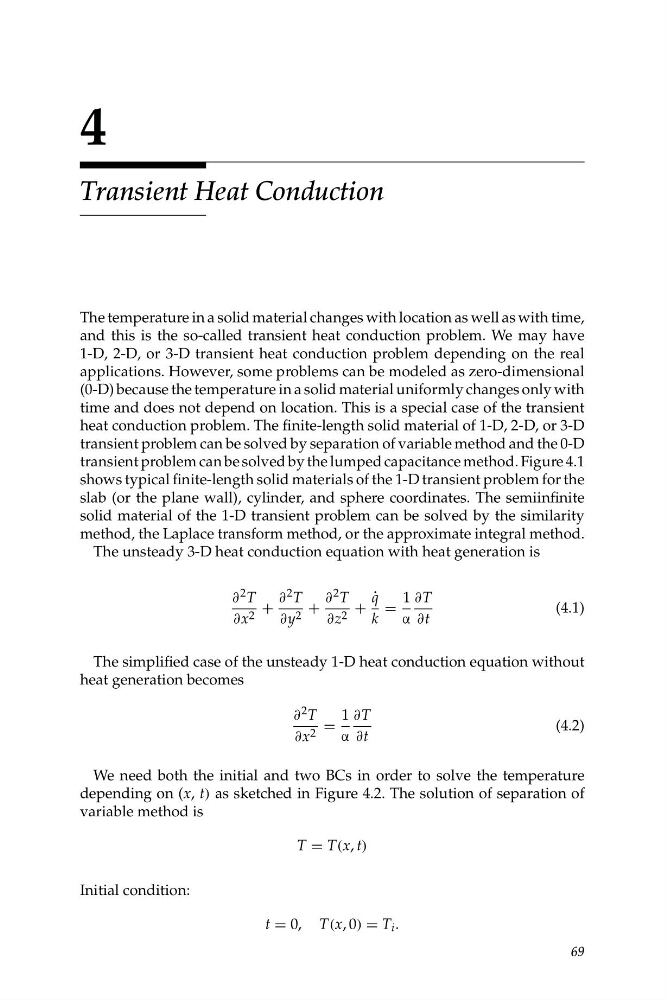
∂ 2 T
∂ 2 T
∂ 2 T
q ˙
1 ∂T
+
+
+ =
(4.1)
∂x 2
∂y 2
∂z 2
k
α ∂t
The simplified case of the unsteady 1-D heat conduction equation without
heat generation becomes
∂ 2 T
1 ∂T
=
(4.2)
∂x 2
α ∂t
We need both the initial and two BCs in order to solve the temperature
depending on (x, t) as sketched in Figure 4.2. The solution of separation of
variable method is
T = T(x, t)
Initial condition:
t = 0, T(x, 0) = T i .
4
Transient Heat Conduction
The temperature in a solid material changes with location as well as with time,
and this is the so-called transient heat conduction problem. We may have
1-D, 2-D, or 3-D transient heat conduction problem depending on the real
applications. However, some problems can be modeled as zero-dimensional
(0-D) because the temperature in a solid material uniformly changes only with
time and does not depend on location. This is a special case of the transient
heat conduction problem. The finite-length solid material of 1-D, 2-D, or 3-D
transient problem can be solved by separation of variable method and the 0-D
transient problem can be solved by the lumped capacitance method. Figure 4.1
shows typical finite-length solid materials of the 1-D transient problem for the
slab (or the plane wall), cylinder, and sphere coordinates. The semiinfinite
solid material of the 1-D transient problem can be solved by the similarity
method, the Laplace transform method, or the approximate integral method.
The unsteady 3-D heat conduction equation with heat generation is
69
∂ 2 T
∂ 2 T
q ˙
1 ∂T
+
+
+ =
(4.1)
∂x 2
∂y 2
∂z 2
k
α ∂t
The simplified case of the unsteady 1-D heat conduction equation without
heat generation becomes
∂ 2 T
1 ∂T
=
(4.2)
∂x 2
α ∂t
We need both the initial and two BCs in order to solve the temperature
depending on (x, t) as sketched in Figure 4.2. The solution of separation of
variable method is
T = T(x, t)
Initial condition:
t = 0, T(x, 0) = T i .
4
Transient Heat Conduction
The temperature in a solid material changes with location as well as with time,
and this is the so-called transient heat conduction problem. We may have
1-D, 2-D, or 3-D transient heat conduction problem depending on the real
applications. However, some problems can be modeled as zero-dimensional
(0-D) because the temperature in a solid material uniformly changes only with
time and does not depend on location. This is a special case of the transient
heat conduction problem. The finite-length solid material of 1-D, 2-D, or 3-D
transient problem can be solved by separation of variable method and the 0-D
transient problem can be solved by the lumped capacitance method. Figure 4.1
shows typical finite-length solid materials of the 1-D transient problem for the
slab (or the plane wall), cylinder, and sphere coordinates. The semiinfinite
solid material of the 1-D transient problem can be solved by the similarity
method, the Laplace transform method, or the approximate integral method.
The unsteady 3-D heat conduction equation with heat generation is
69