

�
�
�
�
�
�
�
�
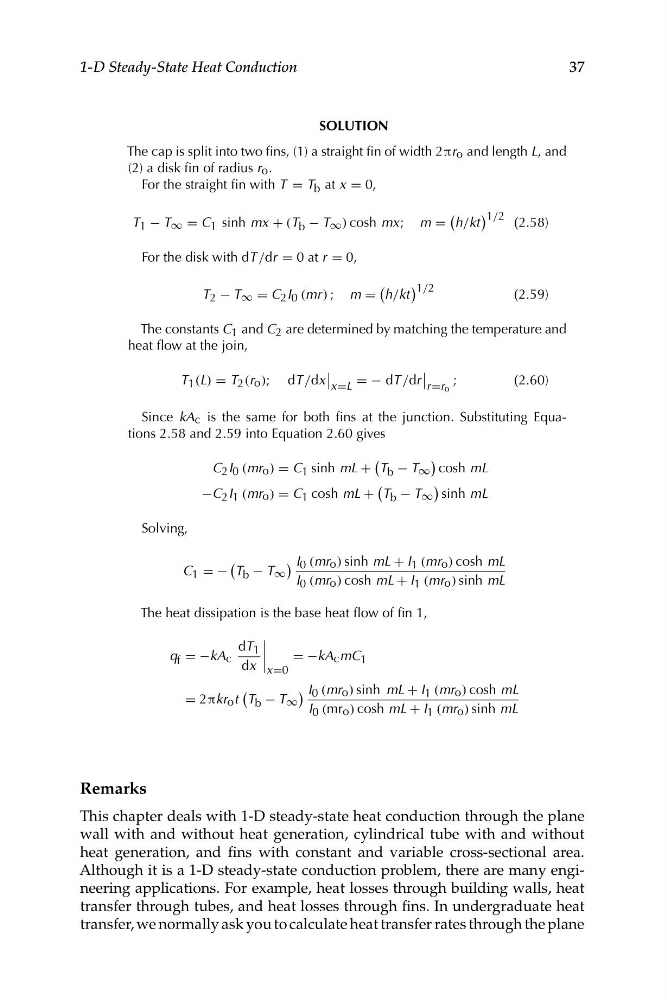
SOLUTION
The cap is split into two fins, (1) a straight fin of width 2πr o and length L, and
(2) a disk fin of radius r o .
For the straight fin with T = T b at x = 0,
(
) 1/2
T 1 − T ∞ = C 1 sinh mx + (T b − T ∞ ) cosh mx; m = h/kt
(2.58)
For the disk with dT /dr = 0 at r = 0,
(
) 1/2
T 2 − T ∞ = C 2 I 0 (mr ) ; m = h/kt
(2.59)
The constants C 1 and C 2 are determined by matching the temperature and
heat flow at the join,
T 1 (L) = T 2 (r o ); dT /dx
L = − dT /dr
;
(2.60)
x=
r =r o
Since kA c is the same for both fins at the junction. Substituting Equations 2.58 and 2.59 into Equation 2.60 gives
(
)
C 2 I 0 (mr o ) = C 1 sinh mL + T b − T ∞ cosh mL
(
)
−C 2 I 1 (mr o ) = C 1 cosh mL + T b − T ∞ sinh mL
Solving,
(
) I 0 (mr o ) sinh mL + I 1 (mr o ) cosh mL
C 1 = − T b − T ∞ I 0 (mr o ) cosh mL + I 1 (mr o ) sinh mL
The heat dissipation is the base heat flow of fin 1,
dT 1
q f = −kA c
= −kA c mC 1
dx x=0
(
) I 0 (mr o ) sinh mL + I 1 (mr o ) cosh mL
= 2πkr o t T b − T ∞ I 0 (mr o ) cosh mL + I 1 (mr o ) sinh mL
37
1-D Steady-State Heat Conduction
Remarks
This chapter deals with 1-D steady-state heat conduction through the plane
wall with and without heat generation, cylindrical tube with and without
heat generation, and fins with constant and variable cross-sectional area.
Although it is a 1-D steady-state conduction problem, there are many engineering applications. For example, heat losses through building walls, heat
transfer through tubes, and heat losses through fins. In undergraduate heat
transfer, we normally ask you to calculate heat transfer rates through the plane
�
�
�
�
�
�
�
SOLUTION
The cap is split into two fins, (1) a straight fin of width 2πr o and length L, and
(2) a disk fin of radius r o .
For the straight fin with T = T b at x = 0,
(
) 1/2
T 1 − T ∞ = C 1 sinh mx + (T b − T ∞ ) cosh mx; m = h/kt
(2.58)
For the disk with dT /dr = 0 at r = 0,
(
) 1/2
T 2 − T ∞ = C 2 I 0 (mr ) ; m = h/kt
(2.59)
The constants C 1 and C 2 are determined by matching the temperature and
heat flow at the join,
T 1 (L) = T 2 (r o ); dT /dx
L = − dT /dr
;
(2.60)
x=
r =r o
Since kA c is the same for both fins at the junction. Substituting Equations 2.58 and 2.59 into Equation 2.60 gives
(
)
C 2 I 0 (mr o ) = C 1 sinh mL + T b − T ∞ cosh mL
(
)
−C 2 I 1 (mr o ) = C 1 cosh mL + T b − T ∞ sinh mL
Solving,
(
) I 0 (mr o ) sinh mL + I 1 (mr o ) cosh mL
C 1 = − T b − T ∞ I 0 (mr o ) cosh mL + I 1 (mr o ) sinh mL
The heat dissipation is the base heat flow of fin 1,
dT 1
q f = −kA c
= −kA c mC 1
dx x=0
(
) I 0 (mr o ) sinh mL + I 1 (mr o ) cosh mL
= 2πkr o t T b − T ∞ I 0 (mr o ) cosh mL + I 1 (mr o ) sinh mL
37
1-D Steady-State Heat Conduction
Remarks
This chapter deals with 1-D steady-state heat conduction through the plane
wall with and without heat generation, cylindrical tube with and without
heat generation, and fins with constant and variable cross-sectional area.
Although it is a 1-D steady-state conduction problem, there are many engineering applications. For example, heat losses through building walls, heat
transfer through tubes, and heat losses through fins. In undergraduate heat
transfer, we normally ask you to calculate heat transfer rates through the plane