

�
�
�
�
�
Substituting into Equation 2.56
2 d 2 θ
dθ
z
+ z
− z 2 θ = 0
(2.57)
dz 2
dz
The solution to the above equation is
θ = C 1 I o (z) + C 2 K o (z)
Boundary conditions
at x = 0, K o → ∞, C 2 = 0,
at x = L, θ = θ b ,
(
)
√
I 0 2m xL
θ = θ b · I 0 (2 mL)
dT �
I 1 (2 mL)
q f = +kA c
= θ b ktwm
dx
I 0 (2 mL)
x=L
q f
1 I 1 (2 mL)
η f =
=
hθ b 2wL
mL I 0 (2 mL)
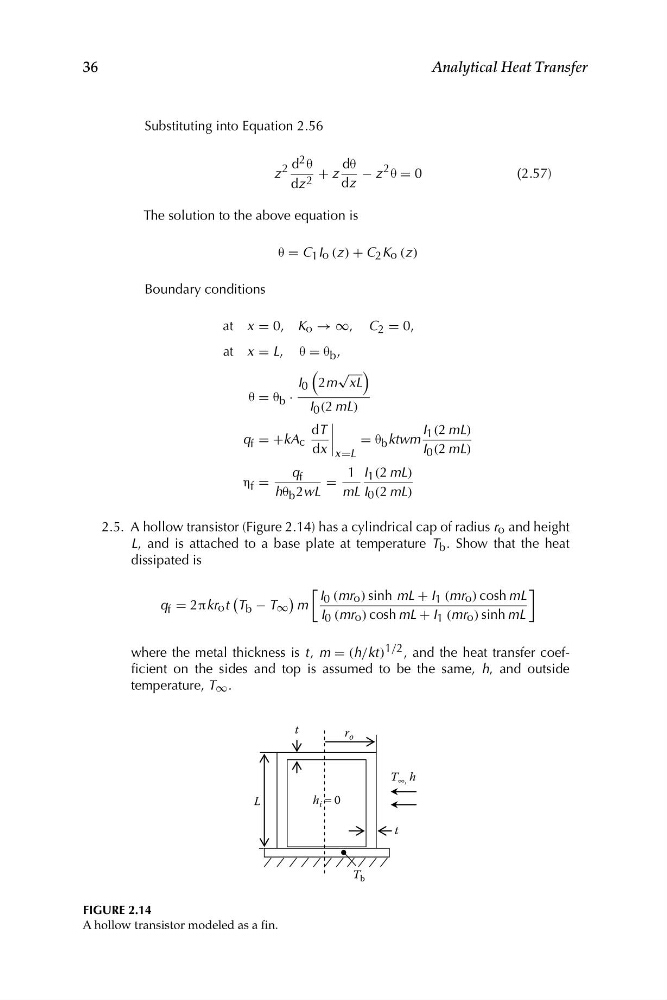
2.5. A hollow transistor (Figure 2.14) has a cylindrical cap of radius r o and height
L, and is attached to a base plate at temperature T b . Show that the heat
dissipated is
(
)
I 0 (mr o ) sinh mL + I 1 (mr o ) cosh mL
q f = 2πkr o t T b − T ∞ m I 0 (mr o ) cosh mL + I 1 (mr o ) sinh mL
where the metal thickness is t , m = (h/kt ) 1/2 , and the heat transfer coefficient on the sides and top is assumed to be the same, h, and outside
temperature, T ∞ .
36
Analytical Heat Transfer
L
t
r o
t
T b
h i = 0
T ∞, h
FIGURE 2.14
A hollow transistor modeled as a fin.
�
�
�
�
Substituting into Equation 2.56
2 d 2 θ
dθ
z
+ z
− z 2 θ = 0
(2.57)
dz 2
dz
The solution to the above equation is
θ = C 1 I o (z) + C 2 K o (z)
Boundary conditions
at x = 0, K o → ∞, C 2 = 0,
at x = L, θ = θ b ,
(
)
√
I 0 2m xL
θ = θ b · I 0 (2 mL)
dT �
I 1 (2 mL)
q f = +kA c
= θ b ktwm
dx
I 0 (2 mL)
x=L
q f
1 I 1 (2 mL)
η f =
=
hθ b 2wL
mL I 0 (2 mL)
2.5. A hollow transistor (Figure 2.14) has a cylindrical cap of radius r o and height
L, and is attached to a base plate at temperature T b . Show that the heat
dissipated is
(
)
I 0 (mr o ) sinh mL + I 1 (mr o ) cosh mL
q f = 2πkr o t T b − T ∞ m I 0 (mr o ) cosh mL + I 1 (mr o ) sinh mL
where the metal thickness is t , m = (h/kt ) 1/2 , and the heat transfer coefficient on the sides and top is assumed to be the same, h, and outside
temperature, T ∞ .
36
Analytical Heat Transfer
L
t
r o
t
T b
h i = 0
T ∞, h
FIGURE 2.14
A hollow transistor modeled as a fin.