

1
0
Thick τ L = ∞
Thin τ L = 0
1.0
1
2
τ τ L
τ L
0
10
1.0
Experimental
Numerical
Optically thin
Optically thick
Q
ϕ(τ)
For 1-D, gray gases, gray and diffuse surface, radiation only, the heat flux
(
)
σ T 1
4 − T 4 Q
q =
2
(14.38)
1 + Q ((1/ε 1 ) + (1/ε 2 ) − 2)
q
1
Q ≡
≡
(14.39)
J 1 − J 2
1 + (3/4)τ L
σT 4 (τ) − J 2
φ(τ) ≡
(14.40)
J 1 − J 2
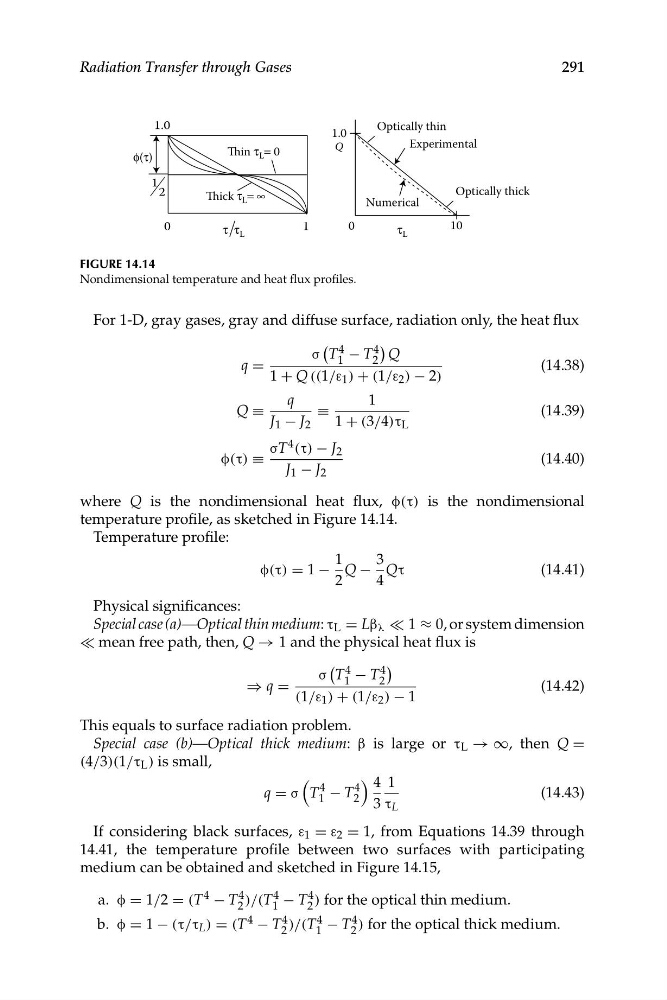
where Q is the nondimensional heat flux, φ(τ) is the nondimensional
temperature profile, as sketched in Figure 14.14.
Temperature profile:
φ(τ) = 1 −
1
2
Q −
3
4
Qτ
(14.41)
Physical significances:
Special case (a)—Optical thin medium: τ L = Lβ λ « 1 ≈ 0, or system dimension
« mean free path, then, Q → 1 and the physical heat flux is
(
)
σ T 1
4 − T 4
⇒ q =
2
(14.42)
(1/ε 1 ) + (1/ε 2 ) − 1
This equals to surface radiation problem.
Special case (b)—Optical thick medium: β is large or τ L → ∞, then Q =
(4/3)(1/τ L ) is small,
(
) 4
q = σ T 1
4
− T
4
1
(14.43)
2 3 τ L
If considering black surfaces, ε 1 = ε 2 = 1, from Equations 14.39 through
14.41, the temperature profile between two surfaces with participating
medium can be obtained and sketched in Figure 14.15,
a. φ = 1/2 = (T 4 − T 2
4 )/(T 1
4 − T 2
4 ) for the optical thin medium.
b. φ = 1 − (τ/τ L ) = (T 4 − T 2
4 )/(T 1
4 − T 2
4 ) for the optical thick medium.
291
Radiation Transfer through Gases
FIGURE 14.14
Nondimensional temperature and heat flux profiles.
0
Thick τ L = ∞
Thin τ L = 0
1.0
1
2
τ τ L
τ L
0
10
1.0
Experimental
Numerical
Optically thin
Optically thick
Q
ϕ(τ)
For 1-D, gray gases, gray and diffuse surface, radiation only, the heat flux
(
)
σ T 1
4 − T 4 Q
q =
2
(14.38)
1 + Q ((1/ε 1 ) + (1/ε 2 ) − 2)
q
1
Q ≡
≡
(14.39)
J 1 − J 2
1 + (3/4)τ L
σT 4 (τ) − J 2
φ(τ) ≡
(14.40)
J 1 − J 2
where Q is the nondimensional heat flux, φ(τ) is the nondimensional
temperature profile, as sketched in Figure 14.14.
Temperature profile:
φ(τ) = 1 −
1
2
Q −
3
4
Qτ
(14.41)
Physical significances:
Special case (a)—Optical thin medium: τ L = Lβ λ « 1 ≈ 0, or system dimension
« mean free path, then, Q → 1 and the physical heat flux is
(
)
σ T 1
4 − T 4
⇒ q =
2
(14.42)
(1/ε 1 ) + (1/ε 2 ) − 1
This equals to surface radiation problem.
Special case (b)—Optical thick medium: β is large or τ L → ∞, then Q =
(4/3)(1/τ L ) is small,
(
) 4
q = σ T 1
4
− T
4
1
(14.43)
2 3 τ L
If considering black surfaces, ε 1 = ε 2 = 1, from Equations 14.39 through
14.41, the temperature profile between two surfaces with participating
medium can be obtained and sketched in Figure 14.15,
a. φ = 1/2 = (T 4 − T 2
4 )/(T 1
4 − T 2
4 ) for the optical thin medium.
b. φ = 1 − (τ/τ L ) = (T 4 − T 2
4 )/(T 1
4 − T 2
4 ) for the optical thick medium.
291
Radiation Transfer through Gases
FIGURE 14.14
Nondimensional temperature and heat flux profiles.