

If considering conduction and radiation,
q = q c + q r = k
T 1 − T 2
L
+
σ
(
T 4
1 − T 4
2
)
Q
1 + Q((1/ε 1 ) + (1/ε 2 ) − 2)
(14.44)
If considering convection and radiation,
q = q conv + q r = ¯
hΔ ¯
T +
σ
(
T 4
1 − T 4
2
)
Q
1 + Q((1/ε 1 ) + (1/ε 2 ) − 2)
(14.45)
292
Analytical Heat Transfer
(b)
(a)
T 4
2
T 4
1
τ/τ L
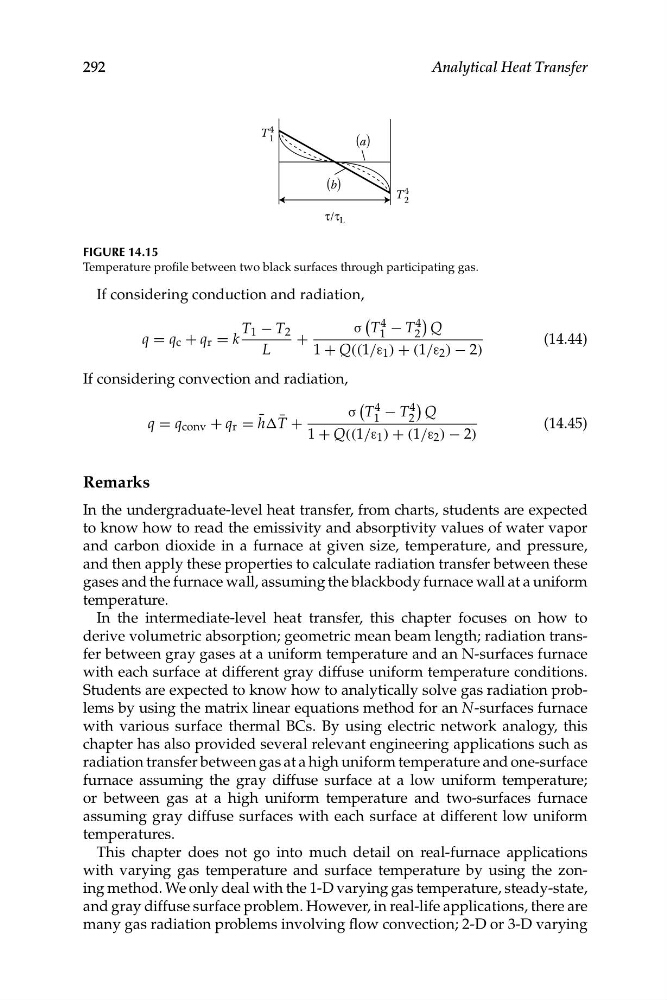
FIGURE 14.15
Temperature profile between two black surfaces through participating gas.
Remarks
In the undergraduate-level heat transfer, from charts, students are expected
to know how to read the emissivity and absorptivity values of water vapor
and carbon dioxide in a furnace at given size, temperature, and pressure,
and then apply these properties to calculate radiation transfer between these
gases and the furnace wall, assuming the blackbody furnace wall at a uniform
temperature.
In the intermediate-level heat transfer, this chapter focuses on how to
derive volumetric absorption; geometric mean beam length; radiation transfer between gray gases at a uniform temperature and an N-surfaces furnace
with each surface at different gray diffuse uniform temperature conditions.
Students are expected to know how to analytically solve gas radiation problems by using the matrix linear equations method for an N-surfaces furnace
with various surface thermal BCs. By using electric network analogy, this
chapter has also provided several relevant engineering applications such as
radiation transfer between gas at a high uniform temperature and one-surface
furnace assuming the gray diffuse surface at a low uniform temperature;
or between gas at a high uniform temperature and two-surfaces furnace
assuming gray diffuse surfaces with each surface at different low uniform
temperatures.
This chapter does not go into much detail on real-furnace applications
with varying gas temperature and surface temperature by using the zoning method. We only deal with the 1-D varying gas temperature, steady-state,
and gray diffuse surface problem. However, in real-life applications, there are
many gas radiation problems involving flow convection; 2-D or 3-D varying
q = q c + q r = k
T 1 − T 2
L
+
σ
(
T 4
1 − T 4
2
)
Q
1 + Q((1/ε 1 ) + (1/ε 2 ) − 2)
(14.44)
If considering convection and radiation,
q = q conv + q r = ¯
hΔ ¯
T +
σ
(
T 4
1 − T 4
2
)
Q
1 + Q((1/ε 1 ) + (1/ε 2 ) − 2)
(14.45)
292
Analytical Heat Transfer
(b)
(a)
T 4
2
T 4
1
τ/τ L
FIGURE 14.15
Temperature profile between two black surfaces through participating gas.
Remarks
In the undergraduate-level heat transfer, from charts, students are expected
to know how to read the emissivity and absorptivity values of water vapor
and carbon dioxide in a furnace at given size, temperature, and pressure,
and then apply these properties to calculate radiation transfer between these
gases and the furnace wall, assuming the blackbody furnace wall at a uniform
temperature.
In the intermediate-level heat transfer, this chapter focuses on how to
derive volumetric absorption; geometric mean beam length; radiation transfer between gray gases at a uniform temperature and an N-surfaces furnace
with each surface at different gray diffuse uniform temperature conditions.
Students are expected to know how to analytically solve gas radiation problems by using the matrix linear equations method for an N-surfaces furnace
with various surface thermal BCs. By using electric network analogy, this
chapter has also provided several relevant engineering applications such as
radiation transfer between gas at a high uniform temperature and one-surface
furnace assuming the gray diffuse surface at a low uniform temperature;
or between gas at a high uniform temperature and two-surfaces furnace
assuming gray diffuse surfaces with each surface at different low uniform
temperatures.
This chapter does not go into much detail on real-furnace applications
with varying gas temperature and surface temperature by using the zoning method. We only deal with the 1-D varying gas temperature, steady-state,
and gray diffuse surface problem. However, in real-life applications, there are
many gas radiation problems involving flow convection; 2-D or 3-D varying