

�
�
∂I = 0
∂φ
∂I = 0
∂θ
e bλ (y)
r λ G λ (y)
dI
+ (θ) = −k λ I
+ ds − r λ I
+ ds + k λ
ds +
ds
(14.37)
λ
λ
λ
π
4π
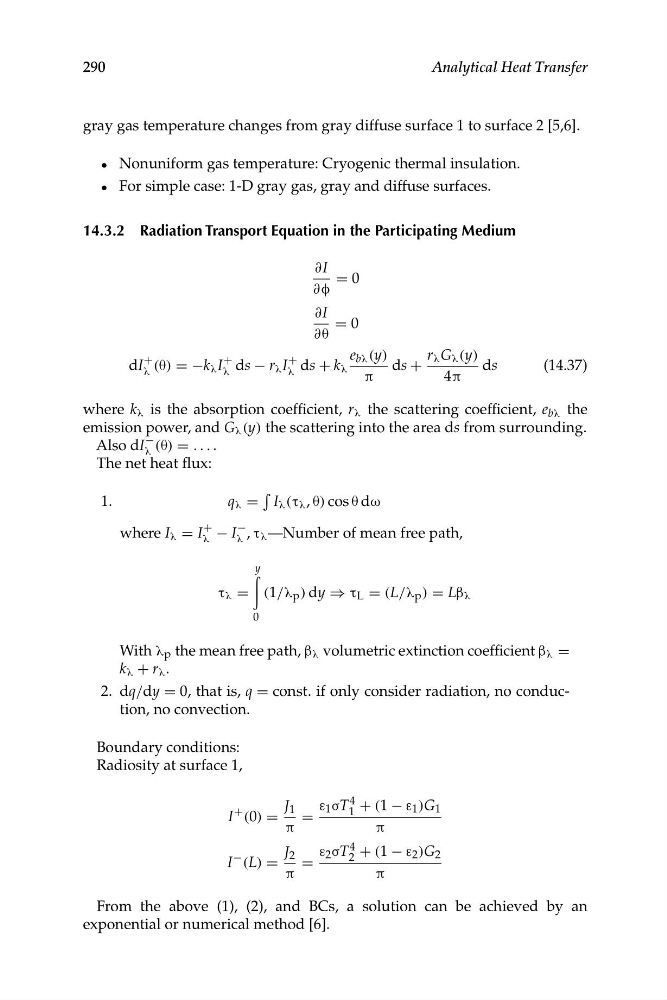
where k λ is the absorption coefficient, r λ the scattering coefficient, e bλ the
emission power, and G λ (y) the scattering into the area ds from surrounding.
Also dI
− (θ) = . . . .
λ
The net heat flux:
1.
q λ = I λ (τ λ , θ) cos θ dω
where I λ = I
+
− I λ
− , τ λ —Number of mean free path,
λ
y
τ λ = (1/λ p ) dy ⇒ τ L = (L/λ p ) = Lβ λ
0
With λ p the mean free path, β λ volumetric extinction coefficient β λ =
k λ + r λ .
2. dq/dy = 0, that is, q = const. if only consider radiation, no conduction, no convection.
Boundary conditions:
Radiosity at surface 1,
J 1
ε 1 σT 1
4 + (1 − ε 1 )G 1
I
+ (0) =
=
π
π
J 2
ε 2 σT 2
4 + (1 − ε 2 )G 2
I
− (L) =
=
π
π
From the above (1), (2), and BCs, a solution can be achieved by an
exponential or numerical method [6].
290
Analytical Heat Transfer
gray gas temperature changes from gray diffuse surface 1 to surface 2 [5,6].
• Nonuniform gas temperature: Cryogenic thermal insulation.
• For simple case: 1-D gray gas, gray and diffuse surfaces.
14.3.2 Radiation Transport Equation in the Participating Medium
�
∂I = 0
∂φ
∂I = 0
∂θ
e bλ (y)
r λ G λ (y)
dI
+ (θ) = −k λ I
+ ds − r λ I
+ ds + k λ
ds +
ds
(14.37)
λ
λ
λ
π
4π
where k λ is the absorption coefficient, r λ the scattering coefficient, e bλ the
emission power, and G λ (y) the scattering into the area ds from surrounding.
Also dI
− (θ) = . . . .
λ
The net heat flux:
1.
q λ = I λ (τ λ , θ) cos θ dω
where I λ = I
+
− I λ
− , τ λ —Number of mean free path,
λ
y
τ λ = (1/λ p ) dy ⇒ τ L = (L/λ p ) = Lβ λ
0
With λ p the mean free path, β λ volumetric extinction coefficient β λ =
k λ + r λ .
2. dq/dy = 0, that is, q = const. if only consider radiation, no conduction, no convection.
Boundary conditions:
Radiosity at surface 1,
J 1
ε 1 σT 1
4 + (1 − ε 1 )G 1
I
+ (0) =
=
π
π
J 2
ε 2 σT 2
4 + (1 − ε 2 )G 2
I
− (L) =
=
π
π
From the above (1), (2), and BCs, a solution can be achieved by an
exponential or numerical method [6].
290
Analytical Heat Transfer
gray gas temperature changes from gray diffuse surface 1 to surface 2 [5,6].
• Nonuniform gas temperature: Cryogenic thermal insulation.
• For simple case: 1-D gray gas, gray and diffuse surfaces.
14.3.2 Radiation Transport Equation in the Participating Medium