

T 1
T 2
I λ (x)
I λ,0
I λ L
dx
L
0
x
Performing integration, we obtain
ln I λ (x) = −K λ x + C 1
(−K λ x+C 1 )
−K λ x
I λ (x) = e
= C e
at x = 0, C = I λ,0
I λ (x) = I λ,0 e
−K λ x
at x = L
I λ,L = I λ,0 e
−K λ L
(14.7)
This exponential decay is called Beer’s law. One can define the transmissivity as
I λ,L
−K λ L
τ λ =
= e
(14.8)
I λ,0
The absorptivity is
−K λ L
α λ = 1 − τ λ = 1 − e
.
For gases, α = ε λ = emissivity. λ
If we consider both gas emission and the absorption effect, the intensity
of the beam is attenuated due to absorption and is augmented due to gas
emission along the distance [2]. Assume a local thermodynamic equilibrium, absorption coefficient will equal emission coefficient, and Equation 14.6
becomes
dI λ (x) = [−K λ I λ (x) + K λ I bλ ] dx
(14.9)
where K I is intensity gained due to gas emission, KI (x) is the intensity
λ bλ
− λ
attenuated due to gas absorption.
278
Analytical Heat Transfer
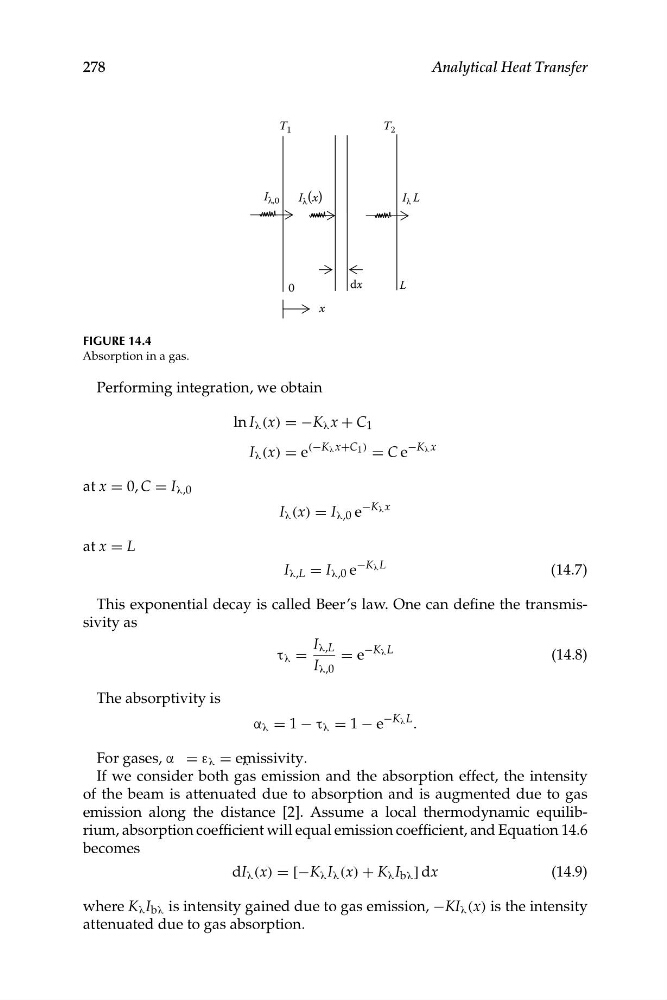
FIGURE 14.4
Absorption in a gas.
T 2
I λ (x)
I λ,0
I λ L
dx
L
0
x
Performing integration, we obtain
ln I λ (x) = −K λ x + C 1
(−K λ x+C 1 )
−K λ x
I λ (x) = e
= C e
at x = 0, C = I λ,0
I λ (x) = I λ,0 e
−K λ x
at x = L
I λ,L = I λ,0 e
−K λ L
(14.7)
This exponential decay is called Beer’s law. One can define the transmissivity as
I λ,L
−K λ L
τ λ =
= e
(14.8)
I λ,0
The absorptivity is
−K λ L
α λ = 1 − τ λ = 1 − e
.
For gases, α = ε λ = emissivity. λ
If we consider both gas emission and the absorption effect, the intensity
of the beam is attenuated due to absorption and is augmented due to gas
emission along the distance [2]. Assume a local thermodynamic equilibrium, absorption coefficient will equal emission coefficient, and Equation 14.6
becomes
dI λ (x) = [−K λ I λ (x) + K λ I bλ ] dx
(14.9)
where K I is intensity gained due to gas emission, KI (x) is the intensity
λ bλ
− λ
attenuated due to gas absorption.
278
Analytical Heat Transfer
FIGURE 14.4
Absorption in a gas.