

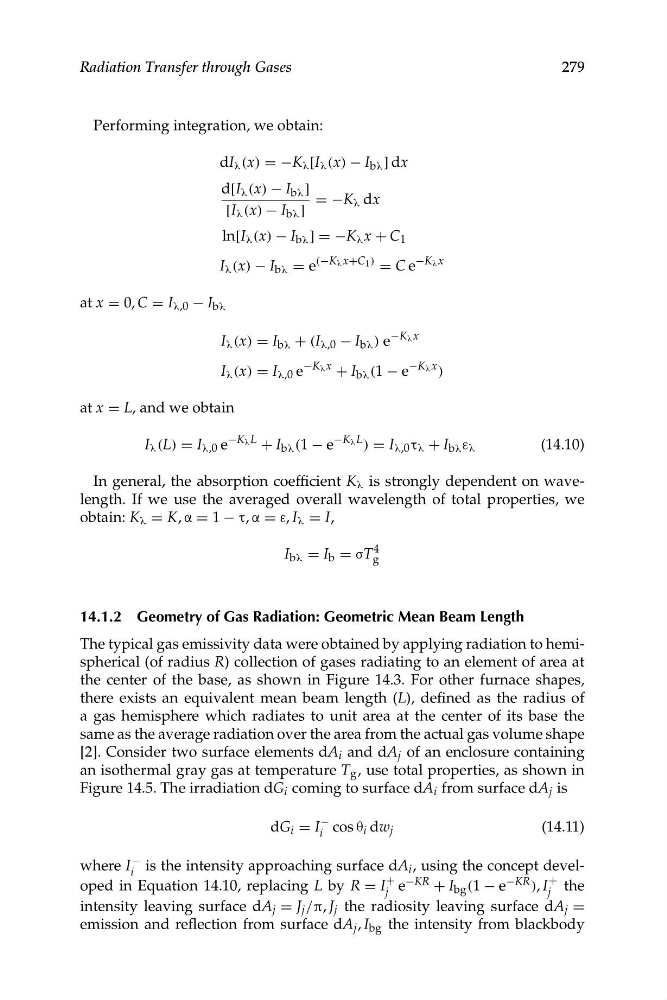
Performing integration, we obtain:
dI λ (x) = −K λ [I λ (x) − I bλ ] dx
d[I λ (x) − I bλ ] = −K λ dx
[I λ (x) − I bλ ]
ln[I λ (x) − I bλ ] = −K λ x + C 1
(−K λ x+C 1 )
−K λ x
I λ (x) − I bλ = e
= C e
at x = 0, C = I λ,0 − I bλ
I λ (x) = I bλ + (I λ,0 − I bλ ) e
−K λ x
I λ (x) = I λ,0 e
−K λ x
+ I bλ (1 − e
−K λ x )
at x = L, and we obtain
I λ (L) = I λ,0 e
−K λ L
+ I bλ (1 − e
−K λ L ) = I λ,0 τ λ + I bλ ε λ
(14.10)
In general, the absorption coefficient K λ is strongly dependent on wavelength. If we use the averaged overall wavelength of total properties, we
obtain: K λ = K, α = 1 − τ, α = ε, I λ = I,
= σT
4
I bλ = I b
g
279
Radiation Transfer through Gases
14.1.2 Geometry of Gas Radiation: Geometric Mean Beam Length
The typical gas emissivity data were obtained by applying radiation to hemispherical (of radius R) collection of gases radiating to an element of area at
the center of the base, as shown in Figure 14.3. For other furnace shapes,
there exists an equivalent mean beam length (L), defined as the radius of
a gas hemisphere which radiates to unit area at the center of its base the
same as the average radiation over the area from the actual gas volume shape
[2]. Consider two surface elements dA i and dA j of an enclosure containing
an isothermal gray gas at temperature T g , use total properties, as shown in
Figure 14.5. The irradiation dG i coming to surface dA i from surface dA j is
dG i = I
− cos θ i dw j
(14.11)
i
where I
− is the intensity approaching surface dA i , using the concept develi
−KR + I bg (1 − e −KR ), I
+
oped in Equation 14.10, replacing L by R = I j
+ e
j the
intensity leaving surface dA j = J j /π, J j the radiosity leaving surface dA j =
emission and reflection from surface dA j , I bg the intensity from blackbody
dI λ (x) = −K λ [I λ (x) − I bλ ] dx
d[I λ (x) − I bλ ] = −K λ dx
[I λ (x) − I bλ ]
ln[I λ (x) − I bλ ] = −K λ x + C 1
(−K λ x+C 1 )
−K λ x
I λ (x) − I bλ = e
= C e
at x = 0, C = I λ,0 − I bλ
I λ (x) = I bλ + (I λ,0 − I bλ ) e
−K λ x
I λ (x) = I λ,0 e
−K λ x
+ I bλ (1 − e
−K λ x )
at x = L, and we obtain
I λ (L) = I λ,0 e
−K λ L
+ I bλ (1 − e
−K λ L ) = I λ,0 τ λ + I bλ ε λ
(14.10)
In general, the absorption coefficient K λ is strongly dependent on wavelength. If we use the averaged overall wavelength of total properties, we
obtain: K λ = K, α = 1 − τ, α = ε, I λ = I,
= σT
4
I bλ = I b
g
279
Radiation Transfer through Gases
14.1.2 Geometry of Gas Radiation: Geometric Mean Beam Length
The typical gas emissivity data were obtained by applying radiation to hemispherical (of radius R) collection of gases radiating to an element of area at
the center of the base, as shown in Figure 14.3. For other furnace shapes,
there exists an equivalent mean beam length (L), defined as the radius of
a gas hemisphere which radiates to unit area at the center of its base the
same as the average radiation over the area from the actual gas volume shape
[2]. Consider two surface elements dA i and dA j of an enclosure containing
an isothermal gray gas at temperature T g , use total properties, as shown in
Figure 14.5. The irradiation dG i coming to surface dA i from surface dA j is
dG i = I
− cos θ i dw j
(14.11)
i
where I
− is the intensity approaching surface dA i , using the concept develi
−KR + I bg (1 − e −KR ), I
+
oped in Equation 14.10, replacing L by R = I j
+ e
j the
intensity leaving surface dA j = J j /π, J j the radiosity leaving surface dA j =
emission and reflection from surface dA j , I bg the intensity from blackbody