

277
Radiation Transfer through Gases
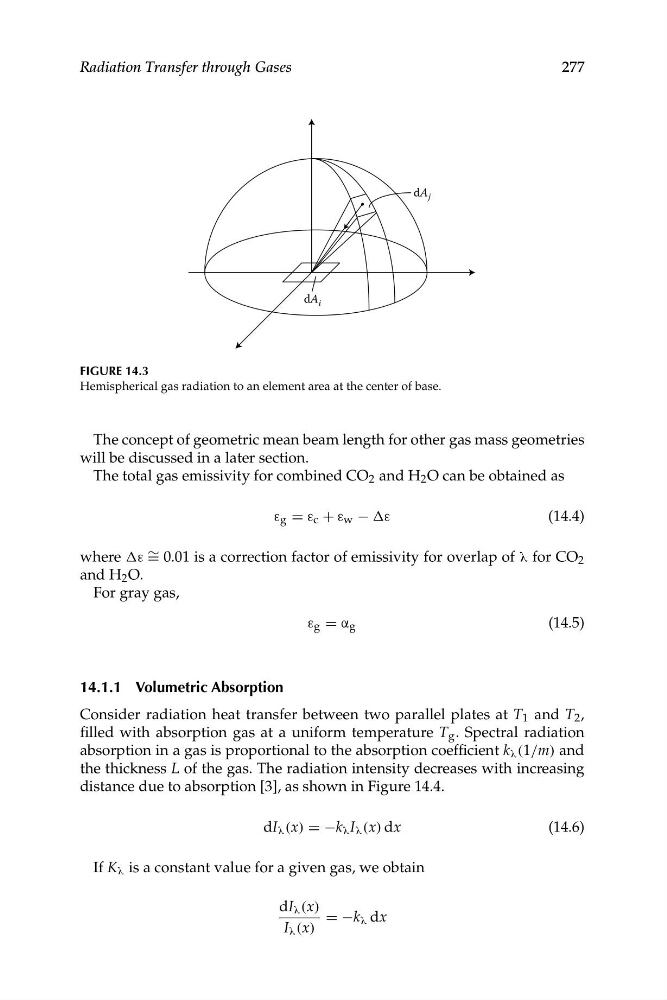
dA j
dA i
FIGURE 14.3
Hemispherical gas radiation to an element area at the center of base.
The concept of geometric mean beam length for other gas mass geometries
will be discussed in a later section.
The total gas emissivity for combined CO 2 and H 2 O can be obtained as
ε g = ε c + ε w − Δε
(14.4)
where Δε ∼ = 0.01 is a correction factor of emissivity for overlap of λ for CO 2
and H 2 O.
For gray gas,
ε g = α g
(14.5)
14.1.1 Volumetric Absorption
Consider radiation heat transfer between two parallel plates at T 1 and T 2 ,
filled with absorption gas at a uniform temperature T g . Spectral radiation
absorption in a gas is proportional to the absorption coefficient k λ (1/m) and
the thickness L of the gas. The radiation intensity decreases with increasing
distance due to absorption [3], as shown in Figure 14.4.
dI λ (x) = −k λ I λ (x) dx
(14.6)
If K λ is a constant value for a given gas, we obtain
dI λ (x) = −k λ dx
I λ (x)
Radiation Transfer through Gases
dA j
dA i
FIGURE 14.3
Hemispherical gas radiation to an element area at the center of base.
The concept of geometric mean beam length for other gas mass geometries
will be discussed in a later section.
The total gas emissivity for combined CO 2 and H 2 O can be obtained as
ε g = ε c + ε w − Δε
(14.4)
where Δε ∼ = 0.01 is a correction factor of emissivity for overlap of λ for CO 2
and H 2 O.
For gray gas,
ε g = α g
(14.5)
14.1.1 Volumetric Absorption
Consider radiation heat transfer between two parallel plates at T 1 and T 2 ,
filled with absorption gas at a uniform temperature T g . Spectral radiation
absorption in a gas is proportional to the absorption coefficient k λ (1/m) and
the thickness L of the gas. The radiation intensity decreases with increasing
distance due to absorption [3], as shown in Figure 14.4.
dI λ (x) = −k λ I λ (x) dx
(14.6)
If K λ is a constant value for a given gas, we obtain
dI λ (x) = −k λ dx
I λ (x)