

13.2 Radiation Exchange between Gray Diffuse
Nonisothermal Surfaces
The following shows how to solve radiation heat transfer between nonisothermal surfaces [4–5]. In this case, one shall consider radiation exchange
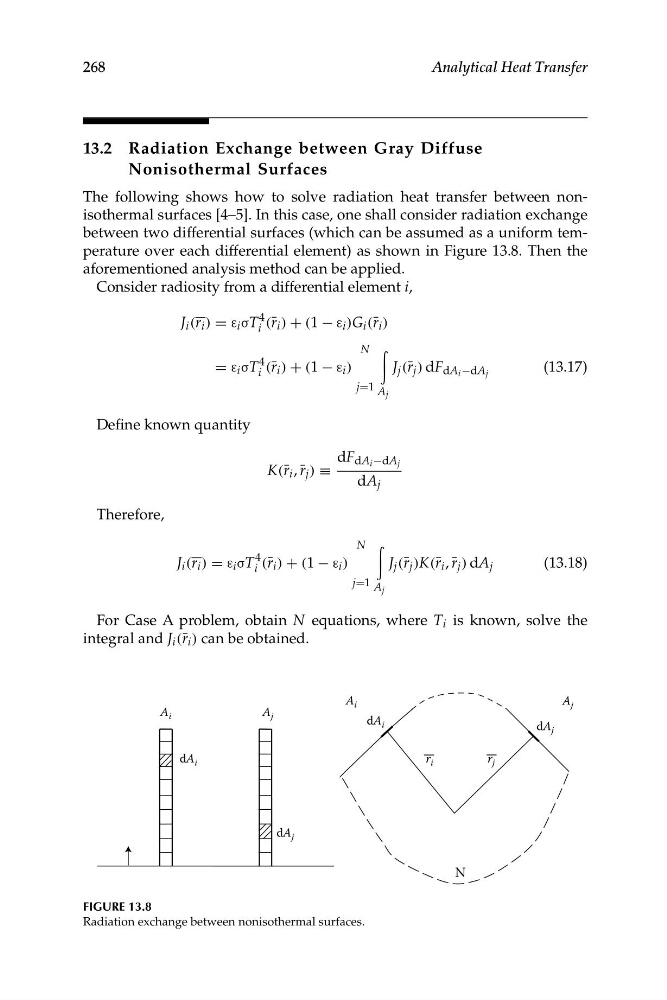
between two differential surfaces (which can be assumed as a uniform temperature over each differential element) as shown in Figure 13.8. Then the
aforementioned analysis method can be applied.
Consider radiosity from a differential element i,
J i (r i ) = ε i σT
4
i (¯ r i ) + (1 − ε i )G i (¯ r i )
= ε i σT
4
i (¯ r i ) + (1 − ε i )
N
j=1
�
A j
J j (¯ r j ) dF dA i −dA j
(13.17)
Define known quantity
K(¯ r i , ¯
r j ) ≡
dF dA i −dA j
dA j
Therefore,
J i (r i ) = ε i σT
4
i (¯ r i ) + (1 − ε i )
N
j=1
�
A j
J j (¯ r j )K(¯ r i , ¯
r j ) dA j
(13.18)
268
Analytical Heat Transfer
For Case A problem, obtain N equations, where T i is known, solve the
integral and J i (r ¯ i ) can be obtained.
dA i
dA i
A j
r j
r i
A j
A i
A i
dA j
dA j
N
FIGURE 13.8
Radiation exchange between nonisothermal surfaces.
Nonisothermal Surfaces
The following shows how to solve radiation heat transfer between nonisothermal surfaces [4–5]. In this case, one shall consider radiation exchange
between two differential surfaces (which can be assumed as a uniform temperature over each differential element) as shown in Figure 13.8. Then the
aforementioned analysis method can be applied.
Consider radiosity from a differential element i,
J i (r i ) = ε i σT
4
i (¯ r i ) + (1 − ε i )G i (¯ r i )
= ε i σT
4
i (¯ r i ) + (1 − ε i )
N
j=1
�
A j
J j (¯ r j ) dF dA i −dA j
(13.17)
Define known quantity
K(¯ r i , ¯
r j ) ≡
dF dA i −dA j
dA j
Therefore,
J i (r i ) = ε i σT
4
i (¯ r i ) + (1 − ε i )
N
j=1
�
A j
J j (¯ r j )K(¯ r i , ¯
r j ) dA j
(13.18)
268
Analytical Heat Transfer
For Case A problem, obtain N equations, where T i is known, solve the
integral and J i (r ¯ i ) can be obtained.
dA i
dA i
A j
r j
r i
A j
A i
A i
dA j
dA j
N
FIGURE 13.8
Radiation exchange between nonisothermal surfaces.