

�
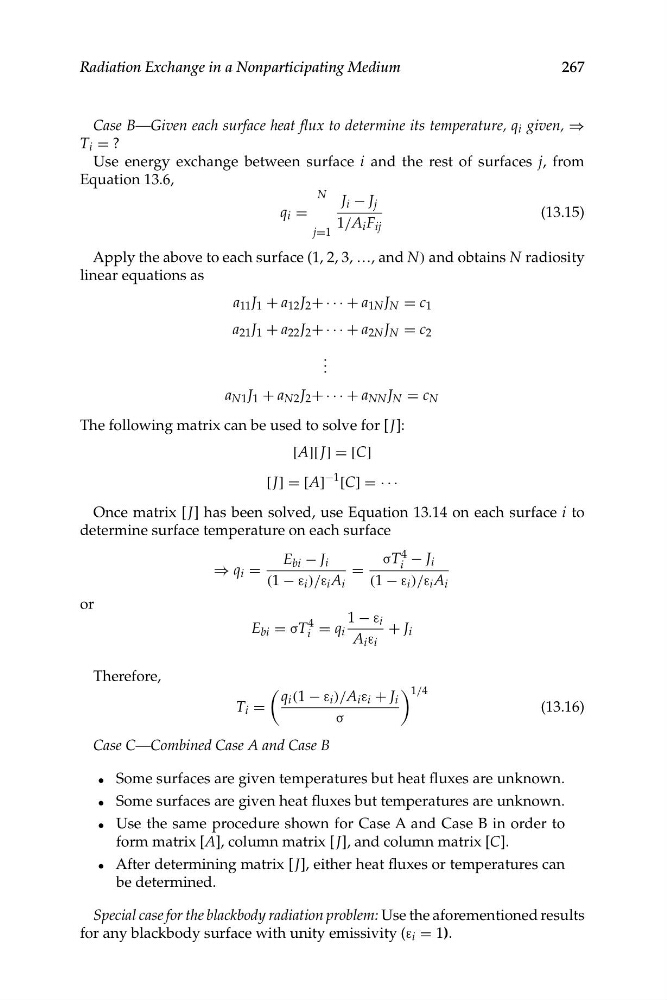
Case B—Given each surface heat flux to determine its temperature, q i given, ⇒
T i = ?
Use energy exchange between surface i and the rest of surfaces j, from
Equation 13.6,
N J i − J j
q i =
(13.15)
1/A i F ij
j=1
Apply the above to each surface (1, 2, 3, …, and N) and obtains N radiosity
linear equations as
a 11 J 1 + a 12 J 2 + · · · + a 1N J N = c 1
a 21 J 1 + a 22 J 2 + · · · + a 2N J N = c 2
. . .
a N1 J 1 + a N2 J 2 + · · · + a NN J N = c N
The following matrix can be used to solve for [ J]:
[A][J] = [C]
[J] = [A]
−1
[C] = · · ·
Once matrix [ J] has been solved, use Equation 13.14 on each surface i to
determine surface temperature on each surface
σT 4 − J i
E bi − J i
i
⇒ q i =
=
(1 − ε i )/ε i A i
(1 − ε i )/ε i A i
or
1 − ε i
E bi = σT i
4
= q i
+ J i
A i ε i
Therefore,
� 1/4
q i (1 − ε i )/A i ε i + J i
T i =
(13.16)
σ
Case C—Combined Case A and Case B
267
Radiation Exchange in a Nonparticipating Medium
• Some surfaces are given temperatures but heat fluxes are unknown.
• Some surfaces are given heat fluxes but temperatures are unknown.
• Use the same procedure shown for Case A and Case B in order to
form matrix [A], column matrix [ J], and column matrix [C].
• After determining matrix [J], either heat fluxes or temperatures can
be determined.
Special case for the blackbody radiation problem: Use the aforementioned results
for any blackbody surface with unity emissivity (ε i = 1).
Case B—Given each surface heat flux to determine its temperature, q i given, ⇒
T i = ?
Use energy exchange between surface i and the rest of surfaces j, from
Equation 13.6,
N J i − J j
q i =
(13.15)
1/A i F ij
j=1
Apply the above to each surface (1, 2, 3, …, and N) and obtains N radiosity
linear equations as
a 11 J 1 + a 12 J 2 + · · · + a 1N J N = c 1
a 21 J 1 + a 22 J 2 + · · · + a 2N J N = c 2
. . .
a N1 J 1 + a N2 J 2 + · · · + a NN J N = c N
The following matrix can be used to solve for [ J]:
[A][J] = [C]
[J] = [A]
−1
[C] = · · ·
Once matrix [ J] has been solved, use Equation 13.14 on each surface i to
determine surface temperature on each surface
σT 4 − J i
E bi − J i
i
⇒ q i =
=
(1 − ε i )/ε i A i
(1 − ε i )/ε i A i
or
1 − ε i
E bi = σT i
4
= q i
+ J i
A i ε i
Therefore,
� 1/4
q i (1 − ε i )/A i ε i + J i
T i =
(13.16)
σ
Case C—Combined Case A and Case B
267
Radiation Exchange in a Nonparticipating Medium
• Some surfaces are given temperatures but heat fluxes are unknown.
• Some surfaces are given heat fluxes but temperatures are unknown.
• Use the same procedure shown for Case A and Case B in order to
form matrix [A], column matrix [ J], and column matrix [C].
• After determining matrix [J], either heat fluxes or temperatures can
be determined.
Special case for the blackbody radiation problem: Use the aforementioned results
for any blackbody surface with unity emissivity (ε i = 1).