

�
�
When J i (r ¯ i ) is determined by using the matrix method, and for given T i (r ¯ i ),
then
( )
q
ε i
(r ¯ i ) =
σT i
4 (r ¯ i ) − J j (r ¯ j )
(13.19)
A i
1 − ε i
can be solved.
Example
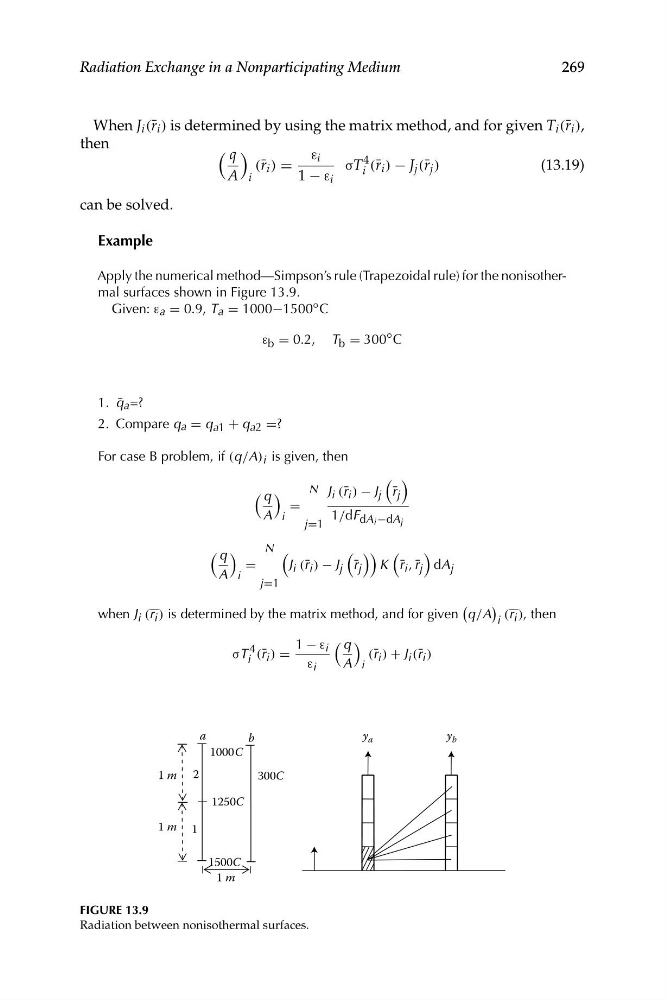
Apply the numerical method—Simpson’s rule (Trapezoidal rule) for the nonisothermal surfaces shown in Figure 13.9.
Given: ε a = 0.9, T a = 1000−1500 ◦ C
ε b = 0.2, T b = 300 ◦ C
1. q ¯ a =?
2. Compare q a = q a1 + q a2 =?
For case B problem, if (q/A) i is given, then
( )
( )
N J i (r ¯ i ) − J j r ¯ j
q =
A i j=1
1/dF dA i −dA j
( )
N (
( )) (
)
q =
¯
K ¯
A i j=1
J i (r ¯ i ) − J j r j
r i , r ¯ j dA j
(
)
when J i (r i ) is determined by the matrix method, and for given q/A i (r i ), then
( )
1 − ε i q
σT i
4 (r ¯ i ) =
(r ¯ i ) + J i (r ¯ i )
ε i
A i
269
Radiation Exchange in a Nonparticipating Medium
a
b
y a
y b
1 m
1 m 1
2
300C
1250C
1000C
1 m
1500C
FIGURE 13.9
Radiation between nonisothermal surfaces.
�
When J i (r ¯ i ) is determined by using the matrix method, and for given T i (r ¯ i ),
then
( )
q
ε i
(r ¯ i ) =
σT i
4 (r ¯ i ) − J j (r ¯ j )
(13.19)
A i
1 − ε i
can be solved.
Example
Apply the numerical method—Simpson’s rule (Trapezoidal rule) for the nonisothermal surfaces shown in Figure 13.9.
Given: ε a = 0.9, T a = 1000−1500 ◦ C
ε b = 0.2, T b = 300 ◦ C
1. q ¯ a =?
2. Compare q a = q a1 + q a2 =?
For case B problem, if (q/A) i is given, then
( )
( )
N J i (r ¯ i ) − J j r ¯ j
q =
A i j=1
1/dF dA i −dA j
( )
N (
( )) (
)
q =
¯
K ¯
A i j=1
J i (r ¯ i ) − J j r j
r i , r ¯ j dA j
(
)
when J i (r i ) is determined by the matrix method, and for given q/A i (r i ), then
( )
1 − ε i q
σT i
4 (r ¯ i ) =
(r ¯ i ) + J i (r ¯ i )
ε i
A i
269
Radiation Exchange in a Nonparticipating Medium
a
b
y a
y b
1 m
1 m 1
2
300C
1250C
1000C
1 m
1500C
FIGURE 13.9
Radiation between nonisothermal surfaces.