

�
�
� 1/4
4 gβ(T w − T ∞ )
y Gr x
η = y
=
(9.6)
4ν 2 x
x
4
where
gβ(T w − T ∞ )x 3
Gr x =
ν 2
Similarity functions for velocity and temperature:
Ψ(x, η)
f (η) =
(9.7)
1/4
4ν (Gr x /4)
T − T ∞
θ =
(9.8)
T w − T ∞
Put them into the above momentum equation and energy equation,
respectively:
∂Ψ
u =
= · · ·
∂y
∂Ψ
v = −
= · · ·
∂x
∂T = · · ·
∂x
∂T = · · ·
∂y
187
Natural Convection
From the above momentum equation, one can see that natural convection is
due to temperature difference between the surface and fluid and the gravity
force. This implies that there is no natural convection if there exists no temperature gradient or no gravity force. The larger delta T and gravity (means larger
Grashof number) will cause larger natural circulation and results in thinner
boundary-layer thickness and higher friction (shear) and higher heat transfer
coefficient. The Grashof number in natural convection plays a similar role
as Reynolds number does in forced convection; the larger Grashof number
causes higher heat transfer in natural convection as the greater Reynolds number has higher heat transfer in forced convection. Prandtl number plays the
same role in both natural and forced convection, basically the fluid property.
Just like in forced convection, both similarity and integral methods can be
used to solve natural convection boundary-layer equations. The following
only outline the similarity method from Ostrach in 1953.
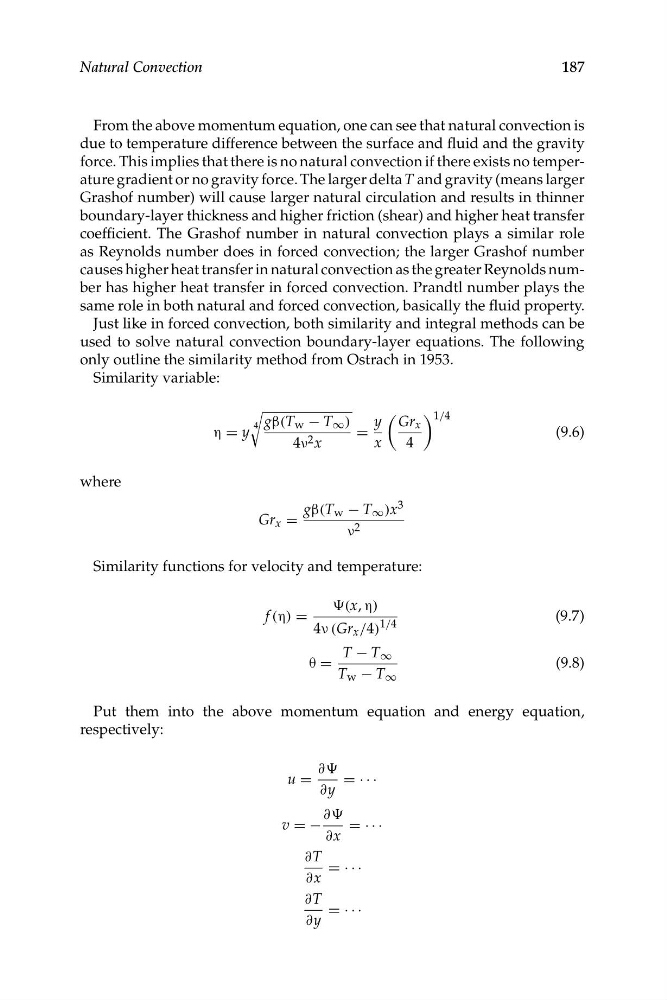
Similarity variable:
�
� 1/4
4 gβ(T w − T ∞ )
y Gr x
η = y
=
(9.6)
4ν 2 x
x
4
where
gβ(T w − T ∞ )x 3
Gr x =
ν 2
Similarity functions for velocity and temperature:
Ψ(x, η)
f (η) =
(9.7)
1/4
4ν (Gr x /4)
T − T ∞
θ =
(9.8)
T w − T ∞
Put them into the above momentum equation and energy equation,
respectively:
∂Ψ
u =
= · · ·
∂y
∂Ψ
v = −
= · · ·
∂x
∂T = · · ·
∂x
∂T = · · ·
∂y
187
Natural Convection
From the above momentum equation, one can see that natural convection is
due to temperature difference between the surface and fluid and the gravity
force. This implies that there is no natural convection if there exists no temperature gradient or no gravity force. The larger delta T and gravity (means larger
Grashof number) will cause larger natural circulation and results in thinner
boundary-layer thickness and higher friction (shear) and higher heat transfer
coefficient. The Grashof number in natural convection plays a similar role
as Reynolds number does in forced convection; the larger Grashof number
causes higher heat transfer in natural convection as the greater Reynolds number has higher heat transfer in forced convection. Prandtl number plays the
same role in both natural and forced convection, basically the fluid property.
Just like in forced convection, both similarity and integral methods can be
used to solve natural convection boundary-layer equations. The following
only outline the similarity method from Ostrach in 1953.
Similarity variable: