

�
�
�
�
�
�
∗
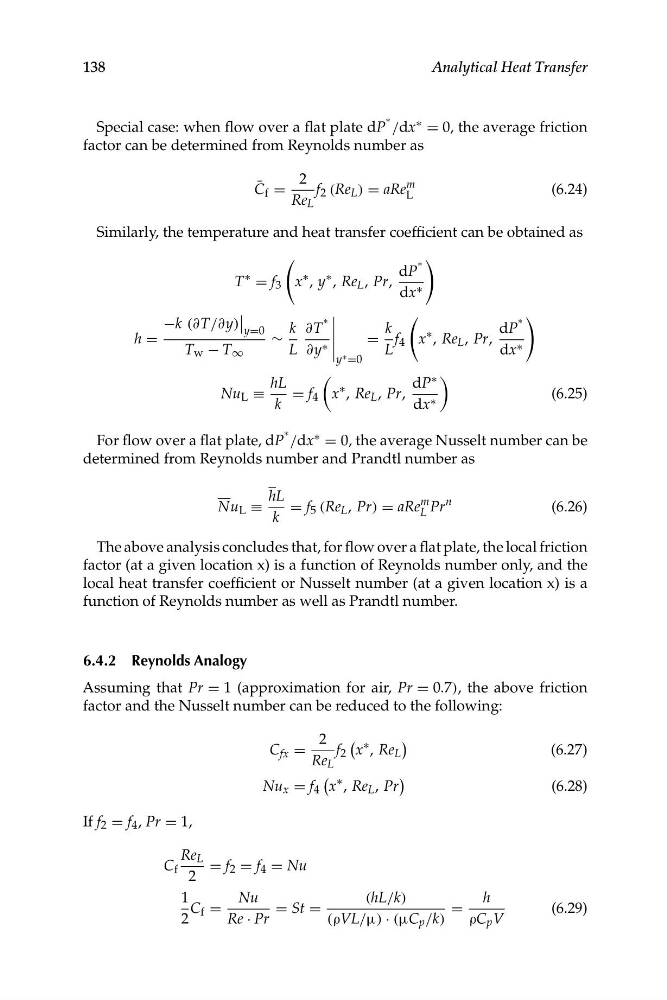
Special case: when flow over a flat plate dP
∗ /dx = 0, the average friction
factor can be determined from Reynolds number as
2
¯
C f =
f 2 (Re L ) = aRe L
m
(6.24)
Re L
Similarly, the temperature and heat transfer coefficient can be obtained as
�
∗
�
∗
∗
T
∗
= f 3 x , y , Re L , Pr,
dP
dx ∗
�
∗
∗
−k (∂T/∂y)
�
y=0
k ∂T �
k
dP
∗
h =
∼
�
= f 4 x , Re L , Pr,
T w − T ∞
L ∂y ∗ �
L
dx ∗
y ∗ =0
hL
dP ∗
∗
Nu L ≡
= f 4 x , Re L , Pr,
(6.25)
k
dx ∗
∗
For flow over a flat plate, dP
∗ /dx = 0, the average Nusselt number can be
determined from Reynolds number and Prandtl number as
hL
Nu L ≡
= f 5 (Re L , Pr) = aRe L
m Pr
n
(6.26)
k
138
Analytical Heat Transfer
The above analysis concludes that, for flow over a flat plate, the local friction
factor (at a given location x) is a function of Reynolds number only, and the
local heat transfer coefficient or Nusselt number (at a given location x) is a
function of Reynolds number as well as Prandtl number.
6.4.2 Reynolds Analogy
Assuming that Pr = 1 (approximation for air, Pr = 0.7), the above friction
factor and the Nusselt number can be reduced to the following:
2
(
)
∗
C fx =
f 2 x , Re L
(6.27)
Re L
(
)
∗
Nu x = f 4 x , Re L , Pr
(6.28)
If f 2 = f 4 , Pr = 1,
Re L
C f
= f 2 = f 4 = Nu
2
1
Nu
(hL/k)
h
C f =
= St =
=
(6.29)
2
Re · Pr
(ρVL/μ) · (μC p /k)
ρC p V
�
�
�
�
�
∗
Special case: when flow over a flat plate dP
∗ /dx = 0, the average friction
factor can be determined from Reynolds number as
2
¯
C f =
f 2 (Re L ) = aRe L
m
(6.24)
Re L
Similarly, the temperature and heat transfer coefficient can be obtained as
�
∗
�
∗
∗
T
∗
= f 3 x , y , Re L , Pr,
dP
dx ∗
�
∗
∗
−k (∂T/∂y)
�
y=0
k ∂T �
k
dP
∗
h =
∼
�
= f 4 x , Re L , Pr,
T w − T ∞
L ∂y ∗ �
L
dx ∗
y ∗ =0
hL
dP ∗
∗
Nu L ≡
= f 4 x , Re L , Pr,
(6.25)
k
dx ∗
∗
For flow over a flat plate, dP
∗ /dx = 0, the average Nusselt number can be
determined from Reynolds number and Prandtl number as
hL
Nu L ≡
= f 5 (Re L , Pr) = aRe L
m Pr
n
(6.26)
k
138
Analytical Heat Transfer
The above analysis concludes that, for flow over a flat plate, the local friction
factor (at a given location x) is a function of Reynolds number only, and the
local heat transfer coefficient or Nusselt number (at a given location x) is a
function of Reynolds number as well as Prandtl number.
6.4.2 Reynolds Analogy
Assuming that Pr = 1 (approximation for air, Pr = 0.7), the above friction
factor and the Nusselt number can be reduced to the following:
2
(
)
∗
C fx =
f 2 x , Re L
(6.27)
Re L
(
)
∗
Nu x = f 4 x , Re L , Pr
(6.28)
If f 2 = f 4 , Pr = 1,
Re L
C f
= f 2 = f 4 = Nu
2
1
Nu
(hL/k)
h
C f =
= St =
=
(6.29)
2
Re · Pr
(ρVL/μ) · (μC p /k)
ρC p V