

�
�
�
�
�
�
�
�
�
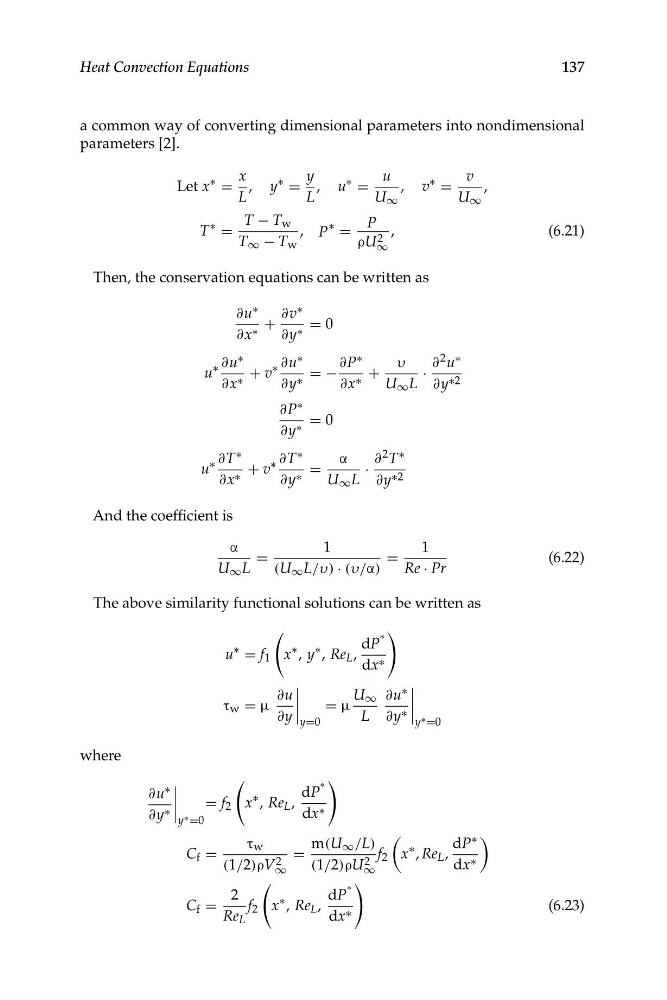
a common way of converting dimensional parameters into nondimensional
parameters [2].
x
y
u
v
∗
∗
∗
∗
Let x = , y = , u =
, v =
,
L
L
U ∞
U ∞
T − T w
∗
P
T
∗
=
, P =
,
(6.21)
T ∞ − T w
ρU 2
∞
Then, the conservation equations can be written as
∗
∗
∂u
∂v
+
= 0
∂x ∗
∂y ∗
∗
∗
∗
∗ ∂u
∗ ∂u
∂P ∗
υ
∂ 2 u
u
+ v
= −
+
·
∂x ∗
∂y ∗
∂x ∗
U ∞ L ∂y ∗2
∂P ∗
= 0
∂y ∗
∗ ∂T ∗
∗ ∂T ∗
α
∂ 2 T ∗
u
+ v
=
·
∂x ∗
∂y ∗
U ∞ L ∂y ∗2
And the coefficient is
α
1
1
=
=
(6.22)
U ∞ L
(U ∞ L/υ) · (υ/α)
Re · Pr
The above similarity functional solutions can be written as
�
∗
�
dP
∗
∗
∗
u = f 1 x , y , Re L , dx ∗
∗
∂u �
U ∞ ∂u �
τ w = μ
= μ
∂y
L ∂y ∗
y=0
y ∗ =0
where
�
�
∗
�
∗
∂u �
dP
∗
�
= f 2 x , Re L ,
∂y ∗
dx ∗
y ∗ =0
τ w
m(U ∞ /L)
dP ∗
∗
C f =
=
f 2 x , Re L ,
(1/2)ρV 2
(1/2)ρU 2
dx ∗
∞
∞
�
∗
�
2
dP
∗
C f =
f 2 x , Re L ,
(6.23)
Re L
dx ∗
137
Heat Convection Equations
�
�
�
�
�
�
�
�
a common way of converting dimensional parameters into nondimensional
parameters [2].
x
y
u
v
∗
∗
∗
∗
Let x = , y = , u =
, v =
,
L
L
U ∞
U ∞
T − T w
∗
P
T
∗
=
, P =
,
(6.21)
T ∞ − T w
ρU 2
∞
Then, the conservation equations can be written as
∗
∗
∂u
∂v
+
= 0
∂x ∗
∂y ∗
∗
∗
∗
∗ ∂u
∗ ∂u
∂P ∗
υ
∂ 2 u
u
+ v
= −
+
·
∂x ∗
∂y ∗
∂x ∗
U ∞ L ∂y ∗2
∂P ∗
= 0
∂y ∗
∗ ∂T ∗
∗ ∂T ∗
α
∂ 2 T ∗
u
+ v
=
·
∂x ∗
∂y ∗
U ∞ L ∂y ∗2
And the coefficient is
α
1
1
=
=
(6.22)
U ∞ L
(U ∞ L/υ) · (υ/α)
Re · Pr
The above similarity functional solutions can be written as
�
∗
�
dP
∗
∗
∗
u = f 1 x , y , Re L , dx ∗
∗
∂u �
U ∞ ∂u �
τ w = μ
= μ
∂y
L ∂y ∗
y=0
y ∗ =0
where
�
�
∗
�
∗
∂u �
dP
∗
�
= f 2 x , Re L ,
∂y ∗
dx ∗
y ∗ =0
τ w
m(U ∞ /L)
dP ∗
∗
C f =
=
f 2 x , Re L ,
(1/2)ρV 2
(1/2)ρU 2
dx ∗
∞
∞
�
∗
�
2
dP
∗
C f =
f 2 x , Re L ,
(6.23)
Re L
dx ∗
137
Heat Convection Equations