

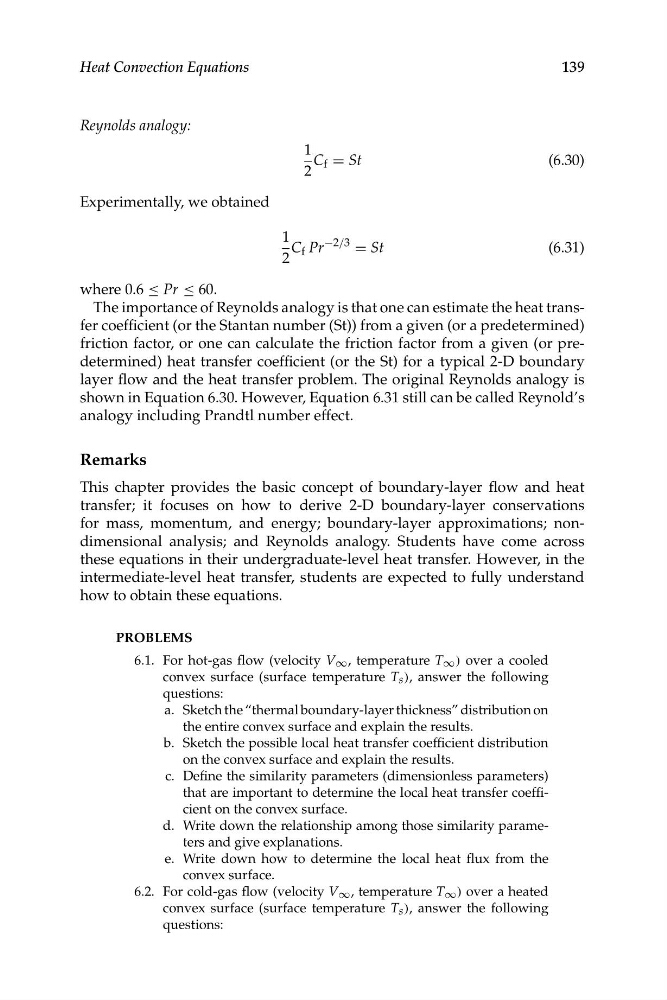
Reynolds analogy:
1 C f = St
(6.30)
2
Experimentally, we obtained
1 C f Pr
−2/3
= St
(6.31)
2
139
Heat Convection Equations
where 0.6 ≤ Pr ≤ 60.
The importance of Reynolds analogy is that one can estimate the heat transfer coefficient (or the Stantan number (St)) from a given (or a predetermined)
friction factor, or one can calculate the friction factor from a given (or predetermined) heat transfer coefficient (or the St) for a typical 2-D boundary
layer flow and the heat transfer problem. The original Reynolds analogy is
shown in Equation 6.30. However, Equation 6.31 still can be called Reynold’s
analogy including Prandtl number effect.
Remarks
This chapter provides the basic concept of boundary-layer flow and heat
transfer; it focuses on how to derive 2-D boundary-layer conservations
for mass, momentum, and energy; boundary-layer approximations; nondimensional analysis; and Reynolds analogy. Students have come across
these equations in their undergraduate-level heat transfer. However, in the
intermediate-level heat transfer, students are expected to fully understand
how to obtain these equations.
PROBLEMS
6.1. For hot-gas flow (velocity V ∞ , temperature T ∞ ) over a cooled
convex surface (surface temperature T s ), answer the following
questions:
a. Sketch the “thermal boundary-layer thickness” distribution on
the entire convex surface and explain the results.
b. Sketch the possible local heat transfer coefficient distribution
on the convex surface and explain the results.
c. Define the similarity parameters (dimensionless parameters)
that are important to determine the local heat transfer coefficient on the convex surface.
d. Write down the relationship among those similarity parameters and give explanations.
e. Write down how to determine the local heat flux from the
convex surface.
6.2. For cold-gas flow (velocity V ∞ , temperature T ∞ ) over a heated
convex surface (surface temperature T s ), answer the following
questions:
1 C f = St
(6.30)
2
Experimentally, we obtained
1 C f Pr
−2/3
= St
(6.31)
2
139
Heat Convection Equations
where 0.6 ≤ Pr ≤ 60.
The importance of Reynolds analogy is that one can estimate the heat transfer coefficient (or the Stantan number (St)) from a given (or a predetermined)
friction factor, or one can calculate the friction factor from a given (or predetermined) heat transfer coefficient (or the St) for a typical 2-D boundary
layer flow and the heat transfer problem. The original Reynolds analogy is
shown in Equation 6.30. However, Equation 6.31 still can be called Reynold’s
analogy including Prandtl number effect.
Remarks
This chapter provides the basic concept of boundary-layer flow and heat
transfer; it focuses on how to derive 2-D boundary-layer conservations
for mass, momentum, and energy; boundary-layer approximations; nondimensional analysis; and Reynolds analogy. Students have come across
these equations in their undergraduate-level heat transfer. However, in the
intermediate-level heat transfer, students are expected to fully understand
how to obtain these equations.
PROBLEMS
6.1. For hot-gas flow (velocity V ∞ , temperature T ∞ ) over a cooled
convex surface (surface temperature T s ), answer the following
questions:
a. Sketch the “thermal boundary-layer thickness” distribution on
the entire convex surface and explain the results.
b. Sketch the possible local heat transfer coefficient distribution
on the convex surface and explain the results.
c. Define the similarity parameters (dimensionless parameters)
that are important to determine the local heat transfer coefficient on the convex surface.
d. Write down the relationship among those similarity parameters and give explanations.
e. Write down how to determine the local heat flux from the
convex surface.
6.2. For cold-gas flow (velocity V ∞ , temperature T ∞ ) over a heated
convex surface (surface temperature T s ), answer the following
questions: