

Laminar
flow
δ
Turbulent
U ∞
,V ∞
(x)
u (x, y)
U ∞
y
U ∞
x
flow
�
�
Shear stress
∂u �
1
�
(ρU
2
τ w = μ
= C f ·
∞ − 0)
∂y
2
y=0
Friction coefficient:
τ w
τ w
μ(∂u/∂y)| y=0
μ (U ∞ /δ)
1
C f =
=
=
∼
∼ ν
(1/2)ρU 2
(1/2)ρU 2
ρ U 2
(1/2)(ρU ∞
2 − 0)
∞
∞
∞
δU ∞
C f is a function of Reynolds number, that is,
C f = aRe
b ; C f = aRe
b
∼
1 ;
Re
126
Analytical Heat Transfer
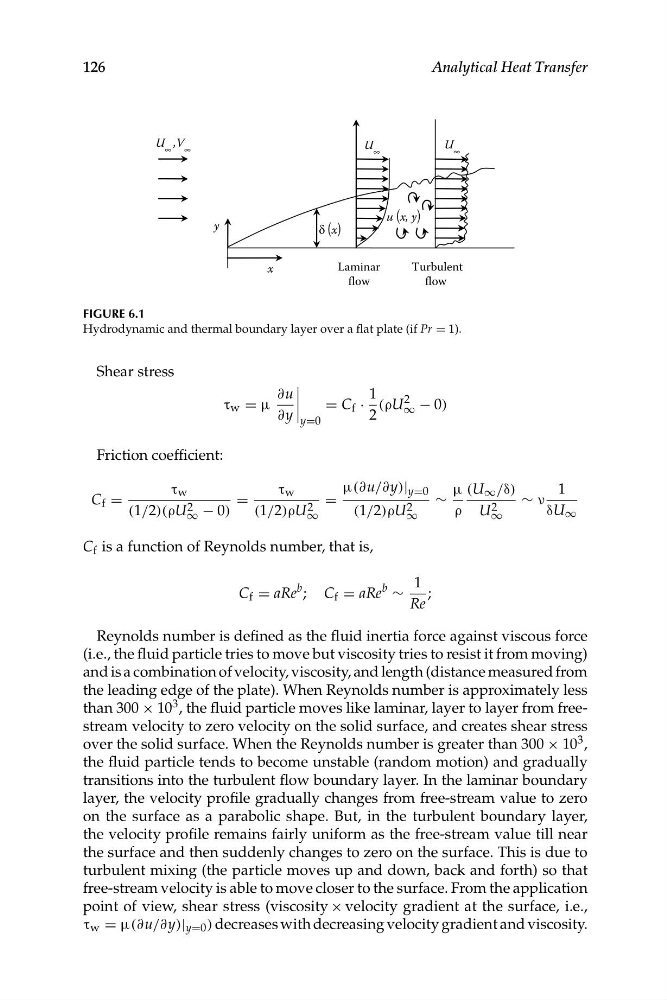
FIGURE 6.1
Hydrodynamic and thermal boundary layer over a flat plate (if Pr = 1).
Reynolds number is defined as the fluid inertia force against viscous force
(i.e., the fluid particle tries to move but viscosity tries to resist it from moving)
and is a combination of velocity, viscosity, and length (distance measured from
the leading edge of the plate). When Reynolds number is approximately less
than 300 × 10 3 , the fluid particle moves like laminar, layer to layer from freestream velocity to zero velocity on the solid surface, and creates shear stress
over the solid surface. When the Reynolds number is greater than 300 × 10 3 ,
the fluid particle tends to become unstable (random motion) and gradually
transitions into the turbulent flow boundary layer. In the laminar boundary
layer, the velocity profile gradually changes from free-stream value to zero
on the surface as a parabolic shape. But, in the turbulent boundary layer,
the velocity profile remains fairly uniform as the free-stream value till near
the surface and then suddenly changes to zero on the surface. This is due to
turbulent mixing (the particle moves up and down, back and forth) so that
free-stream velocity is able to move closer to the surface. From the application
point of view, shear stress (viscosity × velocity gradient at the surface, i.e.,
τ w = μ(∂u/∂y)| y=0 ) decreases with decreasing velocity gradient and viscosity.
flow
δ
Turbulent
U ∞
,V ∞
(x)
u (x, y)
U ∞
y
U ∞
x
flow
�
�
Shear stress
∂u �
1
�
(ρU
2
τ w = μ
= C f ·
∞ − 0)
∂y
2
y=0
Friction coefficient:
τ w
τ w
μ(∂u/∂y)| y=0
μ (U ∞ /δ)
1
C f =
=
=
∼
∼ ν
(1/2)ρU 2
(1/2)ρU 2
ρ U 2
(1/2)(ρU ∞
2 − 0)
∞
∞
∞
δU ∞
C f is a function of Reynolds number, that is,
C f = aRe
b ; C f = aRe
b
∼
1 ;
Re
126
Analytical Heat Transfer
FIGURE 6.1
Hydrodynamic and thermal boundary layer over a flat plate (if Pr = 1).
Reynolds number is defined as the fluid inertia force against viscous force
(i.e., the fluid particle tries to move but viscosity tries to resist it from moving)
and is a combination of velocity, viscosity, and length (distance measured from
the leading edge of the plate). When Reynolds number is approximately less
than 300 × 10 3 , the fluid particle moves like laminar, layer to layer from freestream velocity to zero velocity on the solid surface, and creates shear stress
over the solid surface. When the Reynolds number is greater than 300 × 10 3 ,
the fluid particle tends to become unstable (random motion) and gradually
transitions into the turbulent flow boundary layer. In the laminar boundary
layer, the velocity profile gradually changes from free-stream value to zero
on the surface as a parabolic shape. But, in the turbulent boundary layer,
the velocity profile remains fairly uniform as the free-stream value till near
the surface and then suddenly changes to zero on the surface. This is due to
turbulent mixing (the particle moves up and down, back and forth) so that
free-stream velocity is able to move closer to the surface. From the application
point of view, shear stress (viscosity × velocity gradient at the surface, i.e.,
τ w = μ(∂u/∂y)| y=0 ) decreases with decreasing velocity gradient and viscosity.