

127
Heat Convection Equations
Laminar
flow
τ w
Turbulent
flow
Transition
U ∞
0
x
U ∞
U ∞
0
δ
δ
δ
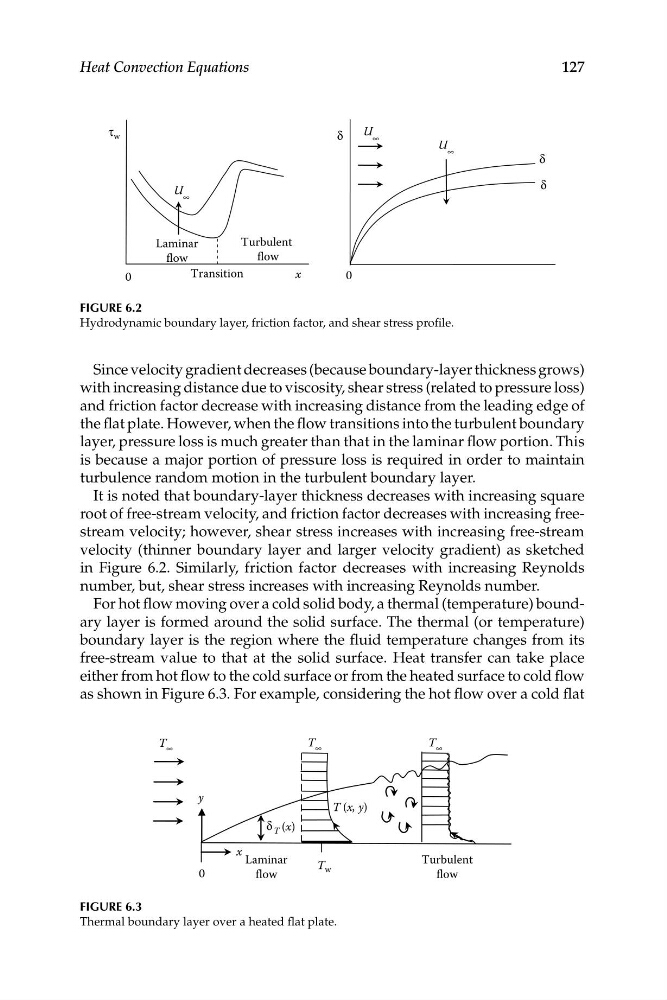
FIGURE 6.2
Hydrodynamic boundary layer, friction factor, and shear stress profile.
Since velocity gradient decreases (because boundary-layer thickness grows)
with increasing distance due to viscosity, shear stress (related to pressure loss)
and friction factor decrease with increasing distance from the leading edge of
the flat plate. However, when the flow transitions into the turbulent boundary
layer, pressure loss is much greater than that in the laminar flow portion. This
is because a major portion of pressure loss is required in order to maintain
turbulence random motion in the turbulent boundary layer.
It is noted that boundary-layer thickness decreases with increasing square
root of free-stream velocity, and friction factor decreases with increasing freestream velocity; however, shear stress increases with increasing free-stream
velocity (thinner boundary layer and larger velocity gradient) as sketched
in Figure 6.2. Similarly, friction factor decreases with increasing Reynolds
number, but, shear stress increases with increasing Reynolds number.
For hot flow moving over a cold solid body, a thermal (temperature) boundary layer is formed around the solid surface. The thermal (or temperature)
boundary layer is the region where the fluid temperature changes from its
free-stream value to that at the solid surface. Heat transfer can take place
either from hot flow to the cold surface or from the heated surface to cold flow
as shown in Figure 6.3. For example, considering the hot flow over a cold flat
Laminar
flow
Turbulent
flow
T ∞
T ∞
x
0
T w
y
T (x)
T ∞
T (x, y)
δ
FIGURE 6.3
Thermal boundary layer over a heated flat plate.
Heat Convection Equations
Laminar
flow
τ w
Turbulent
flow
Transition
U ∞
0
x
U ∞
U ∞
0
δ
δ
δ
FIGURE 6.2
Hydrodynamic boundary layer, friction factor, and shear stress profile.
Since velocity gradient decreases (because boundary-layer thickness grows)
with increasing distance due to viscosity, shear stress (related to pressure loss)
and friction factor decrease with increasing distance from the leading edge of
the flat plate. However, when the flow transitions into the turbulent boundary
layer, pressure loss is much greater than that in the laminar flow portion. This
is because a major portion of pressure loss is required in order to maintain
turbulence random motion in the turbulent boundary layer.
It is noted that boundary-layer thickness decreases with increasing square
root of free-stream velocity, and friction factor decreases with increasing freestream velocity; however, shear stress increases with increasing free-stream
velocity (thinner boundary layer and larger velocity gradient) as sketched
in Figure 6.2. Similarly, friction factor decreases with increasing Reynolds
number, but, shear stress increases with increasing Reynolds number.
For hot flow moving over a cold solid body, a thermal (temperature) boundary layer is formed around the solid surface. The thermal (or temperature)
boundary layer is the region where the fluid temperature changes from its
free-stream value to that at the solid surface. Heat transfer can take place
either from hot flow to the cold surface or from the heated surface to cold flow
as shown in Figure 6.3. For example, considering the hot flow over a cold flat
Laminar
flow
Turbulent
flow
T ∞
T ∞
x
0
T w
y
T (x)
T ∞
T (x, y)
δ
FIGURE 6.3
Thermal boundary layer over a heated flat plate.