

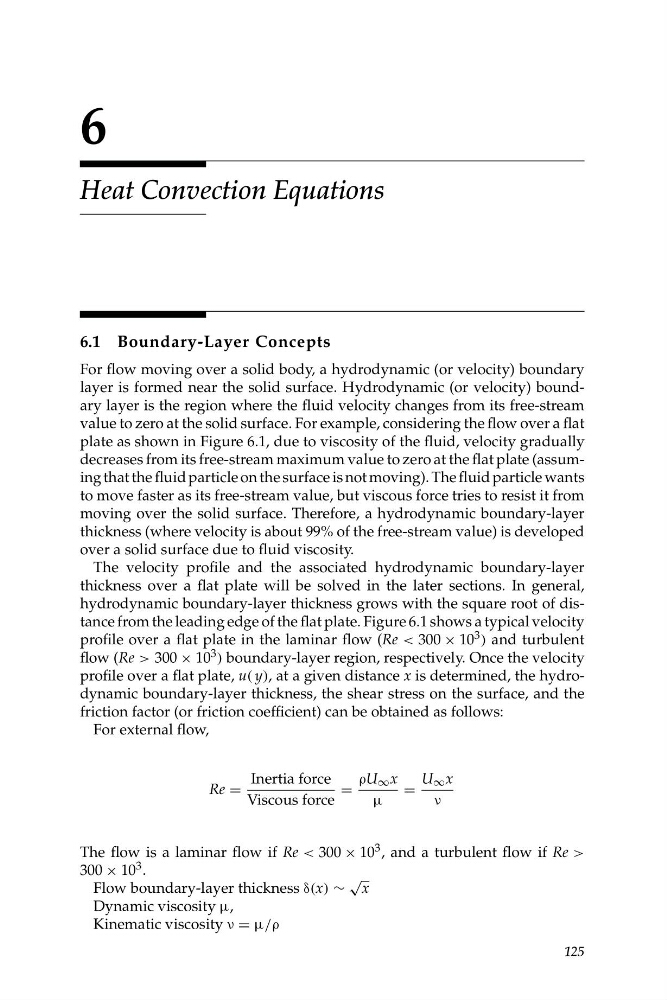
6
Heat Convection Equations
6.1 Boundary-Layer Concepts
For flow moving over a solid body, a hydrodynamic (or velocity) boundary
layer is formed near the solid surface. Hydrodynamic (or velocity) boundary layer is the region where the fluid velocity changes from its free-stream
value to zero at the solid surface. For example, considering the flow over a flat
plate as shown in Figure 6.1, due to viscosity of the fluid, velocity gradually
decreases from its free-stream maximum value to zero at the flat plate (assuming that the fluid particle on the surface is not moving). The fluid particle wants
to move faster as its free-stream value, but viscous force tries to resist it from
moving over the solid surface. Therefore, a hydrodynamic boundary-layer
thickness (where velocity is about 99% of the free-stream value) is developed
over a solid surface due to fluid viscosity.
The velocity profile and the associated hydrodynamic boundary-layer
thickness over a flat plate will be solved in the later sections. In general,
hydrodynamic boundary-layer thickness grows with the square root of distance from the leading edge of the flat plate. Figure 6.1 shows a typical velocity
profile over a flat plate in the laminar flow (Re < 300 × 10 3 ) and turbulent
flow (Re > 300 × 10 3 ) boundary-layer region, respectively. Once the velocity
profile over a flat plate, u( y), at a given distance x is determined, the hydrodynamic boundary-layer thickness, the shear stress on the surface, and the
friction factor (or friction coefficient) can be obtained as follows:
For external flow,
Inertia force
ρU ∞ x
U ∞ x
Re =
=
=
Viscous force
μ
ν
The flow is a laminar flow if Re < 300 × 10 3 , and a turbulent flow if Re >
300 × 10 3 .
√
Flow boundary-layer thickness δ(x) ∼ x
Dynamic viscosity μ,
Kinematic viscosity ν = μ/ρ
125
Heat Convection Equations
6.1 Boundary-Layer Concepts
For flow moving over a solid body, a hydrodynamic (or velocity) boundary
layer is formed near the solid surface. Hydrodynamic (or velocity) boundary layer is the region where the fluid velocity changes from its free-stream
value to zero at the solid surface. For example, considering the flow over a flat
plate as shown in Figure 6.1, due to viscosity of the fluid, velocity gradually
decreases from its free-stream maximum value to zero at the flat plate (assuming that the fluid particle on the surface is not moving). The fluid particle wants
to move faster as its free-stream value, but viscous force tries to resist it from
moving over the solid surface. Therefore, a hydrodynamic boundary-layer
thickness (where velocity is about 99% of the free-stream value) is developed
over a solid surface due to fluid viscosity.
The velocity profile and the associated hydrodynamic boundary-layer
thickness over a flat plate will be solved in the later sections. In general,
hydrodynamic boundary-layer thickness grows with the square root of distance from the leading edge of the flat plate. Figure 6.1 shows a typical velocity
profile over a flat plate in the laminar flow (Re < 300 × 10 3 ) and turbulent
flow (Re > 300 × 10 3 ) boundary-layer region, respectively. Once the velocity
profile over a flat plate, u( y), at a given distance x is determined, the hydrodynamic boundary-layer thickness, the shear stress on the surface, and the
friction factor (or friction coefficient) can be obtained as follows:
For external flow,
Inertia force
ρU ∞ x
U ∞ x
Re =
=
=
Viscous force
μ
ν
The flow is a laminar flow if Re < 300 × 10 3 , and a turbulent flow if Re >
300 × 10 3 .
√
Flow boundary-layer thickness δ(x) ∼ x
Dynamic viscosity μ,
Kinematic viscosity ν = μ/ρ
125