

63
400
80
300
70
0
40
60 70 80 90
SAR (W/kg)
30 40 50
0.3 mm
0.4 mm
0.35 mm
60 70 80 90
Frequency (GHz)
Frequency (GHz)
(a)
(b)
SAR (W/kg)
30 40 50
0.0 mm
0.1 mm
200
60
100
50
Coupling of Electromagnetic Fields into Biological Systems
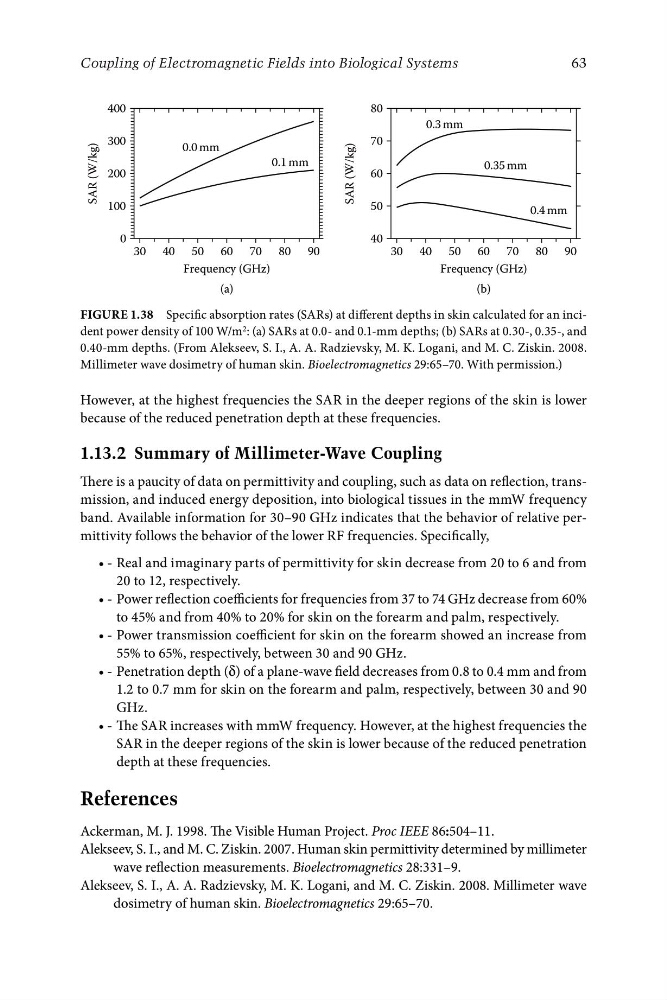
FigurE 1.38 Specific absorption rates (SARs) at different depths in skin calculated for an incident power density of 100 W/m 2 : (a) SARs at 0.0- and 0.1-mm depths; (b) SARs at 0.30-, 0.35-, and
0.40-mm depths. (From Alekseev, S. I., A. A. Radzievsky, M. K. Logani, and M. C. Ziskin. 2008.
Millimeter wave dosimetry of human skin. Bioelectromagnetics 29:65–70. With permission.)
However, at the highest frequencies the SAR in the deeper regions of the skin is lower
because of the reduced penetration depth at these frequencies.
1.13.2 Summary of Millimeter-Wave Coupling
There is a paucity of data on permittivity and coupling, such as data on reflection, transmission, and induced energy deposition, into biological tissues in the mmW frequency
band. Available information for 30–90 GHz indicates that the behavior of relative permittivity follows the behavior of the lower RF frequencies. Specifically,
• Real and imaginary parts of permittivity for skin decrease from 20 to 6 and from
20 to 12, respectively.
• Power reflection coefficients for frequencies from 37 to 74 GHz decrease from 60%
to 45% and from 40% to 20% for skin on the forearm and palm, respectively.
• Power transmission coefficient for skin on the forearm showed an increase from
55% to 65%, respectively, between 30 and 90 GHz.
• Penetration depth (δ) of a plane-wave field decreases from 0.8 to 0.4 mm and from
1.2 to 0.7 mm for skin on the forearm and palm, respectively, between 30 and 90
GHz.
• The SAR increases with mmW frequency. However, at the highest frequencies the
SAR in the deeper regions of the skin is lower because of the reduced penetration
depth at these frequencies.
References
Ackerman, M. J. 1998. The Visible Human Project. Proc IEEE 86:504–11.
Alekseev, S. I., and M. C. Ziskin. 2007. Human skin permittivity determined by millimeter
wave reflection measurements. Bioelectromagnetics 28:331–9.
Alekseev, S. I., A. A. Radzievsky, M. K. Logani, and M. C. Ziskin. 2008. Millimeter wave
dosimetry of human skin. Bioelectromagnetics 29:65–70.
400
80
300
70
0
40
60 70 80 90
SAR (W/kg)
30 40 50
0.3 mm
0.4 mm
0.35 mm
60 70 80 90
Frequency (GHz)
Frequency (GHz)
(a)
(b)
SAR (W/kg)
30 40 50
0.0 mm
0.1 mm
200
60
100
50
Coupling of Electromagnetic Fields into Biological Systems
FigurE 1.38 Specific absorption rates (SARs) at different depths in skin calculated for an incident power density of 100 W/m 2 : (a) SARs at 0.0- and 0.1-mm depths; (b) SARs at 0.30-, 0.35-, and
0.40-mm depths. (From Alekseev, S. I., A. A. Radzievsky, M. K. Logani, and M. C. Ziskin. 2008.
Millimeter wave dosimetry of human skin. Bioelectromagnetics 29:65–70. With permission.)
However, at the highest frequencies the SAR in the deeper regions of the skin is lower
because of the reduced penetration depth at these frequencies.
1.13.2 Summary of Millimeter-Wave Coupling
There is a paucity of data on permittivity and coupling, such as data on reflection, transmission, and induced energy deposition, into biological tissues in the mmW frequency
band. Available information for 30–90 GHz indicates that the behavior of relative permittivity follows the behavior of the lower RF frequencies. Specifically,
• Real and imaginary parts of permittivity for skin decrease from 20 to 6 and from
20 to 12, respectively.
• Power reflection coefficients for frequencies from 37 to 74 GHz decrease from 60%
to 45% and from 40% to 20% for skin on the forearm and palm, respectively.
• Power transmission coefficient for skin on the forearm showed an increase from
55% to 65%, respectively, between 30 and 90 GHz.
• Penetration depth (δ) of a plane-wave field decreases from 0.8 to 0.4 mm and from
1.2 to 0.7 mm for skin on the forearm and palm, respectively, between 30 and 90
GHz.
• The SAR increases with mmW frequency. However, at the highest frequencies the
SAR in the deeper regions of the skin is lower because of the reduced penetration
depth at these frequencies.
References
Ackerman, M. J. 1998. The Visible Human Project. Proc IEEE 86:504–11.
Alekseev, S. I., and M. C. Ziskin. 2007. Human skin permittivity determined by millimeter
wave reflection measurements. Bioelectromagnetics 28:331–9.
Alekseev, S. I., A. A. Radzievsky, M. K. Logani, and M. C. Ziskin. 2008. Millimeter wave
dosimetry of human skin. Bioelectromagnetics 29:65–70.