

T 1 = 1 microsec
=
Time (sec) (×10
4
)
Transmitted pulse (V/m) (×10 3
)
R = 3.5 cm
R = 1.75 cm
R = 0 cm
R = −1.75 cm
R −3.5 cm
−.02
−.01
.01
.02
.03
−.03
−.12
−.07
−.02
.02
.07
.12
52
Electromagnetic Fields in Biological Systems
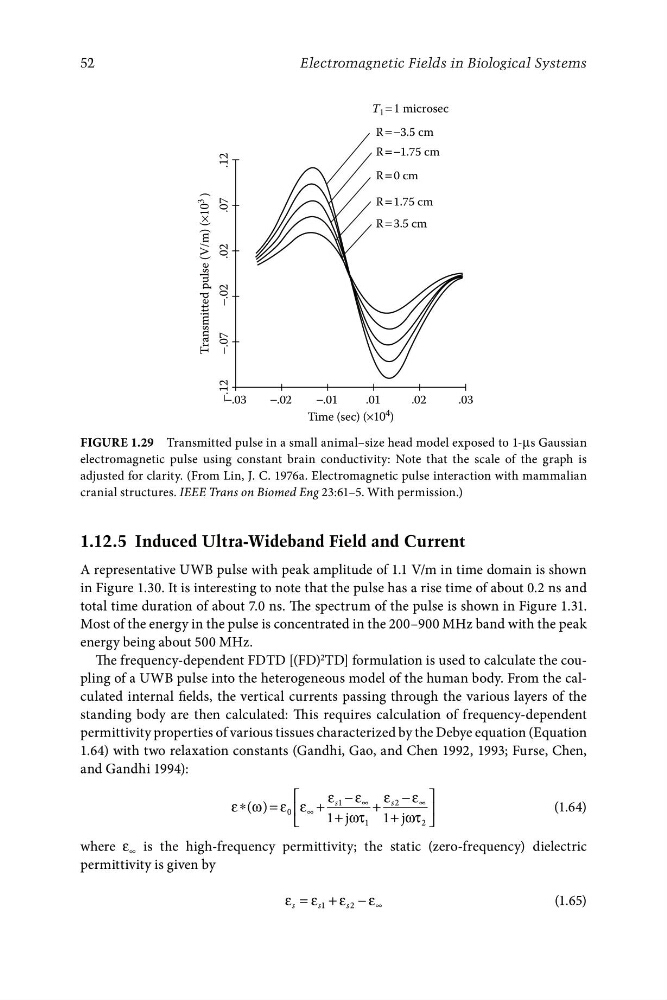
FigurE 1.29 Transmitted pulse in a small animal–size head model exposed to 1-μs Gaussian
electromagnetic pulse using constant brain conductivity: Note that the scale of the graph is
adjusted for clarity. (From Lin, J. C. 1976a. Electromagnetic pulse interaction with mammalian
cranial structures. IEEE Trans on Biomed Eng 23:61–5. With permission.)
1.12.5 Induced Ultra-Wideband Field and Current
A representative UWB pulse with peak amplitude of 1.1 V/m in time domain is shown
in Figure 1.30. It is interesting to note that the pulse has a rise time of about 0.2 ns and
total time duration of about 7.0 ns. The spectrum of the pulse is shown in Figure 1.31.
Most of the energy in the pulse is concentrated in the 200–900 MHz band with the peak
energy being about 500 MHz.
The frequency-dependent FDTD [(FD) 2 TD] formulation is used to calculate the coupling of a UWB pulse into the heterogeneous model of the human body. From the calculated internal fields, the vertical currents passing through the various layers of the
standing body are then calculated: This requires calculation of frequency-dependent
permittivity properties of various tissues characterized by the Debye equation (Equation
1.64) with two relaxation constants (Gandhi, Gao, and Chen 1992, 1993; Furse, Chen,
and Gandhi 1994):
⎡
ε − ε
ε − ε ⎤
s1
∞
s 2
∞
ε ω = ε ε
(1.64)
∗( ) 0 ⎢ ∞ +
+
⎥
⎣
1+ jωτ 1 1+ jωτ 2 ⎦
where ε ∞ is the high-frequency permittivity; the static (zero-frequency) dielectric
permittivity is given by
ε s = ε s1 + ε s 2 − ε ∞
(1.65)
=
Time (sec) (×10
4
)
Transmitted pulse (V/m) (×10 3
)
R = 3.5 cm
R = 1.75 cm
R = 0 cm
R = −1.75 cm
R −3.5 cm
−.02
−.01
.01
.02
.03
−.03
−.12
−.07
−.02
.02
.07
.12
52
Electromagnetic Fields in Biological Systems
FigurE 1.29 Transmitted pulse in a small animal–size head model exposed to 1-μs Gaussian
electromagnetic pulse using constant brain conductivity: Note that the scale of the graph is
adjusted for clarity. (From Lin, J. C. 1976a. Electromagnetic pulse interaction with mammalian
cranial structures. IEEE Trans on Biomed Eng 23:61–5. With permission.)
1.12.5 Induced Ultra-Wideband Field and Current
A representative UWB pulse with peak amplitude of 1.1 V/m in time domain is shown
in Figure 1.30. It is interesting to note that the pulse has a rise time of about 0.2 ns and
total time duration of about 7.0 ns. The spectrum of the pulse is shown in Figure 1.31.
Most of the energy in the pulse is concentrated in the 200–900 MHz band with the peak
energy being about 500 MHz.
The frequency-dependent FDTD [(FD) 2 TD] formulation is used to calculate the coupling of a UWB pulse into the heterogeneous model of the human body. From the calculated internal fields, the vertical currents passing through the various layers of the
standing body are then calculated: This requires calculation of frequency-dependent
permittivity properties of various tissues characterized by the Debye equation (Equation
1.64) with two relaxation constants (Gandhi, Gao, and Chen 1992, 1993; Furse, Chen,
and Gandhi 1994):
⎡
ε − ε
ε − ε ⎤
s1
∞
s 2
∞
ε ω = ε ε
(1.64)
∗( ) 0 ⎢ ∞ +
+
⎥
⎣
1+ jωτ 1 1+ jωτ 2 ⎦
where ε ∞ is the high-frequency permittivity; the static (zero-frequency) dielectric
permittivity is given by
ε s = ε s1 + ε s 2 − ε ∞
(1.65)