

5.0
z = 0 cm
20 cm
10 cm
30 cm
μ
−2
10
8
6
4
2
0
Transmitted pulse (V/m) (×10
−3
)
4.0
3.0
2.0
1.0
0
Time ( sec)
z = 0 cm
z = 30 cm
80 100 120 140 160 180 200
60
40
−1.0
20
0
−20
−40
Transmitted pulse (V/m) (×10
−3
)
5.0
4.0
3.0
2.0
1.0
0
47
Coupling of Electromagnetic Fields into Biological Systems
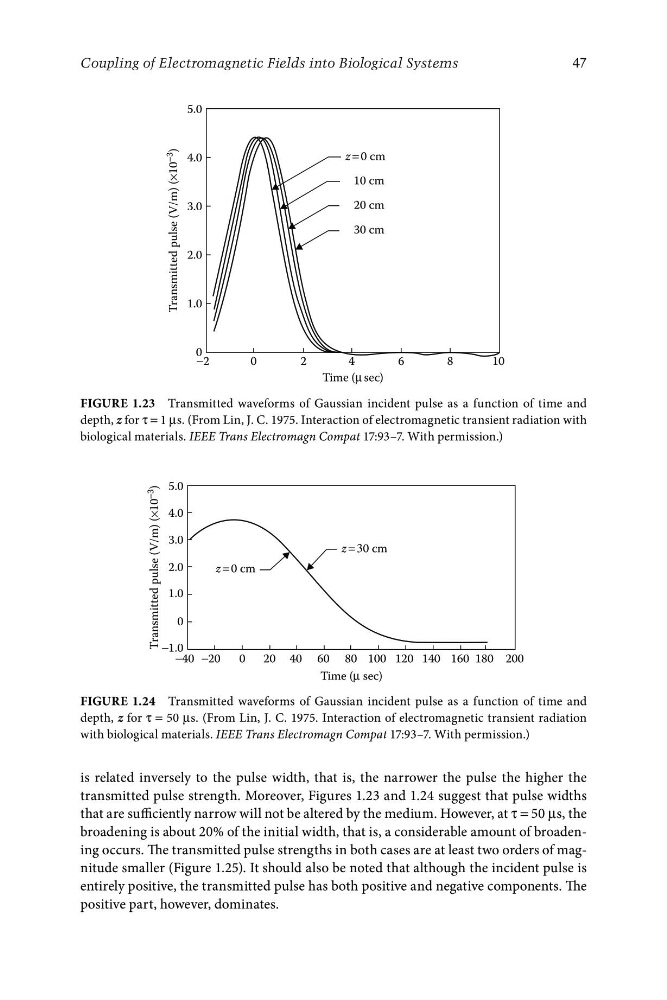
FigurE 1.23 Transmitted waveforms of Gaussian incident pulse as a function of time and
depth, z for τ = 1 μs. (From Lin, J. C. 1975. Interaction of electromagnetic transient radiation with
biological materials. IEEE Trans Electromagn Compat 17:93–7. With permission.)
Time (μ sec)
FigurE 1.24 Transmitted waveforms of Gaussian incident pulse as a function of time and
depth, z for τ = 50 μs. (From Lin, J. C. 1975. Interaction of electromagnetic transient radiation
with biological materials. IEEE Trans Electromagn Compat 17:93–7. With permission.)
is related inversely to the pulse width, that is, the narrower the pulse the higher the
transmitted pulse strength. Moreover, Figures 1.23 and 1.24 suggest that pulse widths
that are sufficiently narrow will not be altered by the medium. However, at τ = 50 μs, the
broadening is about 20% of the initial width, that is, a considerable amount of broadening occurs. The transmitted pulse strengths in both cases are at least two orders of magnitude smaller (Figure 1.25). It should also be noted that although the incident pulse is
entirely positive, the transmitted pulse has both positive and negative components. The
positive part, however, dominates.
z = 0 cm
20 cm
10 cm
30 cm
μ
−2
10
8
6
4
2
0
Transmitted pulse (V/m) (×10
−3
)
4.0
3.0
2.0
1.0
0
Time ( sec)
z = 0 cm
z = 30 cm
80 100 120 140 160 180 200
60
40
−1.0
20
0
−20
−40
Transmitted pulse (V/m) (×10
−3
)
5.0
4.0
3.0
2.0
1.0
0
47
Coupling of Electromagnetic Fields into Biological Systems
FigurE 1.23 Transmitted waveforms of Gaussian incident pulse as a function of time and
depth, z for τ = 1 μs. (From Lin, J. C. 1975. Interaction of electromagnetic transient radiation with
biological materials. IEEE Trans Electromagn Compat 17:93–7. With permission.)
Time (μ sec)
FigurE 1.24 Transmitted waveforms of Gaussian incident pulse as a function of time and
depth, z for τ = 50 μs. (From Lin, J. C. 1975. Interaction of electromagnetic transient radiation
with biological materials. IEEE Trans Electromagn Compat 17:93–7. With permission.)
is related inversely to the pulse width, that is, the narrower the pulse the higher the
transmitted pulse strength. Moreover, Figures 1.23 and 1.24 suggest that pulse widths
that are sufficiently narrow will not be altered by the medium. However, at τ = 50 μs, the
broadening is about 20% of the initial width, that is, a considerable amount of broadening occurs. The transmitted pulse strengths in both cases are at least two orders of magnitude smaller (Figure 1.25). It should also be noted that although the incident pulse is
entirely positive, the transmitted pulse has both positive and negative components. The
positive part, however, dominates.