

Frequency (THz)
0.1 0.2 0.3 0.4 0.5 0.6 0.7 0.8 0.9 1.0 1.1 1.2 1.3 1.4 1.5 1.6
Frequency (cm
−1
)
3.3 6.7 10.0 13.3 16.7 20.0 23.3 26.7 30.0 33.4 36.7 40.0 43.4 46.7 50.0 53.4
Wavelength (μm) 3000 1500 1000 750 600 500 428 375 333 300 273 250 231 214 200 187
2.4
2.4
Real index 2.2
2.2
of refraction 2.0
2.0
[n(w)]
1.8
1.8
1.6
1.6
16
16
14
14
Specular 12
12
reflection
10
(%)
10
8
8
6
6
(a)
Skin
(b)
392
Electromagnetic Fields in Biological Systems
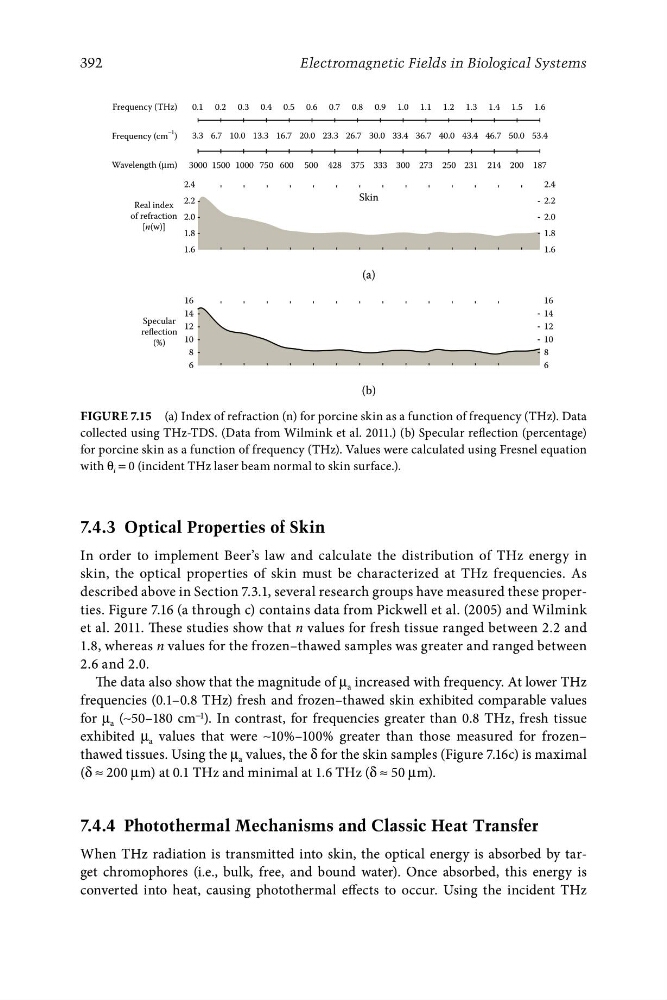
Figure 7.15 (a) Index of refraction (n) for porcine skin as a function of frequency (THz). Data
collected using THz-TDS. (Data from Wilmink et al. 2011.) (b) Specular reflection (percentage)
for porcine skin as a function of frequency (THz). Values were calculated using Fresnel equation
with θ i = 0 (incident THz laser beam normal to skin surface.).
7.4.3 Optical Properties of Skin
In order to implement Beer’s law and calculate the distribution of THz energy in
skin, the optical properties of skin must be characterized at THz frequencies. As
described above in Section 7.3.1, several research groups have measured these properties. Figure 7.16 (a through c) contains data from Pickwell et al. (2005) and Wilmink
et al. 2011. These studies show that n values for fresh tissue ranged between 2.2 and
1.8, whereas n values for the frozen–thawed samples was greater and ranged between
2.6 and 2.0.
The data also show that the magnitude of μ a increased with frequency. At lower THz
frequencies (0.1–0.8 THz) fresh and frozen–thawed skin exhibited comparable values
for μ a (∼50–180 cm −1 ). In contrast, for frequencies greater than 0.8 THz, fresh tissue
exhibited μ a values that were ∼10%–100% greater than those measured for frozen–
thawed tissues. Using the μ a values, the δ for the skin samples (Figure 7.16c) is maximal
(δ ≈ 200 μm) at 0.1 THz and minimal at 1.6 THz (δ ≈ 50 μm).
7.4.4 Photothermal Mechanisms and Classic Heat Transfer
When THz radiation is transmitted into skin, the optical energy is absorbed by target chromophores (i.e., bulk, free, and bound water). Once absorbed, this energy is
converted into heat, causing photothermal effects to occur. Using the incident THz