

Frequency (THz)
0.1 0.2 0.3 0.4 0.5 0.6 0.7 0.8 0.9 1.0 1.1 1.2 1.3 1.4 1.5 1.6
Frequency (cm
−1
)
3.3 6.7 10.0 13.3 16.7 20.0 23.3 26.7 30.0 33.4 36.7 40.0 43.4 46.7 50.0 53.4
Wavelength (μm)
3000 1500 1000 750 600 500 428 375 333 300 273 250 231 214 200 187
3.5
3.0
2.5
2.0
1.5
3.5
3.0
2.5
2.0
1.5
Real index
of refraction
[n(w)]
Skin
Wilmink et al. (n = 9): leg, porcine, frozen-thawed
Wilmink et al. (n = 26): leg, porcine, fresh
Pickwell et al. (2005): leg, human, fresh
(a)
400
400
0
0
(b)
300
200
100
300
200
100
Absorption
coefficient
μ a
200
150
100
50
0
200
150
100
50
0
Optical
penetration
depth δ <μm>
(c)
393
Terahertz Radiation
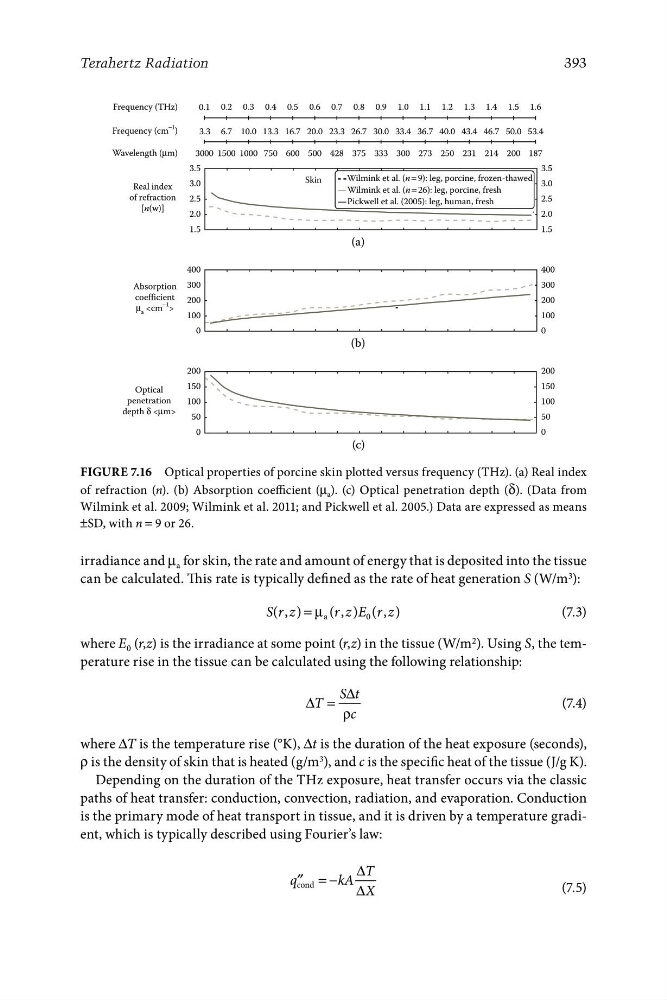
Figure 7.16 Optical properties of porcine skin plotted versus frequency (THz). (a) Real index
of refraction (n). (b) Absorption coefficient (μ a ). (c) Optical penetration depth (δ). (Data from
Wilmink et al. 2009; Wilmink et al. 2011; and Pickwell et al. 2005.) Data are expressed as means
±SD, with n = 9 or 26.
irradiance and μ a for skin, the rate and amount of energy that is deposited into the tissue
can be calculated. This rate is typically defined as the rate of heat generation S (W/m 3 ):
S r z
( , ) = µ a ( ,
r z E
) 0 ( ,
r z )
(7.3)
where E 0 (r,z) is the irradiance at some point (r,z) in the tissue (W/m 2 ). Using S, the temperature rise in the tissue can be calculated using the following relationship:
SΔt
ΔT =
(7.4)
ρc
where ΔT is the temperature rise (°K), Δt is the duration of the heat exposure (seconds),
ρ is the density of skin that is heated (g/m 3 ), and c is the specific heat of the tissue (J/g K).
Depending on the duration of the THz exposure, heat transfer occurs via the classic
paths of heat transfer: conduction, convection, radiation, and evaporation. Conduction
is the primary mode of heat transport in tissue, and it is driven by a temperature gradient, which is typically described using Fourier’s law:
ΔT
q′′ = − kA
cond
ΔX
(7.5)
0.1 0.2 0.3 0.4 0.5 0.6 0.7 0.8 0.9 1.0 1.1 1.2 1.3 1.4 1.5 1.6
Frequency (cm
−1
)
3.3 6.7 10.0 13.3 16.7 20.0 23.3 26.7 30.0 33.4 36.7 40.0 43.4 46.7 50.0 53.4
Wavelength (μm)
3000 1500 1000 750 600 500 428 375 333 300 273 250 231 214 200 187
3.5
3.0
2.5
2.0
1.5
3.5
3.0
2.5
2.0
1.5
Real index
of refraction
[n(w)]
Skin
Wilmink et al. (n = 9): leg, porcine, frozen-thawed
Wilmink et al. (n = 26): leg, porcine, fresh
Pickwell et al. (2005): leg, human, fresh
(a)
400
400
0
0
(b)
300
200
100
300
200
100
Absorption
coefficient
μ a
200
150
100
50
0
200
150
100
50
0
Optical
penetration
depth δ <μm>
(c)
393
Terahertz Radiation
Figure 7.16 Optical properties of porcine skin plotted versus frequency (THz). (a) Real index
of refraction (n). (b) Absorption coefficient (μ a ). (c) Optical penetration depth (δ). (Data from
Wilmink et al. 2009; Wilmink et al. 2011; and Pickwell et al. 2005.) Data are expressed as means
±SD, with n = 9 or 26.
irradiance and μ a for skin, the rate and amount of energy that is deposited into the tissue
can be calculated. This rate is typically defined as the rate of heat generation S (W/m 3 ):
S r z
( , ) = µ a ( ,
r z E
) 0 ( ,
r z )
(7.3)
where E 0 (r,z) is the irradiance at some point (r,z) in the tissue (W/m 2 ). Using S, the temperature rise in the tissue can be calculated using the following relationship:
SΔt
ΔT =
(7.4)
ρc
where ΔT is the temperature rise (°K), Δt is the duration of the heat exposure (seconds),
ρ is the density of skin that is heated (g/m 3 ), and c is the specific heat of the tissue (J/g K).
Depending on the duration of the THz exposure, heat transfer occurs via the classic
paths of heat transfer: conduction, convection, radiation, and evaporation. Conduction
is the primary mode of heat transport in tissue, and it is driven by a temperature gradient, which is typically described using Fourier’s law:
ΔT
q′′ = − kA
cond
ΔX
(7.5)