

BWO frequency synthesizer
Compact BWO
JLabs THz FEL
Collecting waveguide
Magnet (S)
Magnet (N) (∼1 T)
Comb grating
EM wave
Bunches
Anode
Cathode
Electron
beam
(a)
THz
6.5
kV
(b)
382
Electromagnetic Fields in Biological Systems
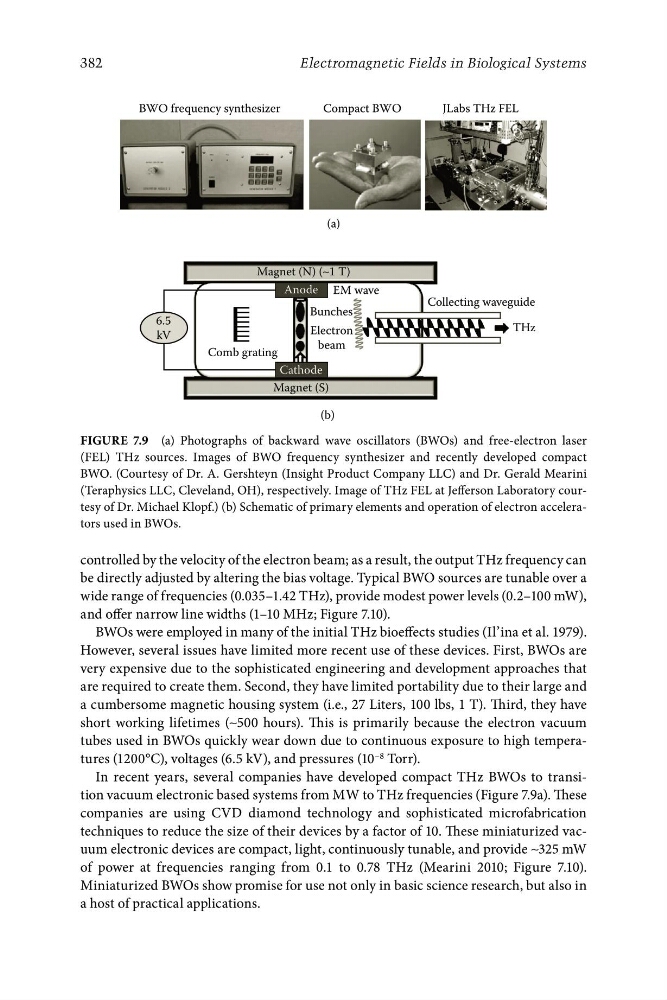
Figure 7.9 (a) Photographs of backward wave oscillators (BWOs) and free-electron laser
(FEL) THz sources. Images of BWO frequency synthesizer and recently developed compact
BWO. (Courtesy of Dr. A. Gershteyn (Insight Product Company LLC) and Dr. Gerald Mearini
(Teraphysics LLC, Cleveland, OH), respectively. Image of THz FEL at Jefferson Laboratory courtesy of Dr. Michael Klopf.) (b) Schematic of primary elements and operation of electron accelerators used in BWOs.
controlled by the velocity of the electron beam; as a result, the output THz frequency can
be directly adjusted by altering the bias voltage. Typical BWO sources are tunable over a
wide range of frequencies (0.035–1.42 THz), provide modest power levels (0.2–100 mW),
and offer narrow line widths (1–10 MHz; Figure 7.10).
BWOs were employed in many of the initial THz bioeffects studies (Il’ina et al. 1979).
However, several issues have limited more recent use of these devices. First, BWOs are
very expensive due to the sophisticated engineering and development approaches that
are required to create them. Second, they have limited portability due to their large and
a cumbersome magnetic housing system (i.e., 27 Liters, 100 lbs, 1 T). Third, they have
short working lifetimes (∼500 hours). This is primarily because the electron vacuum
tubes used in BWOs quickly wear down due to continuous exposure to high temperatures (1200°C), voltages (6.5 kV), and pressures (10 –8 Torr).
In recent years, several companies have developed compact THz BWOs to transition vacuum electronic based systems from MW to THz frequencies (Figure 7.9a). These
companies are using CVD diamond technology and sophisticated microfabrication
techniques to reduce the size of their devices by a factor of 10. These miniaturized vacuum electronic devices are compact, light, continuously tunable, and provide ∼325 mW
of power at frequencies ranging from 0.1 to 0.78 THz (Mearini 2010; Figure 7.10).
Miniaturized BWOs show promise for use not only in basic science research, but also in
a host of practical applications.
Compact BWO
JLabs THz FEL
Collecting waveguide
Magnet (S)
Magnet (N) (∼1 T)
Comb grating
EM wave
Bunches
Anode
Cathode
Electron
beam
(a)
THz
6.5
kV
(b)
382
Electromagnetic Fields in Biological Systems
Figure 7.9 (a) Photographs of backward wave oscillators (BWOs) and free-electron laser
(FEL) THz sources. Images of BWO frequency synthesizer and recently developed compact
BWO. (Courtesy of Dr. A. Gershteyn (Insight Product Company LLC) and Dr. Gerald Mearini
(Teraphysics LLC, Cleveland, OH), respectively. Image of THz FEL at Jefferson Laboratory courtesy of Dr. Michael Klopf.) (b) Schematic of primary elements and operation of electron accelerators used in BWOs.
controlled by the velocity of the electron beam; as a result, the output THz frequency can
be directly adjusted by altering the bias voltage. Typical BWO sources are tunable over a
wide range of frequencies (0.035–1.42 THz), provide modest power levels (0.2–100 mW),
and offer narrow line widths (1–10 MHz; Figure 7.10).
BWOs were employed in many of the initial THz bioeffects studies (Il’ina et al. 1979).
However, several issues have limited more recent use of these devices. First, BWOs are
very expensive due to the sophisticated engineering and development approaches that
are required to create them. Second, they have limited portability due to their large and
a cumbersome magnetic housing system (i.e., 27 Liters, 100 lbs, 1 T). Third, they have
short working lifetimes (∼500 hours). This is primarily because the electron vacuum
tubes used in BWOs quickly wear down due to continuous exposure to high temperatures (1200°C), voltages (6.5 kV), and pressures (10 –8 Torr).
In recent years, several companies have developed compact THz BWOs to transition vacuum electronic based systems from MW to THz frequencies (Figure 7.9a). These
companies are using CVD diamond technology and sophisticated microfabrication
techniques to reduce the size of their devices by a factor of 10. These miniaturized vacuum electronic devices are compact, light, continuously tunable, and provide ∼325 mW
of power at frequencies ranging from 0.1 to 0.78 THz (Mearini 2010; Figure 7.10).
Miniaturized BWOs show promise for use not only in basic science research, but also in
a host of practical applications.