

383
Terahertz Radiation
10
7
10
6
10
5
10
4
10
3
10
2
10
1
10
0
10
−1
t-BWO
c-BWO
h-BWO
TWT
FEL
Gyrotrons
0.1
1
10
7
10
6
10
5
10
4
10
3
10
2
10
1
10
0
10 −1
Power (mW)
Frequency (THz)
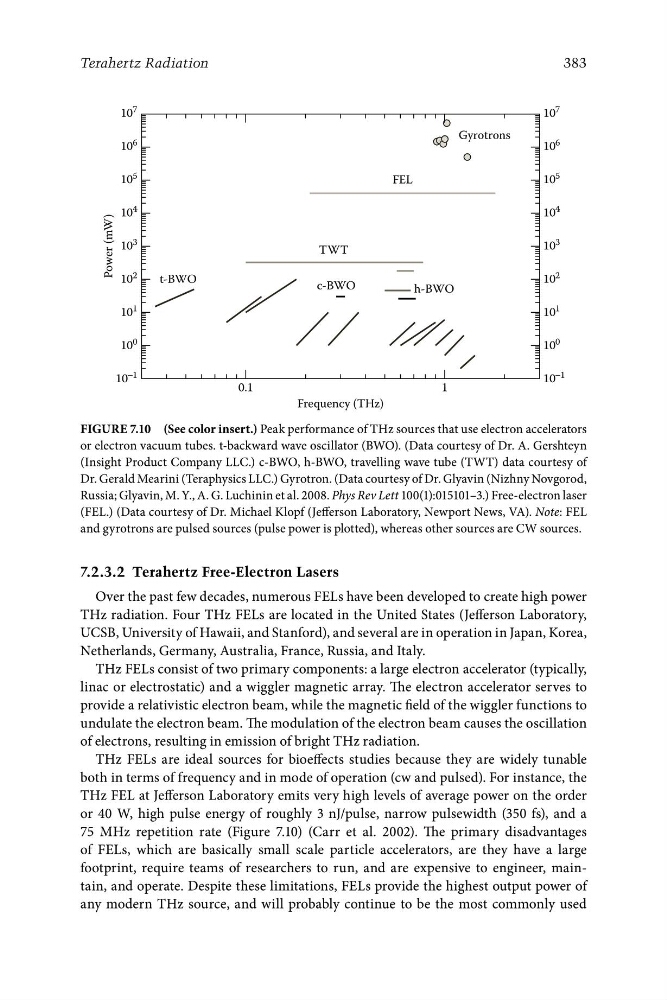
Figure 7.10 (See color insert.) Peak performance of THz sources that use electron accelerators
or electron vacuum tubes. t-backward wave oscillator (BWO). (Data courtesy of Dr. A. Gershteyn
(Insight Product Company LLC.) c-BWO, h-BWO, travelling wave tube (TWT) data courtesy of
Dr. Gerald Mearini (Teraphysics LLC.) Gyrotron. (Data courtesy of Dr. Glyavin (Nizhny Novgorod,
Russia; Glyavin, M. Y., A. G. Luchinin et al. 2008. Phys Rev Lett 100(1):015101–3.) Free-electron laser
(FEL.) (Data courtesy of Dr. Michael Klopf (Jefferson Laboratory, Newport News, VA). Note: FEL
and gyrotrons are pulsed sources (pulse power is plotted), whereas other sources are CW sources.
7.2.3.2 Terahertz Free-Electron Lasers
Over the past few decades, numerous FELs have been developed to create high power
THz radiation. Four THz FELs are located in the United States (Jefferson Laboratory,
UCSB, University of Hawaii, and Stanford), and several are in operation in Japan, Korea,
Netherlands, Germany, Australia, France, Russia, and Italy.
THz FELs consist of two primary components: a large electron accelerator (typically,
linac or electrostatic) and a wiggler magnetic array. The electron accelerator serves to
provide a relativistic electron beam, while the magnetic field of the wiggler functions to
undulate the electron beam. The modulation of the electron beam causes the oscillation
of electrons, resulting in emission of bright THz radiation.
THz FELs are ideal sources for bioeffects studies because they are widely tunable
both in terms of frequency and in mode of operation (cw and pulsed). For instance, the
THz FEL at Jefferson Laboratory emits very high levels of average power on the order
or 40 W, high pulse energy of roughly 3 nJ/pulse, narrow pulsewidth (350 fs), and a
75 MHz repetition rate (Figure 7.10) (Carr et al. 2002). The primary disadvantages
of FELs, which are basically small scale particle accelerators, are they have a large
footprint, require teams of researchers to run, and are expensive to engineer, maintain, and operate. Despite these limitations, FELs provide the highest output power of
any modern THz source, and will probably continue to be the most commonly used