

Si spacer
MM QCL
AR-coated
Si lens
1.94 mm
Retaining
Copper
clip
carrier
(a)
(b)
Injection barrier
0.20
0.15
3
0.10
2
1
g
0.05
E (eV)
Acc V Spot Magn Det WD
10 µm
Injector Active SL
15.0 kV 5.0 3500x SE 15 g
(c)
(d)
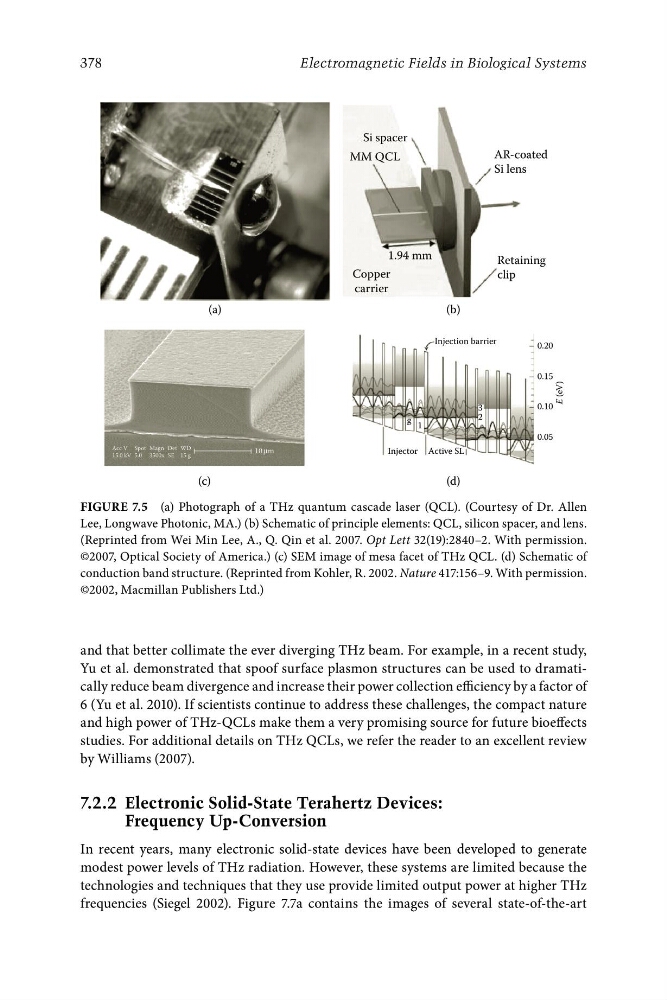
Figure 7.5 (a) Photograph of a THz quantum cascade laser (QCL). (Courtesy of Dr. Allen
Lee, Longwave Photonic, MA.) (b) Schematic of principle elements: QCL, silicon spacer, and lens.
(Reprinted from Wei Min Lee, A., Q. Qin et al. 2007. Opt Lett 32(19):2840–2. With permission.
©2007, Optical Society of America.) (c) SEM image of mesa facet of THz QCL. (d) Schematic of
conduction band structure. (Reprinted from Kohler, R. 2002. Nature 417:156–9. With permission.
©2002, Macmillan Publishers Ltd.)
378
Electromagnetic Fields in Biological Systems
and that better collimate the ever diverging THz beam. For example, in a recent study,
Yu et al. demonstrated that spoof surface plasmon structures can be used to dramatically reduce beam divergence and increase their power collection efficiency by a factor of
6 (Yu et al. 2010). If scientists continue to address these challenges, the compact nature
and high power of THz-QCLs make them a very promising source for future bioeffects
studies. For additional details on THz QCLs, we refer the reader to an excellent review
by Williams (2007).
7.2.2 Electronic Solid-State Terahertz Devices:
Frequency Up-Conversion
In recent years, many electronic solid-state devices have been developed to generate
modest power levels of THz radiation. However, these systems are limited because the
technologies and techniques that they use provide limited output power at higher THz
frequencies (Siegel 2002). Figure 7.7a contains the images of several state-of-the-art
MM QCL
AR-coated
Si lens
1.94 mm
Retaining
Copper
clip
carrier
(a)
(b)
Injection barrier
0.20
0.15
3
0.10
2
1
g
0.05
E (eV)
Acc V Spot Magn Det WD
10 µm
Injector Active SL
15.0 kV 5.0 3500x SE 15 g
(c)
(d)
Figure 7.5 (a) Photograph of a THz quantum cascade laser (QCL). (Courtesy of Dr. Allen
Lee, Longwave Photonic, MA.) (b) Schematic of principle elements: QCL, silicon spacer, and lens.
(Reprinted from Wei Min Lee, A., Q. Qin et al. 2007. Opt Lett 32(19):2840–2. With permission.
©2007, Optical Society of America.) (c) SEM image of mesa facet of THz QCL. (d) Schematic of
conduction band structure. (Reprinted from Kohler, R. 2002. Nature 417:156–9. With permission.
©2002, Macmillan Publishers Ltd.)
378
Electromagnetic Fields in Biological Systems
and that better collimate the ever diverging THz beam. For example, in a recent study,
Yu et al. demonstrated that spoof surface plasmon structures can be used to dramatically reduce beam divergence and increase their power collection efficiency by a factor of
6 (Yu et al. 2010). If scientists continue to address these challenges, the compact nature
and high power of THz-QCLs make them a very promising source for future bioeffects
studies. For additional details on THz QCLs, we refer the reader to an excellent review
by Williams (2007).
7.2.2 Electronic Solid-State Terahertz Devices:
Frequency Up-Conversion
In recent years, many electronic solid-state devices have been developed to generate
modest power levels of THz radiation. However, these systems are limited because the
technologies and techniques that they use provide limited output power at higher THz
frequencies (Siegel 2002). Figure 7.7a contains the images of several state-of-the-art