

Optical phonon emission
Accelerated
via electrical
pumping
HH ground state
HH excited band
Energy
THz emission
Stable LH Landau level
Lower LH Landau level
C h
C 1
P (momentum)
(a)
(b)
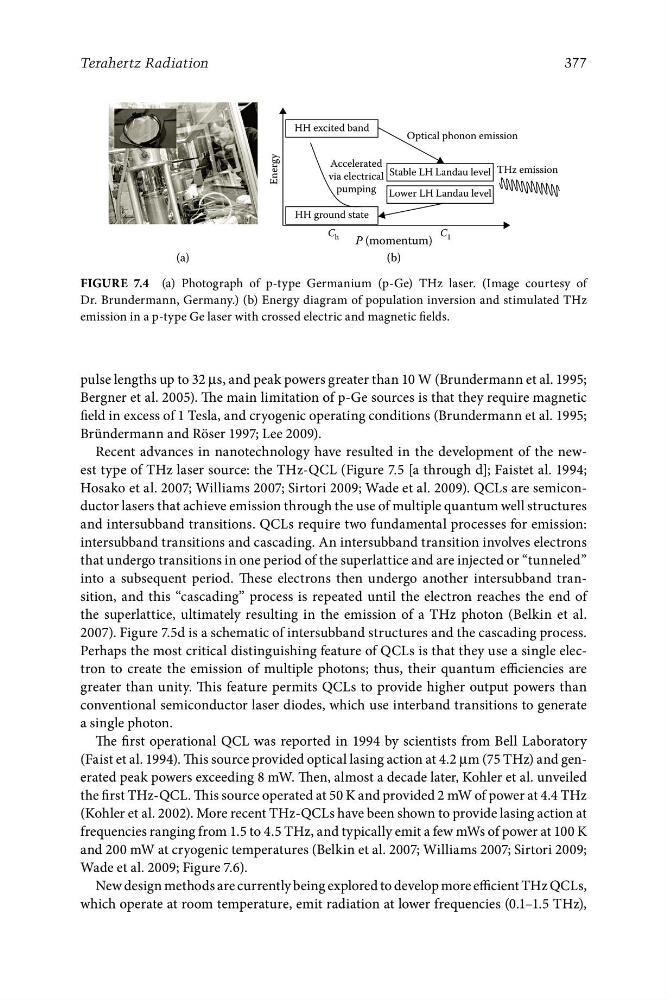
Figure 7.4 (a) Photograph of p-type Germanium (p-Ge) THz laser. (Image courtesy of
Dr. Brundermann, Germany.) (b) Energy diagram of population inversion and stimulated THz
emission in a p-type Ge laser with crossed electric and magnetic fields.
377
Terahertz Radiation
pulse lengths up to 32 μs, and peak powers greater than 10 W (Brundermann et al. 1995;
Bergner et al. 2005). The main limitation of p-Ge sources is that they require magnetic
field in excess of 1 Tesla, and cryogenic operating conditions (Brundermann et al. 1995;
Bründermann and Röser 1997; Lee 2009).
Recent advances in nanotechnology have resulted in the development of the newest type of THz laser source: the THz-QCL (Figure 7.5 [a through d]; Faistet al. 1994;
Hosako et al. 2007; Williams 2007; Sirtori 2009; Wade et al. 2009). QCLs are semiconductor lasers that achieve emission through the use of multiple quantum well structures
and intersubband transitions. QCLs require two fundamental processes for emission:
intersubband transitions and cascading. An intersubband transition involves electrons
that undergo transitions in one period of the superlattice and are injected or “tunneled”
into a subsequent period. These electrons then undergo another intersubband transition, and this “cascading” process is repeated until the electron reaches the end of
the superlattice, ultimately resulting in the emission of a THz photon (Belkin et al.
2007). Figure 7.5d is a schematic of intersubband structures and the cascading process.
Perhaps the most critical distinguishing feature of QCLs is that they use a single electron to create the emission of multiple photons; thus, their quantum efficiencies are
greater than unity. This feature permits QCLs to provide higher output powers than
conventional semiconductor laser diodes, which use interband transitions to generate
a single photon.
The first operational QCL was reported in 1994 by scientists from Bell Laboratory
(Faist et al. 1994). This source provided optical lasing action at 4.2 μm (75 THz) and generated peak powers exceeding 8 mW. Then, almost a decade later, Kohler et al. unveiled
the first THz-QCL. This source operated at 50 K and provided 2 mW of power at 4.4 THz
(Kohler et al. 2002). More recent THz-QCLs have been shown to provide lasing action at
frequencies ranging from 1.5 to 4.5 THz, and typically emit a few mWs of power at 100 K
and 200 mW at cryogenic temperatures (Belkin et al. 2007; Williams 2007; Sirtori 2009;
Wade et al. 2009; Figure 7.6).
New design methods are currently being explored to develop more efficient THz QCLs,
which operate at room temperature, emit radiation at lower frequencies (0.1–1.5 THz),