

1st excitation vibrational
manifold
FIR
(2.5 THz)
CO2
(31 THz)
Lowest vibrational
manifold
Grating-tuned
CO2 laser (31 THz)
THz beam (0.1−7 THz)
FIR laser cell Methonal gas
(a)
(b)
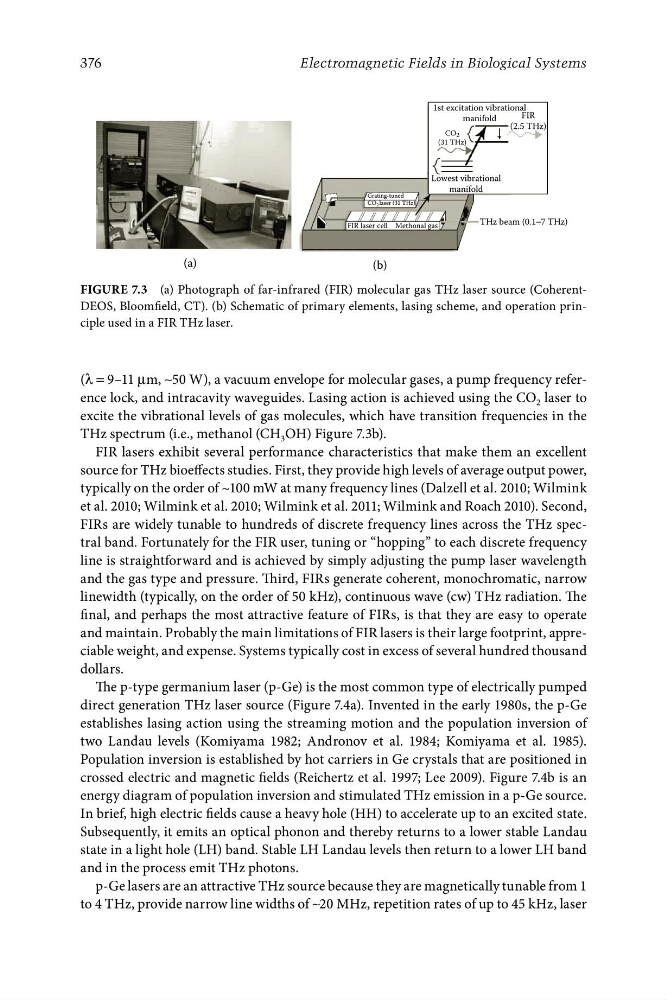
igure 7.3 (a) Photograph of far-infrared (FIR) molecular gas THz laser source (CoherentEOS, Bloomfield, CT). (b) Schematic of primary elements, lasing scheme, and operation priniple used in a FIR THz laser.
376
Electromagnetic Fields in Biological Systems
F
D
c
(λ = 9–11 μm, ∼50 W), a vacuum envelope for molecular gases, a pump frequency reference lock, and intracavity waveguides. Lasing action is achieved using the CO 2 laser to
excite the vibrational levels of gas molecules, which have transition frequencies in the
THz spectrum (i.e., methanol (CH 3 OH) Figure 7.3b).
FIR lasers exhibit several performance characteristics that make them an excellent
source for THz bioeffects studies. First, they provide high levels of average output power,
typically on the order of ~100 mW at many frequency lines (Dalzell et al. 2010; Wilmink
et al. 2010; Wilmink et al. 2010; Wilmink et al. 2011; Wilmink and Roach 2010). Second,
FIRs are widely tunable to hundreds of discrete frequency lines across the THz spectral band. Fortunately for the FIR user, tuning or “hopping” to each discrete frequency
line is straightforward and is achieved by simply adjusting the pump laser wavelength
and the gas type and pressure. Third, FIRs generate coherent, monochromatic, narrow
linewidth (typically, on the order of 50 kHz), continuous wave (cw) THz radiation. The
final, and perhaps the most attractive feature of FIRs, is that they are easy to operate
and maintain. Probably the main limitations of FIR lasers is their large footprint, appreciable weight, and expense. Systems typically cost in excess of several hundred thousand
dollars.
The p-type germanium laser (p-Ge) is the most common type of electrically pumped
direct generation THz laser source (Figure 7.4a). Invented in the early 1980s, the p-Ge
establishes lasing action using the streaming motion and the population inversion of
two Landau levels (Komiyama 1982; Andronov et al. 1984; Komiyama et al. 1985).
Population inversion is established by hot carriers in Ge crystals that are positioned in
crossed electric and magnetic fields (Reichertz et al. 1997; Lee 2009). Figure 7.4b is an
energy diagram of population inversion and stimulated THz emission in a p-Ge source.
In brief, high electric fields cause a heavy hole (HH) to accelerate up to an excited state.
Subsequently, it emits an optical phonon and thereby returns to a lower stable Landau
state in a light hole (LH) band. Stable LH Landau levels then return to a lower LH band
and in the process emit THz photons.
p-Ge lasers are an attractive THz source because they are magnetically tunable from 1
to 4 THz, provide narrow line widths of ∼20 MHz, repetition rates of up to 45 kHz, laser
manifold
FIR
(2.5 THz)
CO2
(31 THz)
Lowest vibrational
manifold
Grating-tuned
CO2 laser (31 THz)
THz beam (0.1−7 THz)
FIR laser cell Methonal gas
(a)
(b)
igure 7.3 (a) Photograph of far-infrared (FIR) molecular gas THz laser source (CoherentEOS, Bloomfield, CT). (b) Schematic of primary elements, lasing scheme, and operation priniple used in a FIR THz laser.
376
Electromagnetic Fields in Biological Systems
F
D
c
(λ = 9–11 μm, ∼50 W), a vacuum envelope for molecular gases, a pump frequency reference lock, and intracavity waveguides. Lasing action is achieved using the CO 2 laser to
excite the vibrational levels of gas molecules, which have transition frequencies in the
THz spectrum (i.e., methanol (CH 3 OH) Figure 7.3b).
FIR lasers exhibit several performance characteristics that make them an excellent
source for THz bioeffects studies. First, they provide high levels of average output power,
typically on the order of ~100 mW at many frequency lines (Dalzell et al. 2010; Wilmink
et al. 2010; Wilmink et al. 2010; Wilmink et al. 2011; Wilmink and Roach 2010). Second,
FIRs are widely tunable to hundreds of discrete frequency lines across the THz spectral band. Fortunately for the FIR user, tuning or “hopping” to each discrete frequency
line is straightforward and is achieved by simply adjusting the pump laser wavelength
and the gas type and pressure. Third, FIRs generate coherent, monochromatic, narrow
linewidth (typically, on the order of 50 kHz), continuous wave (cw) THz radiation. The
final, and perhaps the most attractive feature of FIRs, is that they are easy to operate
and maintain. Probably the main limitations of FIR lasers is their large footprint, appreciable weight, and expense. Systems typically cost in excess of several hundred thousand
dollars.
The p-type germanium laser (p-Ge) is the most common type of electrically pumped
direct generation THz laser source (Figure 7.4a). Invented in the early 1980s, the p-Ge
establishes lasing action using the streaming motion and the population inversion of
two Landau levels (Komiyama 1982; Andronov et al. 1984; Komiyama et al. 1985).
Population inversion is established by hot carriers in Ge crystals that are positioned in
crossed electric and magnetic fields (Reichertz et al. 1997; Lee 2009). Figure 7.4b is an
energy diagram of population inversion and stimulated THz emission in a p-Ge source.
In brief, high electric fields cause a heavy hole (HH) to accelerate up to an excited state.
Subsequently, it emits an optical phonon and thereby returns to a lower stable Landau
state in a light hole (LH) band. Stable LH Landau levels then return to a lower LH band
and in the process emit THz photons.
p-Ge lasers are an attractive THz source because they are magnetically tunable from 1
to 4 THz, provide narrow line widths of ∼20 MHz, repetition rates of up to 45 kHz, laser