

336
Electromagnetic Fields in Biological Systems
or Fe–Co exhibit higher magnetization compared to iron oxide and allow even better
heating. However, with respect to metallic nanoparticles, the main issue concerns their
biocompatibility and hence protection against oxidation and their potential toxicity. To
increase their biocompatibility, particles may be coated by inorganic material (silica and
gold). As an example, to generate a biocompatible coating, CoFe 2 O 4 nanoparticles may
be layered with polygalacturonic acid.
When an external magnetic field is applied to an assembly of superparamagnetic
nanoparticles, their magnetic moments tend to align along and oscillate with the
applied field. Therefore, in addition to heating by induced eddy currents, the magnetic
particles are also heated due to the alternating change of magnetism that follows a hysteresis curve. The area A of this hysteresis loop (expressed in J/g) is dissipated in the
environment under the form of thermal energy. For Fe–Co nanoparticles, A amounts
to 1.5 mJ/g; for Co nanoparticles, it increases to 3.25 mJ/g. It reaches 5.6 mJ/g for Fe
nanoparticles.
In a simplified approach, the SAR for this magnetic heating mechanism can be estimated by multiplying the hysteresis loop area A (in Ws/kg) by the frequency f of the
alternating magnetic field:
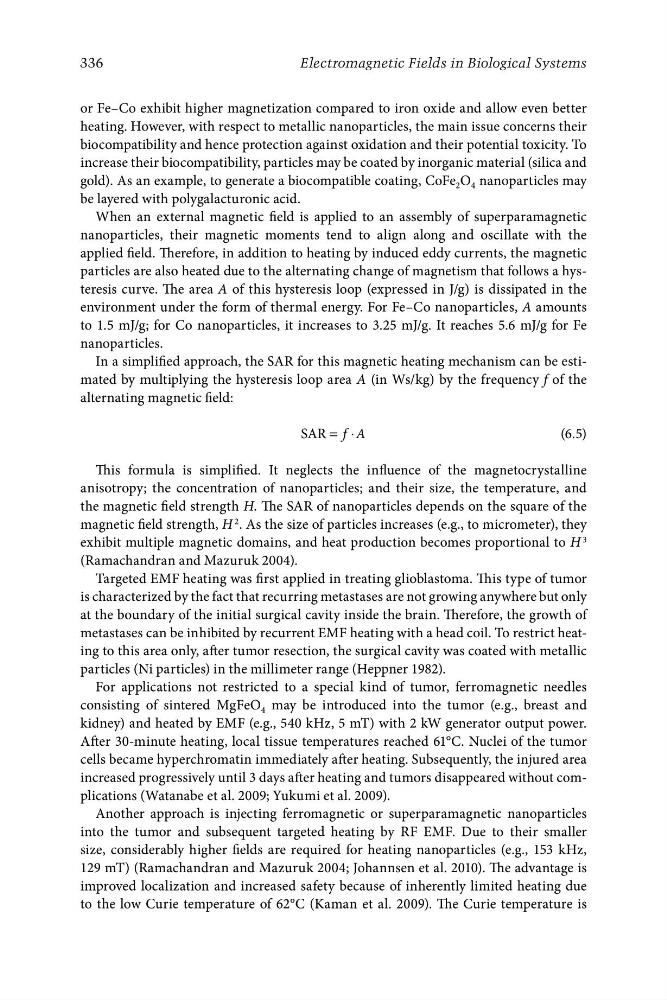
SAR = f ⋅ A
(6.5)
This formula is simplified. It neglects the influence of the magnetocrystalline
anisotropy; the concentration of nanoparticles; and their size, the temperature, and
the magnetic field strength H. The SAR of nanoparticles depends on the square of the
magnetic field strength, H 2 . As the size of particles increases (e.g., to micrometer), they
exhibit multiple magnetic domains, and heat production becomes proportional to H 3
(Ramachandran and Mazuruk 2004).
Targeted EMF heating was first applied in treating glioblastoma. This type of tumor
is characterized by the fact that recurring metastases are not growing anywhere but only
at the boundary of the initial surgical cavity inside the brain. Therefore, the growth of
metastases can be inhibited by recurrent EMF heating with a head coil. To restrict heating to this area only, after tumor resection, the surgical cavity was coated with metallic
particles (Ni particles) in the millimeter range (Heppner 1982).
For applications not restricted to a special kind of tumor, ferromagnetic needles
consisting of sintered MgFeO 4 may be introduced into the tumor (e.g., breast and
kidney) and heated by EMF (e.g., 540 kHz, 5 mT) with 2 kW generator output power.
After 30-minute heating, local tissue temperatures reached 61°C. Nuclei of the tumor
cells became hyperchromatin immediately after heating. Subsequently, the injured area
increased progressively until 3 days after heating and tumors disappeared without complications (Watanabe et al. 2009; Yukumi et al. 2009).
Another approach is injecting ferromagnetic or superparamagnetic nanoparticles
into the tumor and subsequent targeted heating by RF EMF. Due to their smaller
size, considerably higher fields are required for heating nanoparticles (e.g., 153 kHz,
129 mT) (Ramachandran and Mazuruk 2004; Johannsen et al. 2010). The advantage is
improved localization and increased safety because of inherently limited heating due
to the low Curie temperature of 62°C (Kaman et al. 2009). The Curie temperature is