

335
Medical Devices and Systems Exposure and Dosimetry
Muralidharan, and Christophi 2005). Heat delivery can be supported by modulating
blood flow, administrating thermo-sensitizing agents, and introducing ferromagnetic
particles or elements into the target tissue.
Heating is performed with hyperthermia devices with different antenna using frequencies dedicated for industrial, scientific, and medical use (ISM frequencies), in particular 13.5 MHZ, 21.7 MHZ, 433 MHz, and 2.45 GHz and output power up to 500 W for
short-wave devices (IEC 60601-2-3) and 250 W for microwave devices (IEC 60601-2-6).
Different applicators are used for superficial heating (e.g., magnetic loop, capacitor, linear
or two-dimensional antenna arrays, and helical antenna) and deep heating (e.g., inductive, capacitive applicators, biconal dipole antenna, transverse electromagnetic (TEM)
applicator, and annular ring or linear phased array).
Focusing EMF to deep target regions is achieved by real-time shaping and by selecting power deposition patterns of configurations with multiple antennas based on the
result of treatment planning systems and numerical simulation with individual patient
data. To avoid excess superficial heating and/or to modulate the intracorporal treatment
pattern, a fluid-filled bolus is inserted between the body surface and the applicator.
Quantitative exposure data are sparse. However, new methods for noninvasive in
vivo temperature measurement (e.g., based on MRI) are expected to fill the gap. Specific
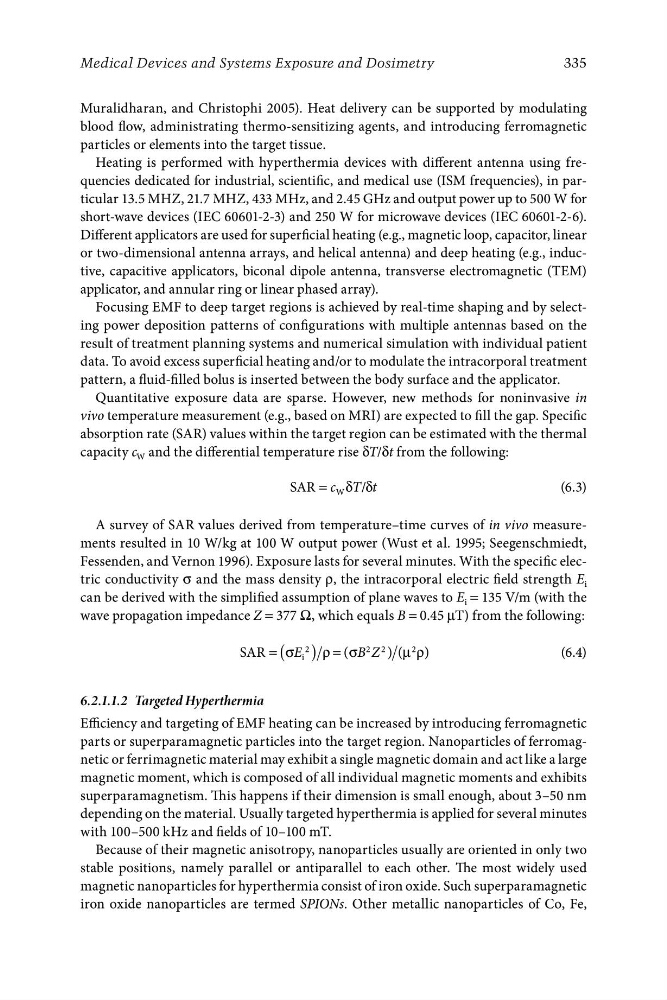
absorption rate (SAR) values within the target region can be estimated with the thermal
capacity c W and the differential temperature rise δT/δt from the following:
SAR = c W δT/δ t
(6.3)
A survey of SAR values derived from temperature–time curves of in vivo measurements resulted in 10 W/kg at 100 W output power (Wust et al. 1995; Seegenschmiedt,
Fessenden, and Vernon 1996). Exposure lasts for several minutes. With the specific electric conductivity σ and the mass density ρ, the intracorporal electric field strength E i
can be derived with the simplified assumption of plane waves to E i = 135 V/m (with the
wave propagation impedance Z = 377 Ω, which equals B = 0.45 μT) from the following:
SAR = ( σ E
2
i ) ρ = (σB
2
Z
2
) ( µ
2
ρ )
(6.4)
6.2.1.1.2 Targeted Hyperthermia
Efficiency and targeting of EMF heating can be increased by introducing ferromagnetic
parts or superparamagnetic particles into the target region. Nanoparticles of ferromagnetic or ferrimagnetic material may exhibit a single magnetic domain and act like a large
magnetic moment, which is composed of all individual magnetic moments and exhibits
superparamagnetism. This happens if their dimension is small enough, about 3–50 nm
depending on the material. Usually targeted hyperthermia is applied for several minutes
with 100–500 kHz and fields of 10–100 mT.
Because of their magnetic anisotropy, nanoparticles usually are oriented in only two
stable positions, namely parallel or antiparallel to each other. The most widely used
magnetic nanoparticles for hyperthermia consist of iron oxide. Such superparamagnetic
iron oxide nanoparticles are termed SPIONs. Other metallic nanoparticles of Co, Fe,
Medical Devices and Systems Exposure and Dosimetry
Muralidharan, and Christophi 2005). Heat delivery can be supported by modulating
blood flow, administrating thermo-sensitizing agents, and introducing ferromagnetic
particles or elements into the target tissue.
Heating is performed with hyperthermia devices with different antenna using frequencies dedicated for industrial, scientific, and medical use (ISM frequencies), in particular 13.5 MHZ, 21.7 MHZ, 433 MHz, and 2.45 GHz and output power up to 500 W for
short-wave devices (IEC 60601-2-3) and 250 W for microwave devices (IEC 60601-2-6).
Different applicators are used for superficial heating (e.g., magnetic loop, capacitor, linear
or two-dimensional antenna arrays, and helical antenna) and deep heating (e.g., inductive, capacitive applicators, biconal dipole antenna, transverse electromagnetic (TEM)
applicator, and annular ring or linear phased array).
Focusing EMF to deep target regions is achieved by real-time shaping and by selecting power deposition patterns of configurations with multiple antennas based on the
result of treatment planning systems and numerical simulation with individual patient
data. To avoid excess superficial heating and/or to modulate the intracorporal treatment
pattern, a fluid-filled bolus is inserted between the body surface and the applicator.
Quantitative exposure data are sparse. However, new methods for noninvasive in
vivo temperature measurement (e.g., based on MRI) are expected to fill the gap. Specific
absorption rate (SAR) values within the target region can be estimated with the thermal
capacity c W and the differential temperature rise δT/δt from the following:
SAR = c W δT/δ t
(6.3)
A survey of SAR values derived from temperature–time curves of in vivo measurements resulted in 10 W/kg at 100 W output power (Wust et al. 1995; Seegenschmiedt,
Fessenden, and Vernon 1996). Exposure lasts for several minutes. With the specific electric conductivity σ and the mass density ρ, the intracorporal electric field strength E i
can be derived with the simplified assumption of plane waves to E i = 135 V/m (with the
wave propagation impedance Z = 377 Ω, which equals B = 0.45 μT) from the following:
SAR = ( σ E
2
i ) ρ = (σB
2
Z
2
) ( µ
2
ρ )
(6.4)
6.2.1.1.2 Targeted Hyperthermia
Efficiency and targeting of EMF heating can be increased by introducing ferromagnetic
parts or superparamagnetic particles into the target region. Nanoparticles of ferromagnetic or ferrimagnetic material may exhibit a single magnetic domain and act like a large
magnetic moment, which is composed of all individual magnetic moments and exhibits
superparamagnetism. This happens if their dimension is small enough, about 3–50 nm
depending on the material. Usually targeted hyperthermia is applied for several minutes
with 100–500 kHz and fields of 10–100 mT.
Because of their magnetic anisotropy, nanoparticles usually are oriented in only two
stable positions, namely parallel or antiparallel to each other. The most widely used
magnetic nanoparticles for hyperthermia consist of iron oxide. Such superparamagnetic
iron oxide nanoparticles are termed SPIONs. Other metallic nanoparticles of Co, Fe,