

334
Electromagnetic Fields in Biological Systems
forces acting at charged particles or magnetic moments, respectively, causing translational, oscillating, and/or rotational movements. In a macroscopic point of view, heat is
defined by the frequency of collisions of particles and hence their statistical movement
(Brownian motion).
6.2.1.1 Hyperthermia
Hyperthermia aims at increasing the temperature of target tissue sufficiently long above
a critical temperature to damage cancer cells. To protect healthy tissue, sophisticated
treatment planning is required, usually based on numerical modeling. Energy delivery by EMG can be performed either by direct absorption by the tissue or by targeted
absorption by introducing ferromagnetic or superparamagnetic parts and particles into
the target tissue.
6.2.1.1.1 Direct Electromagnetic Field Heating
As the result of their specific biological properties (e.g., reduced heat dissipating ability,
lower interstitial pH, and increased proliferation rate), tumor cells are more susceptible
to heat than normal cells. However, individual thermal susceptibility of different tumor
cell types can lead to different responses, from complete regression to growth delay.
However, individual reactions might also include heat-induced growth stimulation.
Repeated thermal exposure with sublethal doses may result in a transient increase of
cellular resistance to heat (Seegenschmiedt, Fessenden, and Vernon 1996). The response
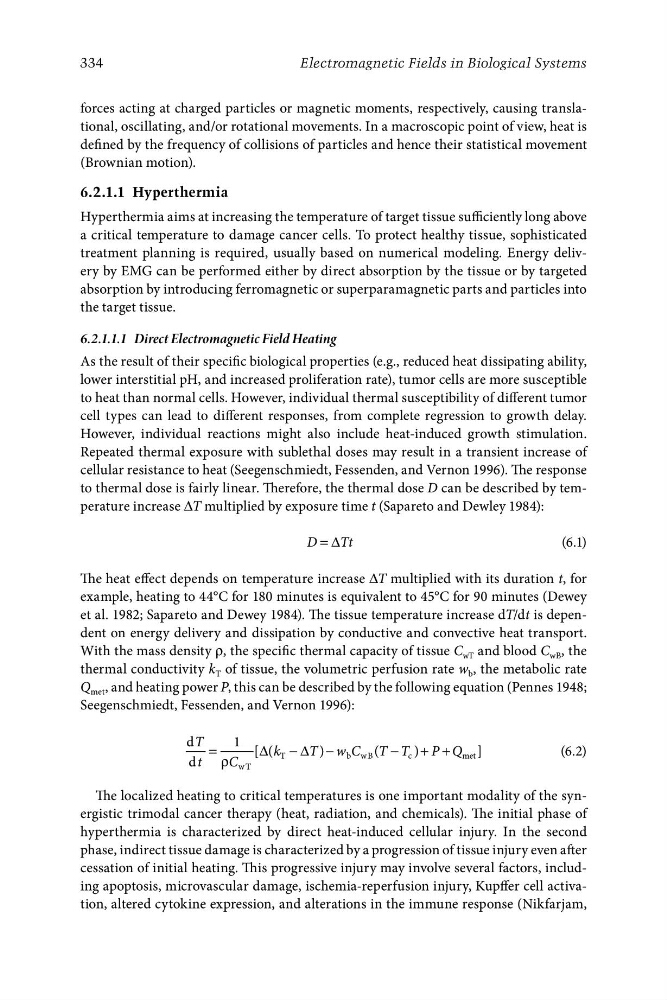
to thermal dose is fairly linear. Therefore, the thermal dose D can be described by temperature increase ΔT multiplied by exposure time t (Sapareto and Dewley 1984):
D = ΔTt
(6.1)
The heat effect depends on temperature increase ΔT multiplied with its duration t, for
example, heating to 44°C for 180 minutes is equivalent to 45°C for 90 minutes (Dewey
et al. 1982; Sapareto and Dewey 1984). The tissue temperature increase dT/dt is dependent on energy delivery and dissipation by conductive and convective heat transport.
With the mass density ρ, the specific thermal capacity of tissue C wT and blood C wB , the
thermal conductivity k T of tissue, the volumetric perfusion rate w b , the metabolic rate
Q met , and heating power P, this can be described by the following equation (Pennes 1948;
Seegenschmiedt, Fessenden, and Vernon 1996):
dT
1 [ ( k − ΔT ) − w C (T − T ) P Q ]
(6.2)
=
Δ
+ +
T
b w B
c
met
dt ρC w T
The localized heating to critical temperatures is one important modality of the synergistic trimodal cancer therapy (heat, radiation, and chemicals). The initial phase of
hyperthermia is characterized by direct heat-induced cellular injury. In the second
phase, indirect tissue damage is characterized by a progression of tissue injury even after
cessation of initial heating. This progressive injury may involve several factors, including apoptosis, microvascular damage, ischemia-reperfusion injury, Kupffer cell activation, altered cytokine expression, and alterations in the immune response (Nikfarjam,
Electromagnetic Fields in Biological Systems
forces acting at charged particles or magnetic moments, respectively, causing translational, oscillating, and/or rotational movements. In a macroscopic point of view, heat is
defined by the frequency of collisions of particles and hence their statistical movement
(Brownian motion).
6.2.1.1 Hyperthermia
Hyperthermia aims at increasing the temperature of target tissue sufficiently long above
a critical temperature to damage cancer cells. To protect healthy tissue, sophisticated
treatment planning is required, usually based on numerical modeling. Energy delivery by EMG can be performed either by direct absorption by the tissue or by targeted
absorption by introducing ferromagnetic or superparamagnetic parts and particles into
the target tissue.
6.2.1.1.1 Direct Electromagnetic Field Heating
As the result of their specific biological properties (e.g., reduced heat dissipating ability,
lower interstitial pH, and increased proliferation rate), tumor cells are more susceptible
to heat than normal cells. However, individual thermal susceptibility of different tumor
cell types can lead to different responses, from complete regression to growth delay.
However, individual reactions might also include heat-induced growth stimulation.
Repeated thermal exposure with sublethal doses may result in a transient increase of
cellular resistance to heat (Seegenschmiedt, Fessenden, and Vernon 1996). The response
to thermal dose is fairly linear. Therefore, the thermal dose D can be described by temperature increase ΔT multiplied by exposure time t (Sapareto and Dewley 1984):
D = ΔTt
(6.1)
The heat effect depends on temperature increase ΔT multiplied with its duration t, for
example, heating to 44°C for 180 minutes is equivalent to 45°C for 90 minutes (Dewey
et al. 1982; Sapareto and Dewey 1984). The tissue temperature increase dT/dt is dependent on energy delivery and dissipation by conductive and convective heat transport.
With the mass density ρ, the specific thermal capacity of tissue C wT and blood C wB , the
thermal conductivity k T of tissue, the volumetric perfusion rate w b , the metabolic rate
Q met , and heating power P, this can be described by the following equation (Pennes 1948;
Seegenschmiedt, Fessenden, and Vernon 1996):
dT
1 [ ( k − ΔT ) − w C (T − T ) P Q ]
(6.2)
=
Δ
+ +
T
b w B
c
met
dt ρC w T
The localized heating to critical temperatures is one important modality of the synergistic trimodal cancer therapy (heat, radiation, and chemicals). The initial phase of
hyperthermia is characterized by direct heat-induced cellular injury. In the second
phase, indirect tissue damage is characterized by a progression of tissue injury even after
cessation of initial heating. This progressive injury may involve several factors, including apoptosis, microvascular damage, ischemia-reperfusion injury, Kupffer cell activation, altered cytokine expression, and alterations in the immune response (Nikfarjam,