

303
Mobile Communication Fields in Biological Systems
cross-section where the maximum value is located. In all analyzed situations, with the
maximum radiated power allowed for these technologies, the exposure levels were lower
than those obtained from exposure to cellular phones and far below the limits established by the guidelines.
Placing of the cellular phone on other parts of the body has also been studied. In
the study by Han et al. (2006), the coupling between a hip-mounted 1800 MHz cellular phone fitted with a monopole antenna and a 1 m long wire representing a handsfree wire was investigated. For the scenarios considered, all peak SAR values were well
within international guidelines on EM exposure. In the study by Troulis, Scanlon, and
Evans (2003), an increase of the SAR values and deposited power was found when the
phone was placed at the waist of the body with respect to the case in which the phone
was placed close to the ear.
Overall, even under unlikely worst-case scenarios, wired and wireless hands-free
devices offer very substantial reductions in SAR compared to the normal use of the
phone against the head. In general, wired hands-free devices lead to a considerable
reduction of the exposure of the head. On the other hand, wireless (Bluetooth) handsfree devices cause a low but constant level of exposure. From a precautionary point of
view, the use of hands-free devices is nowadays recommended by many authorities
(Mild and Wilen 2009).
5.4.3 Base Stations
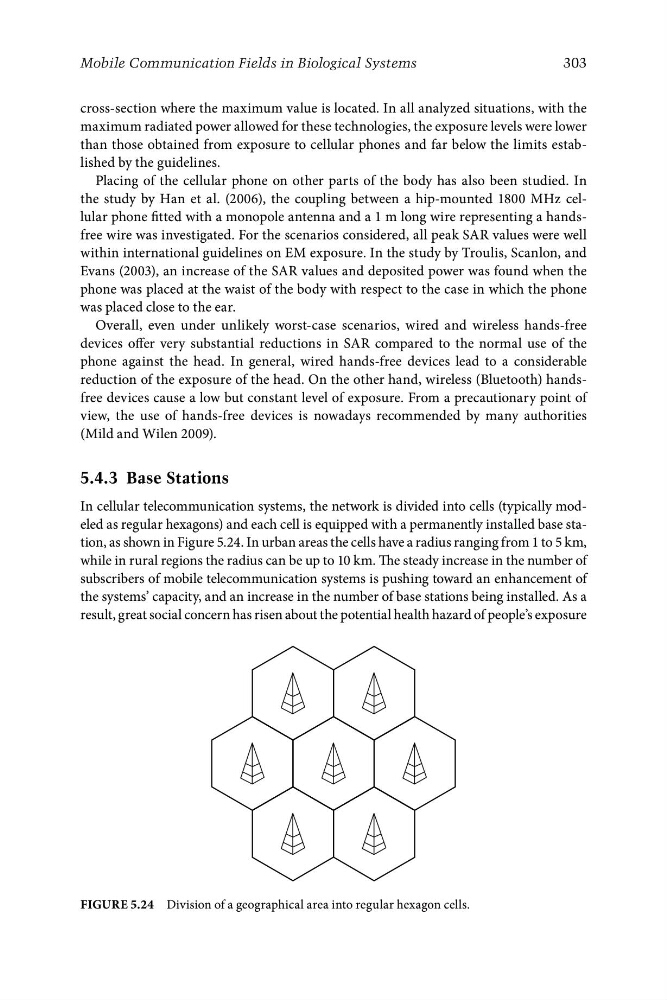
In cellular telecommunication systems, the network is divided into cells (typically modeled as regular hexagons) and each cell is equipped with a permanently installed base station, as shown in Figure 5.24. In urban areas the cells have a radius ranging from 1 to 5 km,
while in rural regions the radius can be up to 10 km. The steady increase in the number of
subscribers of mobile telecommunication systems is pushing toward an enhancement of
the systems’ capacity, and an increase in the number of base stations being installed. As a
result, great social concern has risen about the potential health hazard of people’s exposure
Figure 5.24 Division of a geographical area into regular hexagon cells.
Mobile Communication Fields in Biological Systems
cross-section where the maximum value is located. In all analyzed situations, with the
maximum radiated power allowed for these technologies, the exposure levels were lower
than those obtained from exposure to cellular phones and far below the limits established by the guidelines.
Placing of the cellular phone on other parts of the body has also been studied. In
the study by Han et al. (2006), the coupling between a hip-mounted 1800 MHz cellular phone fitted with a monopole antenna and a 1 m long wire representing a handsfree wire was investigated. For the scenarios considered, all peak SAR values were well
within international guidelines on EM exposure. In the study by Troulis, Scanlon, and
Evans (2003), an increase of the SAR values and deposited power was found when the
phone was placed at the waist of the body with respect to the case in which the phone
was placed close to the ear.
Overall, even under unlikely worst-case scenarios, wired and wireless hands-free
devices offer very substantial reductions in SAR compared to the normal use of the
phone against the head. In general, wired hands-free devices lead to a considerable
reduction of the exposure of the head. On the other hand, wireless (Bluetooth) handsfree devices cause a low but constant level of exposure. From a precautionary point of
view, the use of hands-free devices is nowadays recommended by many authorities
(Mild and Wilen 2009).
5.4.3 Base Stations
In cellular telecommunication systems, the network is divided into cells (typically modeled as regular hexagons) and each cell is equipped with a permanently installed base station, as shown in Figure 5.24. In urban areas the cells have a radius ranging from 1 to 5 km,
while in rural regions the radius can be up to 10 km. The steady increase in the number of
subscribers of mobile telecommunication systems is pushing toward an enhancement of
the systems’ capacity, and an increase in the number of base stations being installed. As a
result, great social concern has risen about the potential health hazard of people’s exposure
Figure 5.24 Division of a geographical area into regular hexagon cells.