

304
Electromagnetic Fields in Biological Systems
to the field radiated by base-station antennas and several recent studies have addressed
this issue. Research on base-station dosimetry is particularly important since people can
be exposed to the field radiated by base stations for a long time.
RF emissions vary depending on the design and power of the base station. Basestation antennas situated inside the buildings have low transmission powers, usually less
than 1 W. Regarding human exposure, these low power antennas can be considered to
be safe at any distance. Most powerful antennas, with transmission powers usually less
than 40 W, can also be used. However, since exposure limits may be exceeded in such
cases, these antennas are generally sited on high places, so that the general public cannot
access the area immediately surrounding the antenna.
In Europe, standards are under development describing the requirements and procedures to verify that the general public has no access to areas where exposure to EM
fields radiated by base-station antennas exceed the limits. Most base-station antennas
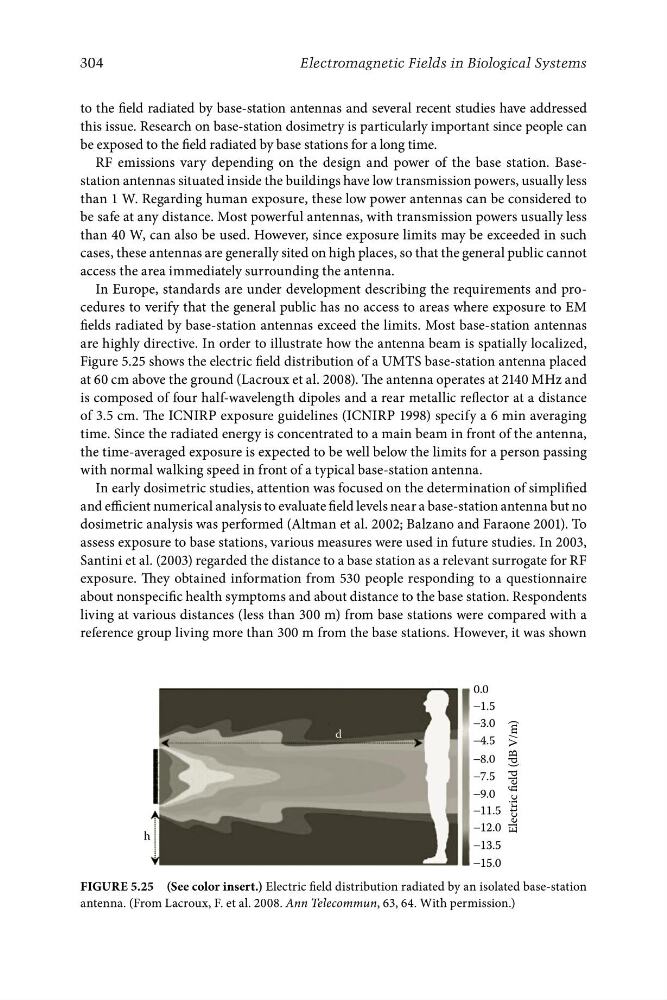
are highly directive. In order to illustrate how the antenna beam is spatially localized,
Figure 5.25 shows the electric field distribution of a UMTS base-station antenna placed
at 60 cm above the ground (Lacroux et al. 2008). The antenna operates at 2140 MHz and
is composed of four half-wavelength dipoles and a rear metallic reflector at a distance
of 3.5 cm. The ICNIRP exposure guidelines (ICNIRP 1998) specify a 6 min averaging
time. Since the radiated energy is concentrated to a main beam in front of the antenna,
the time-averaged exposure is expected to be well below the limits for a person passing
with normal walking speed in front of a typical base-station antenna.
In early dosimetric studies, attention was focused on the determination of simplified
and efficient numerical analysis to evaluate field levels near a base-station antenna but no
dosimetric analysis was performed (Altman et al. 2002; Balzano and Faraone 2001). To
assess exposure to base stations, various measures were used in future studies. In 2003,
Santini et al. (2003) regarded the distance to a base station as a relevant surrogate for RF
exposure. They obtained information from 530 people responding to a questionnaire
about nonspecific health symptoms and about distance to the base station. Respondents
living at various distances (less than 300 m) from base stations were compared with a
reference group living more than 300 m from the base stations. However, it was shown
h
0.0
−1.5
−3.0
−4.5
−8.0
−7.5
−9.0
−11.5
−12.0
−13.5
−15.0
d
Electric fi eld (dB V/m)
Figure 5.25 (See color insert.) Electric field distribution radiated by an isolated base-station
antenna. (From Lacroux, F. et al. 2008. Ann Telecommun, 63, 64. With permission.)
Electromagnetic Fields in Biological Systems
to the field radiated by base-station antennas and several recent studies have addressed
this issue. Research on base-station dosimetry is particularly important since people can
be exposed to the field radiated by base stations for a long time.
RF emissions vary depending on the design and power of the base station. Basestation antennas situated inside the buildings have low transmission powers, usually less
than 1 W. Regarding human exposure, these low power antennas can be considered to
be safe at any distance. Most powerful antennas, with transmission powers usually less
than 40 W, can also be used. However, since exposure limits may be exceeded in such
cases, these antennas are generally sited on high places, so that the general public cannot
access the area immediately surrounding the antenna.
In Europe, standards are under development describing the requirements and procedures to verify that the general public has no access to areas where exposure to EM
fields radiated by base-station antennas exceed the limits. Most base-station antennas
are highly directive. In order to illustrate how the antenna beam is spatially localized,
Figure 5.25 shows the electric field distribution of a UMTS base-station antenna placed
at 60 cm above the ground (Lacroux et al. 2008). The antenna operates at 2140 MHz and
is composed of four half-wavelength dipoles and a rear metallic reflector at a distance
of 3.5 cm. The ICNIRP exposure guidelines (ICNIRP 1998) specify a 6 min averaging
time. Since the radiated energy is concentrated to a main beam in front of the antenna,
the time-averaged exposure is expected to be well below the limits for a person passing
with normal walking speed in front of a typical base-station antenna.
In early dosimetric studies, attention was focused on the determination of simplified
and efficient numerical analysis to evaluate field levels near a base-station antenna but no
dosimetric analysis was performed (Altman et al. 2002; Balzano and Faraone 2001). To
assess exposure to base stations, various measures were used in future studies. In 2003,
Santini et al. (2003) regarded the distance to a base station as a relevant surrogate for RF
exposure. They obtained information from 530 people responding to a questionnaire
about nonspecific health symptoms and about distance to the base station. Respondents
living at various distances (less than 300 m) from base stations were compared with a
reference group living more than 300 m from the base stations. However, it was shown
h
0.0
−1.5
−3.0
−4.5
−8.0
−7.5
−9.0
−11.5
−12.0
−13.5
−15.0
d
Electric fi eld (dB V/m)
Figure 5.25 (See color insert.) Electric field distribution radiated by an isolated base-station
antenna. (From Lacroux, F. et al. 2008. Ann Telecommun, 63, 64. With permission.)