

301
Mobile Communication Fields in Biological Systems
However, some specific configurations with wired hands-free devices have been
found to give rise to measurable SAR levels in the head (Manning and Gabriel 2000).
Such conditions are considered to be extremely unlikely and should not be encountered
in normal use. This involves leading the earpiece cable close to or around the phone’s
antenna. The effects of such cable routing are sensitively affected by the exact configuration employed especially with external antennas. As a result of further exploratory
tests, it was found that exposure from wired hands-free devices was raised when the
earpiece cable is placed in contact with the cheek of the phantom as compared to when
the earpiece cable hangs vertically downwards. Defining such reproducible conditions
has proven to be difficult.
In the case of wireless hands-free operation (Bluetooth technology), the added effect
of the exposure to the antenna of the cellular phone, which also has a Bluetooth antenna,
plus the exposure to the Bluetooth antenna of the hands-free device, have to be considered. Few, yet indicative, dosimetric studies have been performed so far. In the study by
Wong et al. (2007), a Bluetooth internal antenna was presented in the presence of the
user’s head, but no calculation of the absorption in the head was made. In the research
by Martinez-Burdalo et al. (2009), several geometrical configurations were considered
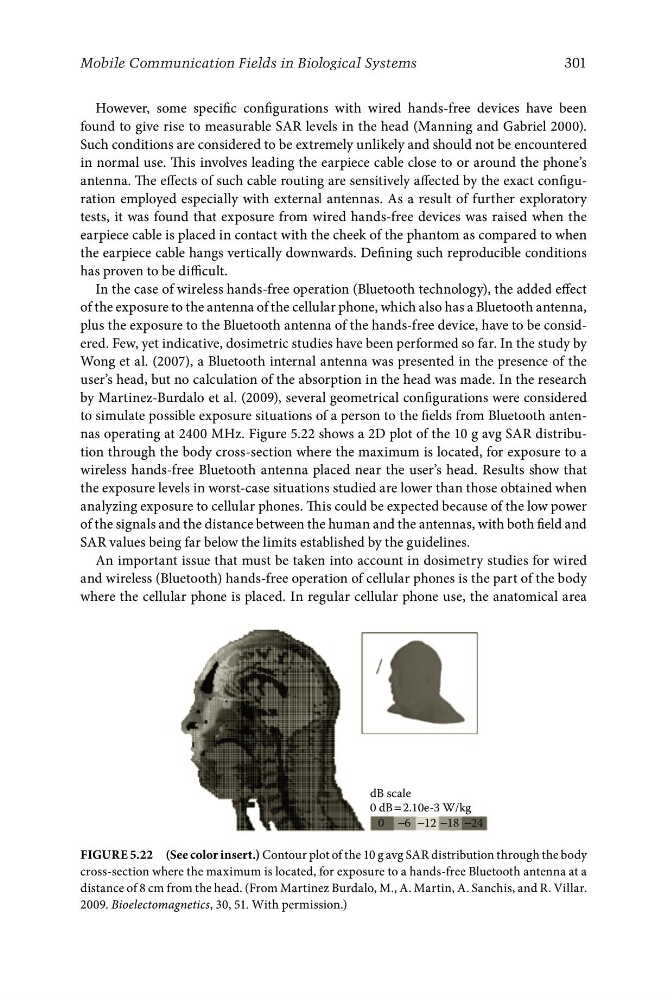
to simulate possible exposure situations of a person to the fields from Bluetooth antennas operating at 2400 MHz. Figure 5.22 shows a 2D plot of the 10 g avg SAR distribution through the body cross-section where the maximum is located, for exposure to a
wireless hands-free Bluetooth antenna placed near the user’s head. Results show that
the exposure levels in worst-case situations studied are lower than those obtained when
analyzing exposure to cellular phones. This could be expected because of the low power
of the signals and the distance between the human and the antennas, with both field and
SAR values being far below the limits established by the guidelines.
An important issue that must be taken into account in dosimetry studies for wired
and wireless (Bluetooth) hands-free operation of cellular phones is the part of the body
where the cellular phone is placed. In regular cellular phone use, the anatomical area
dB scale
0 dB = 2.10e-3 W/kg
0 −6 −12 −18 −24
Figure 5.22 (See color insert.) Contour plot of the 10 g avg SAR distribution through the body
cross-section where the maximum is located, for exposure to a hands-free Bluetooth antenna at a
distance of 8 cm from the head. (From Martinez Burdalo, M., A. Martin, A. Sanchis, and R. Villar.
2009. Bioelectomagnetics, 30, 51. With permission.)
Mobile Communication Fields in Biological Systems
However, some specific configurations with wired hands-free devices have been
found to give rise to measurable SAR levels in the head (Manning and Gabriel 2000).
Such conditions are considered to be extremely unlikely and should not be encountered
in normal use. This involves leading the earpiece cable close to or around the phone’s
antenna. The effects of such cable routing are sensitively affected by the exact configuration employed especially with external antennas. As a result of further exploratory
tests, it was found that exposure from wired hands-free devices was raised when the
earpiece cable is placed in contact with the cheek of the phantom as compared to when
the earpiece cable hangs vertically downwards. Defining such reproducible conditions
has proven to be difficult.
In the case of wireless hands-free operation (Bluetooth technology), the added effect
of the exposure to the antenna of the cellular phone, which also has a Bluetooth antenna,
plus the exposure to the Bluetooth antenna of the hands-free device, have to be considered. Few, yet indicative, dosimetric studies have been performed so far. In the study by
Wong et al. (2007), a Bluetooth internal antenna was presented in the presence of the
user’s head, but no calculation of the absorption in the head was made. In the research
by Martinez-Burdalo et al. (2009), several geometrical configurations were considered
to simulate possible exposure situations of a person to the fields from Bluetooth antennas operating at 2400 MHz. Figure 5.22 shows a 2D plot of the 10 g avg SAR distribution through the body cross-section where the maximum is located, for exposure to a
wireless hands-free Bluetooth antenna placed near the user’s head. Results show that
the exposure levels in worst-case situations studied are lower than those obtained when
analyzing exposure to cellular phones. This could be expected because of the low power
of the signals and the distance between the human and the antennas, with both field and
SAR values being far below the limits established by the guidelines.
An important issue that must be taken into account in dosimetry studies for wired
and wireless (Bluetooth) hands-free operation of cellular phones is the part of the body
where the cellular phone is placed. In regular cellular phone use, the anatomical area
dB scale
0 dB = 2.10e-3 W/kg
0 −6 −12 −18 −24
Figure 5.22 (See color insert.) Contour plot of the 10 g avg SAR distribution through the body
cross-section where the maximum is located, for exposure to a hands-free Bluetooth antenna at a
distance of 8 cm from the head. (From Martinez Burdalo, M., A. Martin, A. Sanchis, and R. Villar.
2009. Bioelectomagnetics, 30, 51. With permission.)