

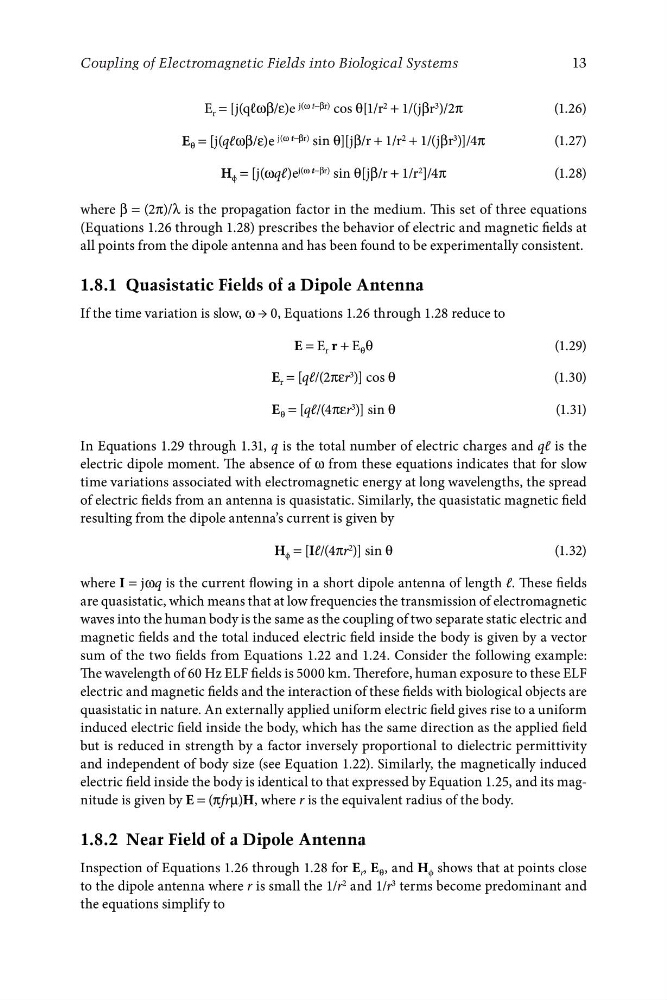
E r = [j(qℓωβ/ε)e j(ω t−βr) cos θ[1/r 2 + 1/(jβr 3 )/2π
(1.26)
E θ = [j(qℓωβ/ε)e j(ω t−βr) sin θ][jβ/r + 1/r 2 + 1/(jβr 3 )]/4π
(1.27)
H ϕ = [j(ωqℓ)e j(ω t−βr) sin θ[jβ/r + 1/r 2 ]/4π
(1.28)
where β = (2π)/λ is the propagation factor in the medium. This set of three equations
(Equations 1.26 through 1.28) prescribes the behavior of electric and magnetic fields at
all points from the dipole antenna and has been found to be experimentally consistent.
1.8.1 Quasistatic Fields of a Dipole Antenna
If the time variation is slow, ω → 0, Equations 1.26 through 1.28 reduce to
13
Coupling of Electromagnetic Fields into Biological Systems
E = E r r + E θ θ
(1.29)
E r = [qℓ/(2πεr 3 )] cos θ
(1.30)
E θ = [qℓ/(4πεr 3 )] sin θ
(1.31)
In Equations 1.29 through 1.31, q is the total number of electric charges and qℓ is the
electric dipole moment. The absence of ω from these equations indicates that for slow
time variations associated with electromagnetic energy at long wavelengths, the spread
of electric fields from an antenna is quasistatic. Similarly, the quasistatic magnetic field
resulting from the dipole antenna’s current is given by
H ϕ = [iℓ/(4πr 2 )] sin θ
(1.32)
where i = jωq is the current flowing in a short dipole antenna of length ℓ. These fields
are quasistatic, which means that at low frequencies the transmission of electromagnetic
waves into the human body is the same as the coupling of two separate static electric and
magnetic fields and the total induced electric field inside the body is given by a vector
sum of the two fields from Equations 1.22 and 1.24. Consider the following example:
The wavelength of 60 Hz ELF fields is 5000 km. Therefore, human exposure to these ELF
electric and magnetic fields and the interaction of these fields with biological objects are
quasistatic in nature. An externally applied uniform electric field gives rise to a uniform
induced electric field inside the body, which has the same direction as the applied field
but is reduced in strength by a factor inversely proportional to dielectric permittivity
and independent of body size (see Equation 1.22). Similarly, the magnetically induced
electric field inside the body is identical to that expressed by Equation 1.25, and its magnitude is given by E = (πfrμ)H, where r is the equivalent radius of the body.
1.8.2 Near Field of a Dipole Antenna
Inspection of Equations 1.26 through 1.28 for E r , E θ , and H ϕ shows that at points close
to the dipole antenna where r is small the 1/r 2 and 1/r 3 terms become predominant and
the equations simplify to
(1.26)
E θ = [j(qℓωβ/ε)e j(ω t−βr) sin θ][jβ/r + 1/r 2 + 1/(jβr 3 )]/4π
(1.27)
H ϕ = [j(ωqℓ)e j(ω t−βr) sin θ[jβ/r + 1/r 2 ]/4π
(1.28)
where β = (2π)/λ is the propagation factor in the medium. This set of three equations
(Equations 1.26 through 1.28) prescribes the behavior of electric and magnetic fields at
all points from the dipole antenna and has been found to be experimentally consistent.
1.8.1 Quasistatic Fields of a Dipole Antenna
If the time variation is slow, ω → 0, Equations 1.26 through 1.28 reduce to
13
Coupling of Electromagnetic Fields into Biological Systems
E = E r r + E θ θ
(1.29)
E r = [qℓ/(2πεr 3 )] cos θ
(1.30)
E θ = [qℓ/(4πεr 3 )] sin θ
(1.31)
In Equations 1.29 through 1.31, q is the total number of electric charges and qℓ is the
electric dipole moment. The absence of ω from these equations indicates that for slow
time variations associated with electromagnetic energy at long wavelengths, the spread
of electric fields from an antenna is quasistatic. Similarly, the quasistatic magnetic field
resulting from the dipole antenna’s current is given by
H ϕ = [iℓ/(4πr 2 )] sin θ
(1.32)
where i = jωq is the current flowing in a short dipole antenna of length ℓ. These fields
are quasistatic, which means that at low frequencies the transmission of electromagnetic
waves into the human body is the same as the coupling of two separate static electric and
magnetic fields and the total induced electric field inside the body is given by a vector
sum of the two fields from Equations 1.22 and 1.24. Consider the following example:
The wavelength of 60 Hz ELF fields is 5000 km. Therefore, human exposure to these ELF
electric and magnetic fields and the interaction of these fields with biological objects are
quasistatic in nature. An externally applied uniform electric field gives rise to a uniform
induced electric field inside the body, which has the same direction as the applied field
but is reduced in strength by a factor inversely proportional to dielectric permittivity
and independent of body size (see Equation 1.22). Similarly, the magnetically induced
electric field inside the body is identical to that expressed by Equation 1.25, and its magnitude is given by E = (πfrμ)H, where r is the equivalent radius of the body.
1.8.2 Near Field of a Dipole Antenna
Inspection of Equations 1.26 through 1.28 for E r , E θ , and H ϕ shows that at points close
to the dipole antenna where r is small the 1/r 2 and 1/r 3 terms become predominant and
the equations simplify to