

14
Electromagnetic Fields in Biological Systems
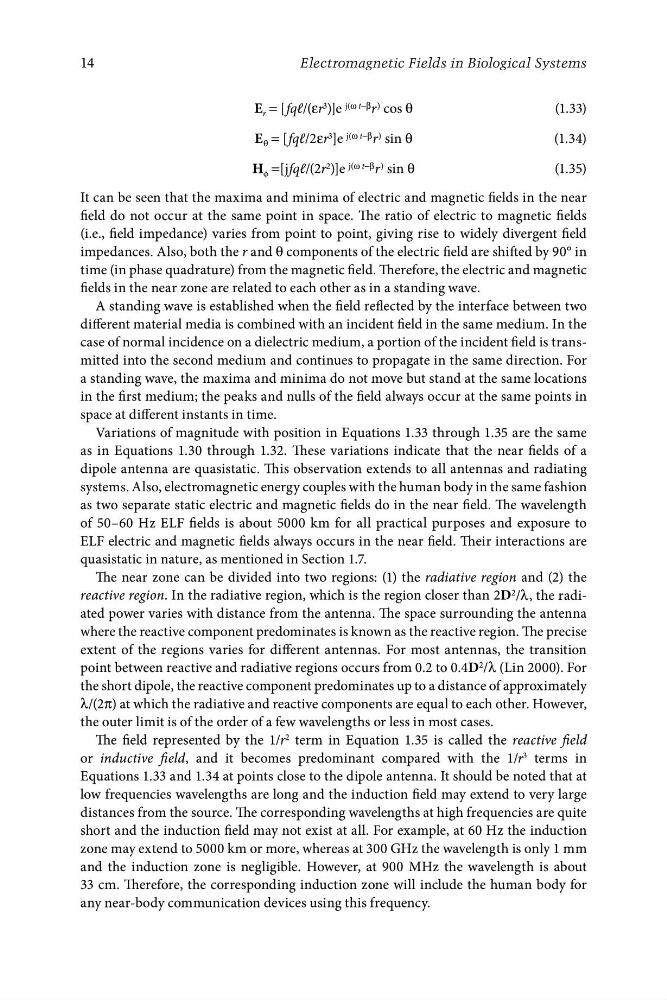
E r = [fqℓ/(εr 3 )]e j(ω t−β r ) cos θ
(1.33)
E θ = [fqℓ/2εr 3 ]e j(ω t−β r ) sin θ
(1.34)
H ϕ =[jfqℓ/(2r 2 )]e j(ω t−β r ) sin θ
(1.35)
It can be seen that the maxima and minima of electric and magnetic fields in the near
field do not occur at the same point in space. The ratio of electric to magnetic fields
(i.e., field impedance) varies from point to point, giving rise to widely divergent field
impedances. Also, both the r and θ components of the electric field are shifted by 90° in
time (in phase quadrature) from the magnetic field. Therefore, the electric and magnetic
fields in the near zone are related to each other as in a standing wave.
A standing wave is established when the field reflected by the interface between two
different material media is combined with an incident field in the same medium. In the
case of normal incidence on a dielectric medium, a portion of the incident field is transmitted into the second medium and continues to propagate in the same direction. For
a standing wave, the maxima and minima do not move but stand at the same locations
in the first medium; the peaks and nulls of the field always occur at the same points in
space at different instants in time.
Variations of magnitude with position in Equations 1.33 through 1.35 are the same
as in Equations 1.30 through 1.32. These variations indicate that the near fields of a
dipole antenna are quasistatic. This observation extends to all antennas and radiating
systems. Also, electromagnetic energy couples with the human body in the same fashion
as two separate static electric and magnetic fields do in the near field. The wavelength
of 50–60 Hz ELF fields is about 5000 km for all practical purposes and exposure to
ELF electric and magnetic fields always occurs in the near field. Their interactions are
quasistatic in nature, as mentioned in Section 1.7.
The near zone can be divided into two regions: (1) the radiative region and (2) the
reactive region. In the radiative region, which is the region closer than 2D 2 /λ, the radiated power varies with distance from the antenna. The space surrounding the antenna
where the reactive component predominates is known as the reactive region. The precise
extent of the regions varies for different antennas. For most antennas, the transition
point between reactive and radiative regions occurs from 0.2 to 0.4D 2 /λ (Lin 2000). For
the short dipole, the reactive component predominates up to a distance of approximately
λ/(2π) at which the radiative and reactive components are equal to each other. However,
the outer limit is of the order of a few wavelengths or less in most cases.
The field represented by the 1/r 2 term in Equation 1.35 is called the reactive field
or inductive field, and it becomes predominant compared with the 1/r 3 terms in
Equations 1.33 and 1.34 at points close to the dipole antenna. It should be noted that at
low frequencies wavelengths are long and the induction field may extend to very large
distances from the source. The corresponding wavelengths at high frequencies are quite
short and the induction field may not exist at all. For example, at 60 Hz the induction
zone may extend to 5000 km or more, whereas at 300 GHz the wavelength is only 1 mm
and the induction zone is negligible. However, at 900 MHz the wavelength is about
33 cm. Therefore, the corresponding induction zone will include the human body for
any near-body communication devices using this frequency.
Electromagnetic Fields in Biological Systems
E r = [fqℓ/(εr 3 )]e j(ω t−β r ) cos θ
(1.33)
E θ = [fqℓ/2εr 3 ]e j(ω t−β r ) sin θ
(1.34)
H ϕ =[jfqℓ/(2r 2 )]e j(ω t−β r ) sin θ
(1.35)
It can be seen that the maxima and minima of electric and magnetic fields in the near
field do not occur at the same point in space. The ratio of electric to magnetic fields
(i.e., field impedance) varies from point to point, giving rise to widely divergent field
impedances. Also, both the r and θ components of the electric field are shifted by 90° in
time (in phase quadrature) from the magnetic field. Therefore, the electric and magnetic
fields in the near zone are related to each other as in a standing wave.
A standing wave is established when the field reflected by the interface between two
different material media is combined with an incident field in the same medium. In the
case of normal incidence on a dielectric medium, a portion of the incident field is transmitted into the second medium and continues to propagate in the same direction. For
a standing wave, the maxima and minima do not move but stand at the same locations
in the first medium; the peaks and nulls of the field always occur at the same points in
space at different instants in time.
Variations of magnitude with position in Equations 1.33 through 1.35 are the same
as in Equations 1.30 through 1.32. These variations indicate that the near fields of a
dipole antenna are quasistatic. This observation extends to all antennas and radiating
systems. Also, electromagnetic energy couples with the human body in the same fashion
as two separate static electric and magnetic fields do in the near field. The wavelength
of 50–60 Hz ELF fields is about 5000 km for all practical purposes and exposure to
ELF electric and magnetic fields always occurs in the near field. Their interactions are
quasistatic in nature, as mentioned in Section 1.7.
The near zone can be divided into two regions: (1) the radiative region and (2) the
reactive region. In the radiative region, which is the region closer than 2D 2 /λ, the radiated power varies with distance from the antenna. The space surrounding the antenna
where the reactive component predominates is known as the reactive region. The precise
extent of the regions varies for different antennas. For most antennas, the transition
point between reactive and radiative regions occurs from 0.2 to 0.4D 2 /λ (Lin 2000). For
the short dipole, the reactive component predominates up to a distance of approximately
λ/(2π) at which the radiative and reactive components are equal to each other. However,
the outer limit is of the order of a few wavelengths or less in most cases.
The field represented by the 1/r 2 term in Equation 1.35 is called the reactive field
or inductive field, and it becomes predominant compared with the 1/r 3 terms in
Equations 1.33 and 1.34 at points close to the dipole antenna. It should be noted that at
low frequencies wavelengths are long and the induction field may extend to very large
distances from the source. The corresponding wavelengths at high frequencies are quite
short and the induction field may not exist at all. For example, at 60 Hz the induction
zone may extend to 5000 km or more, whereas at 300 GHz the wavelength is only 1 mm
and the induction zone is negligible. However, at 900 MHz the wavelength is about
33 cm. Therefore, the corresponding induction zone will include the human body for
any near-body communication devices using this frequency.